Log splitter drill bit buying guide
You already own a drill, and small dry offcuts are waiting by the stove. A log splitter drill bit looks like the cheap way to make kindling, while titles in this capture name oak. The UK reviews mostly describe a cone that bores in and sticks. Before you spend £8.99 to £19.69, check whether the wood is in scope, what the listing excludes, which diameter you need, and whether the shank fits your chuck and stays on in reverse. The ten rows are on the [log splitter drill bit comparison](/hub/drilling-and-accessories/log-splitter-drill-bit). Prices are the saved listings from 22 October 2026. A qualifying purchase can earn a commission at no extra cost to you.
You already own a drill, and small dry offcuts are waiting by the stove. A log splitter drill bit looks like the cheap way to make kindling, while titles in this capture name oak.
You already own a drill, and small dry offcuts are waiting by the stove. A log splitter drill bit looks like the cheap way to make kindling, while titles in this capture name oak. The UK reviews mostly describe a cone that bores in and sticks. Before you spend £8.99 to £19.69, check whether the wood is in scope, what the listing excludes, which diameter you need, and whether the shank fits your chuck and stays on in reverse. The ten rows are on the log splitter drill bit comparison. Prices are the saved listings from 22 October 2026. A qualifying purchase can earn a commission at no extra cost to you.
Our top picks
| Badge | Product | Cone size | Shank | Listing wood limit | Note | Price | Offer |
|---|---|---|---|---|---|---|---|
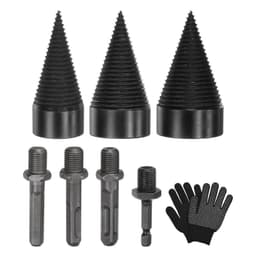
| Best overall |  Holy Feather Holy Feather 32 mm and 42 mm set | 32 mm and 42 mm | Four shanks; UK review names hex 6 mm, hex 10 mm, SDS, SDS+ | Bullet names beech, oak, birch and pine; no wet-wood line | 6.1 | about £9.97 | View offer |
| Alternative |  METERXITY METERXITY 38, 45 and 50 mm set | 38 mm, 45 mm and 50 mm | Square, round, hex and small hex | Not for wood that is too hard or too wet; start at the edges | 4.4 | about £19.49 | View offer |
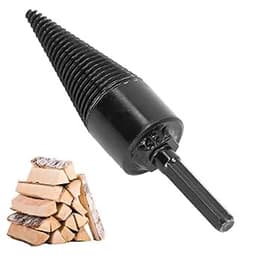
| Best value |  Ejoyous Ejoyous 32 mm hex cone | 32 mm | Hex | Not stated | 4.4 | about £12.50 | View offer |

On this page
Is a log splitter drill bit the right job?
What the listing excludes
Diameter and how many cones
Shank and whether it stays on
What this capture costs
Common questions
What diameter should I buy for small, dry offcuts?
Does a 50 mm cone need a more powerful drill than a 32 mm cone?
Will a hex, square or SDS-style shank fit my chuck?
Why do listings say oak if the same page excludes hard wood?
When is the honest answer not to buy a cone?
Related pages
Sources
Public UK sources for the safety and firewood points. Listing prices, stars and review text are the amazon.co.uk captures. Those files were not re-checked on 22 October 2026.
- HSE, PUWER overview (retrieved 22 October 2026)
- HSE, Safe use of woodworking machinery (L114) (retrieved 22 October 2026)
- GOV.UK, Selling wood for domestic use in England (retrieved 22 October 2026)
- GOV.UK, Smoke control area rules (retrieved 22 October 2026)
- Electrical Safety First, drills (retrieved 22 October 2026)
- BSI, BS EN 62841-2-1 scope (retrieved 22 October 2026)
- Consumer Rights Act 2015 (retrieved 22 October 2026)
- betterout.co.uk, drill-powered conical wood splitter (retrieved 22 October 2026)