Independent comparisons. We may earn from shop links. More info

Hole saw for downlights

Updated: 2026-10-23

The downlight is still in the box, the bezel looks about 90 mm across, and the hole you must cut is the smaller number printed as the cut-out. A hole saw for downlights is that number, plus a dead circuit and a plan for plasterboard dust. Which set scores highest stays on the [hole saw set comparison](/hub/drilling-and-accessories/hole-saw-set). Products Compared used UK cut-out guidance and the amazon.co.uk size lines checked on 19 October 2026, and did not run a lab test. If you cannot prove the lighting circuit is dead, you do not start the drill.

The downlight is still in the box, the bezel looks about 90 mm across, and the hole you must cut is the smaller number printed as the cut-out.

Our top picks

On this page

The cut-out on the box, not the bezel

The cut-out is the hole. The bezel is the trim that hides the edge, and it is always larger. LightHub’s UK guide groups recessed lights around 65 mm, 68–72 mm and 75 mm, and there is no single British Standard hole. Fire-rated fittings are tested at the cut-out the maker states. Measure the carton, or an existing hole only after the circuit is proved dead. A 64 mm cup is not close enough as a rule. If the fitting says 72 mm and no cup prints 72 mm, do not stretch a 68 mm saw. Buy the fitting first. Tooth, depth and arbor, once you know the millimetres, are in the hole saw set buying guide.

Cups in this category that match

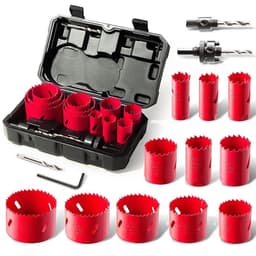
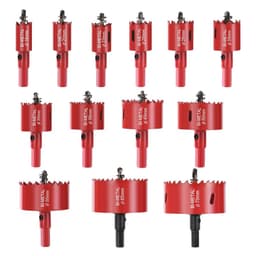
Read the size bullet, not the piece count. Amazon Basics and both HYCHIKA sets include 68 mm. The bi-metal set stops at 68 mm, states 40 mm, and names gypsum board. HYCHIKA carbon also includes 76 mm, states 25 mm, and says not hard board. 76 mm is the usual stand-in when 75 mm is missing. Check the carton before you treat it as a match. Flintronic lists 65 mm and 75 mm, states 25 mm, and the bullets say both carbon steel and M42. TOOLMAYS lists 65 mm and 76 mm for timber and plasterboard, not metal, at 25 mm per pass, with three Canadian reviews. Gunpla and Oudtinz list 64 mm and 76 mm, not 65, 68 or 75. BULLITT stops at 32 mm, Dokka at 35 mm, Mollom at 54 mm. If the carton says 65 mm, Flintronic and TOOLMAYS print it. If it says 68 mm, Amazon Basics and both HYCHIKA sets do. That is a contents check, not a ranking.

Dead circuit, void and dust

Isolate the lighting circuit at the consumer unit and prove it dead at the switch and at the cable you are about to approach. Unplug before you change a bit, use eye protection, and do not carry the drill by the lead. A pilot hole, after the circuit is proved dead, lets you look into the void before the cup opens a 68 mm circle. If the pilot meets something solid that is not plasterboard, stop. Plasterboard dust spreads. HSE’s wood-dust advice asks for extraction and for respiratory protection at APF 20, an FFP3 being the example, when power-tool cutting runs on. A kitchen full of downlights is no longer one hole. Use a vacuum at the cup, and a mask if you are cutting several. Keep hammer mode off. Speed bands stay on the how-to page. In England, Approved Document P (2013) makes a new circuit, a consumer-unit change or a bathroom-zone alteration notifiable. The plasterboard hole is not that work. Connecting the light can be. Wales, Scotland and Northern Ireland do not copy England’s list. If the connection is unclear, stop before the cable is stripped.

Fixed cup or adjustable head

A fixed cup at the printed cut-out is the simpler tool: one diameter, a pilot, a round hole if you stay square. A 68 mm bi-metal cup will cut plasterboard when the listing names gypsum. It does not make a stainless set the right buy for a ceiling. Ribowri is one adjustable cutter from 40 mm to 200 mm, with twin blades, a PC dust cover and two spare pilots, at £79.90. The bullets name plasterboard, plywood, MDF and wood-based sheet. Metal is asked and not answered. Weight prints as 3 kg and as 3.2 kg. There is no customer-review line. It can hit a 72 mm hole if you set it on scrap, and it can wander. A fixed cup at the printed size is the calmer choice when that size is in the listing. The dust cover is useful. It is not a reason to skip isolation.

Common questions

What diameter do I cut for a UK downlight?
The cut-out printed on the fitting, not the bezel. UK fittings cluster around 65 mm, 68–72 mm and 75 mm. There is no single British Standard hole. Measure the carton only after the circuit is proved dead.
Is 68 mm the same as a 65 mm or a 75 mm fitting?
No. Those are different cut-outs. A 76 mm cup is the usual stand-in when 75 mm is missing, and you still check the fitting. A 64 mm cup is not a general substitute for 65 mm.
Which of these sets list 65, 68 or 75 mm?
Flintronic lists 65 mm and 75 mm. TOOLMAYS lists 65 mm and 76 mm. Amazon Basics and both HYCHIKA sets list 68 mm. Gunpla and Oudtinz list 64 mm and 76 mm, not 65, 68 or 75. BULLITT, Dokka and Mollom stop short of a typical cut-out.
Do I need an adjustable cutter instead?
Only when no fixed cup matches the cut-out. Ribowri covers 40–200 mm and includes a dust cover, with no review line. A fixed cup at the printed size is the simpler cut.
What do I do about cables and dust before the cup touches the ceiling?
Isolate, prove dead, and pilot into the void before the full cut. Catch plasterboard dust with extraction, and use FFP3-level protection for a long run, the HSE wood-dust example of APF 20. Stop if the pilot hits anything solid.
Is cutting the hole notifiable electrical work in England?
The plasterboard hole is not, on the Approved Document P list, a new circuit or a consumer-unit change. Connecting the light can be. Wales, Scotland and Northern Ireland use their own rules.
Can I use a metal-cutting set on plasterboard?
Yes, if that listing also names plasterboard or gypsum and the diameter matches. HYCHIKA bi-metal names gypsum and includes 68 mm. Do not buy Mollom, which stops at 54 mm, just to open a ceiling.

Related pages

Sources

Public UK sources from the research digest, last checked on 19 October 2026. Shelf prices and star lines are the amazon.co.uk figures checked on 19 October 2026.

  1. HSE: PUWER overview (retrieved 19 October 2026)
  2. HSE: wood dust (retrieved 19 October 2026)
  3. RS: hole saws guide (retrieved 19 October 2026)
  4. RS PRO bi-metal hole saw datasheet (retrieved 19 October 2026)
  5. Starrett UK: bi-metal speeds (retrieved 19 October 2026)
  6. Approved Document P (2013) (retrieved 19 October 2026)
  7. LightHub: downlight cut-out sizes (retrieved 19 October 2026)
  8. Electrical Safety First: drills (retrieved 19 October 2026)