Independent comparisons. We may earn from shop links. More info

How to use a Bosch rotary hammer

Updated: 22 October 2026

You have a Bosch hammer on the floor, a plug to seat in brick, or a tile to lift, and the mode switch is the part that goes wrong first. How to use a Bosch rotary hammer, for the tools in this set, means a detector before the trigger, an SDS-plus bit if that is the holder, hammer-drilling for the plug, and a chisel only when the listing writes that mode down. Prices stay on the [Bosch rotary hammer comparison](/hub/drilling-and-accessories/bosch-rotary-hammer). A qualifying Amazon purchase can earn us a commission at no extra cost to you. There is no lab test, and this page does not replace the manual in the carton.

You have a Bosch hammer on the floor, a plug to seat in brick, or a tile to lift, and the mode switch is the part that goes wrong first.

Our top picks

Bosch Bosch UniversalHammer 18V body

Best overall

Bosch Bosch UniversalHammer 18V body
7.8/10about £97.92
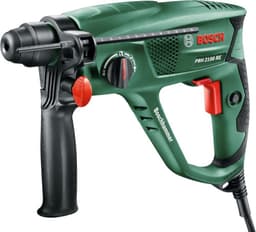
Bosch Bosch PBH 2100 RE

Rank 2

Bosch Bosch PBH 2100 RE
9.0/10about £59.94
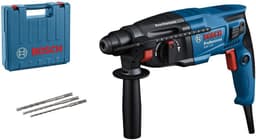
Bosch Bosch GBH 2-21 230 V

Best value

Bosch Bosch GBH 2-21 230 V
8.5/10about £120.15
On this page

Check the wall and the shank before the mode switch

Run a detector across the plaster before you mark the hole. A cable or a pipe is the usual reason to stop. If the listing is SDS-plus only, a masonry bit from a combi case will not lock. The UniversalHammer rows, both GBH 2-21 kits and the GBH 2-28 name SDS-plus. The PBH bullets say a keyless chuck, and reviews say SDS-plus bits are required and that a round-shank adapter is bulky and extra. OneChuck, on the GBH 18V-18 X and the GBH 18V-22 X, also names cylindrical and hex bits. Push an SDS-plus bit in until it clicks, and pull it to check the lock. Only the two GBH 2-21 kits list 6, 8 and 10 mm bits in the box. Which box you should have bought is on the Bosch rotary hammer buying guide.

Drill the plug hole

Set hammer drilling, not rotation-only and not chisel, for a plug in brick or block. Use light pressure and let the mechanism do the work. Clear dust about every 20 mm to 30 mm rather than forcing a packed flute. A depth stop, or tape on the bit, marks the plug length so the plug sits flush. The 230 V GBH 2-21 includes a depth stop and 6, 8 and 10 mm bits. On the UniversalHammer body, one review cites about 14 to 15 holes of 8 mm by 100 mm on a 2.5 Ah pack before heat if the holes follow straight on. That is a reason to pause. If the tool smells hot, or it smokes, stop. One UniversalHammer smoked while removing lime plaster, and one GBH 2-28 smoked during about five minutes of chiselling. Neither report is a failure rate.

Lift a tile only when chiselling is written down

A glazed tile is not the first place for hammer drilling. Rotary only through the glaze, then hammer once you are in the masonry, if you are drilling rather than lifting. Lifting the tile is chisel work: rotation stop, a chisel, and a shallow angle. Use that mode only where the listing writes it down. The PBH, both UniversalHammers and both GBH 2-21 rows name chiselling. The GBH 2-28 puts drill and chisel on the compatible-devices line. The GBH 18V-18 X does not name chiselling. Part 0611927000, the GBH 18V-22 X and the GBH 18V-22 leave it off the bullets. A review is not a mode switch on the listing. A whole floor was already too much for one PBH buyer. Lead or battery for that session is on the cordless or corded rotary hammer page.

Dust, noise, and when to stop

One plug hole is not the same dust job as chasing a channel. HSE's note CN3 expects class M or H extraction at the bit once the work is more than a one-off hole, and RPE of APF 20 if that extraction is missing. A household vacuum is not an M-class unit. The GDE extractor named on some GBH bullets is not in the box. Under the Control of Noise at Work Regulations 2005 the action values are 80 dB(A) and 85 dB(A), and the limit is 87 dB(A). Vibration under the 2005 vibration regulations has an action value of 2.5 m/s² A(8) and a limit of 5 m/s² A(8). HSE's rough guide is to assess regular hammer-action work past about 15 minutes a day. Gloves are not protection. Stop if you cannot trace the cable, if the hole is structural, or if the tool smokes or leaks oil.

Common questions

Which mode is a plug hole, and which is a tile?
Hammer drilling is the plug hole in brick or block, with an SDS-plus bit and light pressure. A tile you are only drilling starts in rotary mode through the glaze, then hammer once you are through it. Lifting the tile is chisel mode, and only on a listing that names chiselling. The GBH 18V-18 X does not name that mode.
Will combi drill bits fit?
They fit only if the holder accepts a round or hex shank. SDS-plus listings in this set do not. The PBH bullets say a keyless chuck, and the reviews say you need SDS-plus bits or a bulky adapter. OneChuck on the GBH 18V-18 X and the GBH 18V-22 X names SDS-plus, cylindrical and hex.
Do I need the side handle on every model?
Use it whenever the scope line includes an auxiliary handle. The GBH 18V-22 scope line does not name one. A handle left in the case is how a jam twists the wrist. KickBack Control, where a listing names it, is not a substitute for the handle.
How do I know the hole is deep enough for the plug?
Set the depth stop to the plug length, or wrap tape around the bit at that length. The plug should finish flush so the screw still bites. The two GBH 2-21 kits include a depth stop and 6, 8 and 10 mm bits. Other boxes do not itemise bits.
When do I stop and call someone?
Stop when the detector is unclear, when the hole is structural, or when hammer-action work at a workplace passes HSE's triggers of about 15 minutes to assess and about an hour as a possible limit breach. Stop when the tool smokes, sparks or leaks oil. One smoke review is not a failure rate, and it is still the end of that session.

Related pages

Sources

Public UK sources from the research digest. Shelf prices and star lines are the amazon.co.uk figures in this comparison.

  1. HSE: Electrical systems on construction sites (retrieved 22 October 2026)
  2. Control of Vibration at Work Regulations 2005 (retrieved 22 October 2026)
  3. HSE: Vibration from hand-held tools (retrieved 22 October 2026)
  4. Control of Noise at Work Regulations 2005 (retrieved 22 October 2026)
  5. HSE CN3: Construction dust (retrieved 22 October 2026)
  6. Bosch Professional GB: SDS-max rotary hammers (retrieved 22 October 2026)
  7. Bosch Professional GB: GBH 18V-22 (retrieved 22 October 2026)
  8. Provision and Use of Work Equipment Regulations 1998 (retrieved 22 October 2026)