Independent comparisons. We may earn from shop links. More info

Short barrel vs long barrel air hammer

Updated: 22 October 2026

You are choosing between a 190 mm title and a 250 mm title, and you want to know whether a short barrel vs long barrel air hammer is a question of reach, of how hard it hits, or of two numbers that shops mix up. Barrel length is how far the body reaches. Stroke is how far the piston travels. A longer title is not a harder hit until a stroke is printed. Peter F. compared amazon.co.uk captures from 19 October 2026, with no lab test. A qualifying purchase can earn a commission at no extra cost to you. The listings are on the [air chisel hammer comparison](/hub/drilling-and-accessories/air-chisel-hammer).

You are choosing between a 190 mm title and a 250 mm title, and you want to know whether a short barrel vs long barrel air hammer is a question of reach, of how hard it hits, or of two numbers that shops mix up.

Our top picks

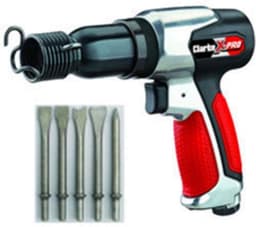
Clarke Clarke X-Pro CAT138

Alternative

Clarke Clarke X-Pro CAT138
7.9/10about £34.66
On this page

Barrel length is not the stroke

The barrel is the nose you aim into a wheel arch. The stroke is how far the piston travels. Ingersoll Rand's short 133MAX lists 3,330 blows per minute and a 2.5 inch stroke. The long 139MAX lists 2,600 blows and a 3.74 inch stroke. The long tool hits fewer times and travels further. If the stroke is blank, do not invent it from the barrel title. The checks are on the air chisel hammer buying guide.

What these listings actually print

The Clarke is a 190 mm title with a 66 mm stroke and 3,000 blows, at about £34.66. The BGS is 170 mm, with a 67 mm stroke and 3,500 strokes. The Proster prints a 250 mm barrel, a 92 mm stroke and 2,500 blows, at about £47.99. That 92 mm is the longest stroke on an amazon.co.uk listing here, behind three reviews. The 119MAX sheet prints 89 mm and 2,530 blows. A scraped 3.5 mm stroke is a bad table. The sheet says 3.5 inches. Both Pneupacture captures leave stroke blank, and the NP0229 copy calls the barrel both medium and long. The Draper Amazon page prints no stroke. A dealer page's 43 mm is a different source.

When the shorter tool is the one to hold

Choose the shorter body when the space is tight and the work is light. A 170 mm or 190 mm nose is easier beside a subframe. The Clarke's 66 mm stroke and the BGS's 67 mm stroke are almost the same travel, with the BGS striking more often. A short stroke does not harden a soft starter bit. The Draper is 17.4 cm on the dimensions line, and Amazon does not print a stroke, so you cannot call it the short-stroke choice from that page. The NP0219 is a 190 mm title at 2.51 kg with no stroke, and reviews include air and no impact. The Clarke's 14 cfm on load is the price of its printed stroke. A small compressor may prefer the 119MAX sheet's 3.7 cfm.

When the longer stroke is the point

Choose the longer stroke when you are shocking a pin and you have room. The Proster's 92 mm and the 119MAX sheet's 89 mm are the long figures you can cite, at 2,500 and 2,530 blows. That is the same shape as the 139MAX versus the 133MAX. The Proster weighs 3.4 kg, with three reviews and no cfm. The 119MAXK is 2.04 kg with 3.7 cfm on the sheet, at about £215.48. If the arch will not take the body, the stroke does not help. Do not infer a long stroke for the NP0229 from 250 mm and 2,200 blows. If you own one hammer, pick the printed stroke that matches the tighter limit, access or the hit.

Common questions

Does a longer barrel always hit harder?
No. A longer barrel is reach. A longer stroke is the travel that can make each blow heavier, usually with fewer blows per minute. Ingersoll Rand's own short and long 130MAX tools show that split. A 250 mm title with no stroke printed, such as the NP0229, is not yet a harder hammer. Fortis HD's percentage is their calculation, not a test of these listings.
What is the difference between barrel length and stroke?
Barrel length is the body size in your hand. Stroke is how far the piston moves. The Clarke is a 190 mm barrel with a 66 mm stroke. The Proster is a 250 mm barrel with a 92 mm stroke. Those second numbers are the ones to compare when you care how hard it hits. The first numbers are the ones to compare when you care whether it fits.
Is 190 mm a short hammer?
In this set, 190 mm is the short title next to 250 mm. The Clarke CAT138 and the NP0219 both use it. Only the Clarke prints a stroke, 66 mm, close to the BGS at 67 mm on a 170 mm body. Ingersoll Rand's own short pattern, the 123MAX, is also in that faster, shorter-stroke class, and it is not one of these listings. A 190 mm label without a stroke is only a length.
Why does the 250 mm kit show fewer blows?
Where a long stroke is actually printed, fewer blows are the usual pair. The Proster lists 2,500 blows with a 92 mm stroke. The 119MAX sheet lists 2,530 blows with an 89 mm stroke. The short titles list 3,000 or 3,500 with strokes around 66 mm, when they print a stroke at all. The NP0229 lists 2,200 blows on a 250 mm title and prints no stroke, so you cannot finish that sentence for it.
Which of these listings actually print a stroke?
The Clarke prints 66 mm. The BGS prints 67 mm. The Proster prints 92 mm. The 119MAX sheet prints 89 mm, and the Amazon listing does not. The Draper Amazon page does not. A dealer page prints 43 mm for the Draper, which is a different source. Both Pneupacture captures leave stroke blank. If it is blank, do not borrow a number from the barrel length.

Related pages

Sources

Public UK sources and the maker data sheet from the research digest, last checked on 19 October 2026. Shelf prices and star lines are the amazon.co.uk figures in the display file.

  1. Ingersoll Rand 119MAX data sheet (retrieved 19 October 2026)
  2. Ingersoll Rand UK air hammer retainers (retrieved 19 October 2026)
  3. HSE: PUWER overview (retrieved 19 October 2026)
  4. Control of Noise at Work Regulations 2005, regulation 4 (retrieved 19 October 2026)
  5. Control of Vibration at Work Regulations 2005, regulation 4 (retrieved 19 October 2026)
  6. Consumer Rights Act 2015, section 9 (retrieved 19 October 2026)
  7. ISO 11148-4:2012 hand-held non-electric power tools, percussion tools (retrieved 19 October 2026)
  8. HSE HSG39: compressed air safety (retrieved 19 October 2026)