Independent comparisons. We may earn from shop links. More info

How to use an air hammer

Updated: 22 October 2026

The hose is in your hand, the chisel is still on the bench, and the useful question is how to use an air hammer without throwing the bit or listening to a hiss that never hits. You oil the inlet, you set the pressure the sheet allows, you fit the chisel with the air off, and you stop if the bit will not stay in the nose. Peter F. drew the steps from maker manuals and from faults on the amazon.co.uk captures of 19 October 2026, not from a lab session. A qualifying purchase can earn a commission at no extra cost to you. Which hammer to buy is on the [air chisel hammer comparison](/hub/drilling-and-accessories/air-chisel-hammer).

The hose is in your hand, the chisel is still on the bench, and the useful question is how to use an air hammer without throwing the bit or listening to a hiss that never hits.

Our top picks

Draper Draper Storm Force 65142

Best value

Draper Draper Storm Force 65142
8.1/10about £25.50
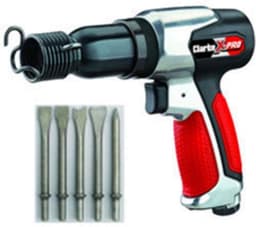
Clarke Clarke X-Pro CAT138

Alternative

Clarke Clarke X-Pro CAT138
7.9/10about £34.66
On this page

Air, oil and the hose

Drain water from the tank before you pull the trigger. Where this set prints a pressure, it is 6.2 bar, and the Clarke CAT138 states that as a maximum. The Sealey SA12/S sheet says 90 psi and says not to exceed it. If your box has its own figure, that figure wins. The Sealey sheet says about a teaspoon of air-tool oil in the inlet if there is no airline oiler. The Blue Spot sheet says a few drops. Follow the sheet in your box. Those two doses are a range, not a rule for the Ingersoll Rand or the Draper. Fit a leader hose so the coupling is not clipped to the body. HSE guidance in HSG39 covers oil, hose condition, and air aimed at the body. Do not blow the hose at your skin.

Fit the chisel with the air off

Disconnect the hose before the chisel goes in or comes out. The Sealey sheet says to disconnect before you change chisels. The Clarke manual tells you to unscrew the retaining spring, insert the chisel, and refit the spring, and it treats the spring as a wearing part. One UK review of the NP0229 says only one supplied chisel enters the spring collet. A 10 mm round bit, a 0.401 in round bit and a hex bit are not the same order. The air chisel hammer buying guide covers that match. If you can pull the bit out with the retainer locked, do not pull the trigger.

How to hold it and when it is loud

The Clarke CAT138 manual says to hold the hammer at about 60 to 70 degrees, with light contact, then move slowly. That angle is that manual's instruction. A flat laid almost parallel will skate. A point driven into a fastener you meant to reuse will mushroom the thread. At work, the Control of Noise at Work Regulations 2005 set action values at 80 and 85 dB(A) and a limit of 87 dB(A). The BGS listing prints 93 dB(A) and 104 dB(A). The 119MAX sheet prints 95.7 and 106.7 dB(A). The vibration regulations set an action value of 2.5 m/s² A(8). The BGS prints 9.686 m/s² and the 119MAX sheet prints 4.5 m/s². Those figures are not a personal minute allowance. If your hands tingle, stop.

If it only hisses or the bit leaves

A hiss with no hit is what UK reviewers describe on the NP0229 after oil and the stated pressure, and on the NP0219 as air with no impact. Check pressure, oil and a seated chisel before you condemn the hammer. A stuck trigger in Draper and NP0219 reviews is a different fault. Do not tape the trigger down. If those checks still produce only air, stop and isolate the hose. One NP0219 report is a snapped fitting. Do not feel a leak with a finger. Call a professional for structural concrete, a brake or steering part you cannot name, or heat near fuel or brake lines.

Common questions

Where does the oil go, and how much?
It goes in the air inlet, unless your hammer has a dedicated oiler. The Sealey SA12/S sheet describes about a teaspoon when there is no oiler, then a short run. The Blue Spot sheet says a few drops. Use the sheet in your box. Those two quantities show the range. They are not a single dose for every brand in this comparison.
Do I fit the chisel with the air connected?
No. Isolate or disconnect the hose before the chisel goes in or comes out. The Sealey instructions say to disconnect before you change chisels. A spring or collar that is only half closed will let the bit leave once the piston starts. If you can pull the chisel out by hand after you think it is locked, leave the trigger alone.
What angle do I hold it at?
The Clarke CAT138 manual says about 60 to 70 degrees, light contact, then a slow move once the trigger is in. That is that manual's instruction. A point driven square into a thread you hoped to reuse will mushroom it. A flat laid too shallow will skate across the flange and mark the pipe. Let the blows work, rather than leaning your bodyweight on a stalled tip.
Why does it only hiss?
Check oil, pressure and a fully seated chisel before you condemn the hammer. UK reviews of the NP0229 describe a hiss and no hit after oil and the stated pressure, and the NP0219 file includes air with no impact. If those three checks are already right, stop. A failed seal or a snapped fitting needs the hose isolated, not a higher regulator setting.
What if the chisel will not enter?
Stop. One UK review of the NP0229 says only one supplied chisel seats in the spring collet. The shank is wrong, or the collet is faulty. More air will not resize a 10 mm bit, a 0.401 in bit or a hex bit into each other. If none of the bits that came in the box will enter, that is a return, not a technique.

Related pages

Sources

Public UK sources and the maker data sheet from the research digest, last checked on 19 October 2026. Shelf prices and star lines are the amazon.co.uk figures in the display file.

  1. Ingersoll Rand 119MAX data sheet (retrieved 19 October 2026)
  2. Ingersoll Rand UK air hammer retainers (retrieved 19 October 2026)
  3. HSE: PUWER overview (retrieved 19 October 2026)
  4. Control of Noise at Work Regulations 2005, regulation 4 (retrieved 19 October 2026)
  5. Control of Vibration at Work Regulations 2005, regulation 4 (retrieved 19 October 2026)
  6. Consumer Rights Act 2015, section 9 (retrieved 19 October 2026)
  7. ISO 11148-4:2012 hand-held non-electric power tools, percussion tools (retrieved 19 October 2026)
  8. HSE HSG39: compressed air safety (retrieved 19 October 2026)