Independent comparisons. We may earn from shop links. More info

12V vs 18V cordless drill

Updated: 22 October 2026

The shortlist has a compact 12V kit beside a heavier 18V combi, plus a box that says 20V MAX. The useful difference in a 12V vs 18V cordless drill is the hole and the weight, not a belief that a higher number is always better. Choose 12V for furniture, plasterboard, overhead fixing and tight cupboards. Choose 18V when this will be the only drill in a brick house. Choose an SDS drill when the hole is concrete or the bit has stopped. The [12V cordless drill comparison](/hub/drilling-and-accessories/12v-cordless-drill) is the compact kits we kept. Products Compared used published diameters and those listings, not a lab, on 19 October 2026. A qualifying purchase can earn a commission at no extra cost to you.

The shortlist has a compact 12V kit beside a heavier 18V combi, plus a box that says 20V MAX.

Our top picks

On this page

They are different classes

A 12V drill and an 18V drill are different tool classes, even when both are cordless combis with a 10 mm chuck. Bosch Professional treats 12V as the maximum label for the system it used to call 10.8V, and those packs fit that system only. An 18V pack from the same brand does not slide onto the 12V body. Nominal 18V is the larger class: more mass, and a masonry diameter Bosch states higher on its 18V combis than on its 12V combis. 20V MAX is a nominal 18V pack described at its peak, not a step above 18V and not a 12V drill. An 8V stick drill and a 4V screwdriver are smaller than 12V. A 21+1 collar is clutch steps, not a reason to jump to 18V.

When 12V is the better buy

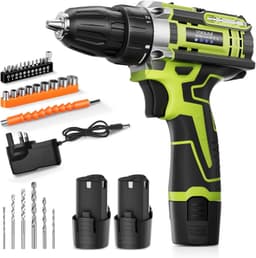
12V is the better buy when you can hold the tool up and still steer the screw. Bosch Professional describes lighter 12V tools for overhead work and tight spaces. A wardrobe, a curtain pole and shelves in an alcove are that work. Bosch DIY puts 12V drill drivers at screws to about 6 mm and wood to about 20 mm. The green FADAKWALT at 20 Nm and the VOERJIA at 35 Nm sit at that light end. Bosch's EasyImpact 12 is 1.00 kg with a battery, and the GSB 12V-15 is about 1.3 kg. In our set the VOERJIA is 900 g. The Durofix table says 2 kg against a bullet of 870 g.

When 18V or an SDS drill wins

18V wins when the screw is larger, the hole is wider, or the house is brick and this is the only drill you will own. Bosch DIY puts masonry rawlplugs at about 6 mm on a 12V combi and about 13 mm on an 18V combi, and it sends concrete to an SDS drill. A 12V combi can make a small plug hole. It is the wrong only drill for a brick house. Bosch's EasyImpact 12 states 6 mm in masonry. The GSB 12V-15 at Screwfix states 10 mm. Those figures do not transfer to every 12V hammer setting. The FAHEFANA states no diameter, and reviewers say it will not drill brick. If the bit only dusts the surface, more trigger will not invent an SDS mechanism. BS EN 62841-2-1 covers drills and impact drills, not rotary hammers. The cable check is on the how to use a cordless drill page.

Weight, runtime and platforms

A higher voltage does not mean a longer run. Runtime is amp-hours, the work, and whether you own a second pack. A 12V 2.0Ah pack can outlast an 18V 1.5Ah pack on light screws, and it will not outlast it on a 13 mm masonry hole. The green FADAKWALT's single 1.3Ah pack is why reviewers stop to charge. The VOERJIA's two 2000 mAh packs are why others keep going. Neither fact makes 12V into 18V. Packs do not cross brands or voltage classes. If you already own 18V batteries, a matching 18V drill uses them. Buy 12V if the work is light or overhead. Buy 18V if the house is brick and this drill has to do the plug holes too. Buy an SDS drill if the hole is concrete or the combi has stalled.

Common questions

Is 12V enough for a UK house?
It is enough for furniture, plasterboard, light timber and a small number of masonry plugs if the combi states a diameter. Bosch DIY puts that 12V band at about 6 mm. It is not enough as your only drill in a brick house, or for concrete. An 18V combi or an SDS drill is the class that matches those holes.
Is 20V MAX the same as 18V?
On the usual UK and US-style labelling, 20V MAX is a nominal 18V pack described at its maximum, not a 20V class and not a 12V drill. A listing that says 20V MAX on a 12V search is the wrong box. Read the nominal voltage before you compare torque or price.
Can a 12V combi drill brick?
Some can, up to the diameter the maker states. Bosch's EasyImpact 12 states 6 mm in masonry. The GSB 12V-15 states 10 mm. Those figures do not transfer to every 12V combi. The FAHEFANA states no diameter, and reviewers say it will not drill brick. Dense concrete is SDS work.
When do I need an SDS drill?
You need one when the hole is in concrete, or when a combi bit is not progressing through engineering brick or a long run of plugs. BS EN 62841-2-1 covers drills and impact drills, not rotary hammers, so an SDS tool is a different product. More voltage on a rotary combi does not add the SDS mechanism. Stop if the bit only polishes the surface.
Can I mix 12V and 18V batteries?
No. They are different packs, even inside one brand. A Bosch 18V pack does not fit a Bosch 12V body, and Makita, DeWalt and Milwaukee keep the same split. If you already own 18V packs, an 18V drill uses them. A 12V drill means a second charger and a second set of batteries.

Related pages

Sources

Public UK sources from the research digest, last checked on 19 October 2026. Shelf prices and star lines are the amazon.co.uk figures in the product display for this comparison.

  1. Bosch Professional: changeover from 10.8V to 12V (retrieved 19 October 2026)
  2. BSI: BS EN 62841-2-1, hand-held drills and impact drills (retrieved 19 October 2026)
  3. HSE: PUWER overview (retrieved 19 October 2026)
  4. Electrical Safety First: drills (retrieved 19 October 2026)
  5. Electrical Safety First: DIY and cables (retrieved 19 October 2026)
  6. GOV.UK: Electrical Equipment (Safety) Regulations 2016 (retrieved 19 October 2026)
  7. GOV.UK: recycling batteries and electrical waste (retrieved 19 October 2026)
  8. Screwfix: best drills guide (retrieved 19 October 2026)