Independent comparisons. We may earn from shop links. More info

12V cordless drill buying guide

Updated: 22 October 2026

Every box in the hallway says 12V, and the jobs are a flat-pack wardrobe, a plasterboard fixing and one brick plug. This 12V cordless drill buying guide puts the hole first, then the chuck, the battery and the plug. A 12V tool, which Bosch Professional also sells as 10.8V inside its own system, is the compact class for furniture and light timber, not a day of masonry. The [12V cordless drill comparison](/hub/drilling-and-accessories/12v-cordless-drill) ranks the amazon.co.uk listings we kept. Products Compared used those listings and public UK guides, not a lab, on 19 October 2026. A qualifying purchase can earn a commission at no extra cost to you.

Every box in the hallway says 12V, and the jobs are a flat-pack wardrobe, a plasterboard fixing and one brick plug. This 12V cordless drill buying guide puts the hole first, then the chuck, the battery and the plug.

Our top picks

On this page

Start with the job, not the star rating

The first split is the hole, not the star line. A drill driver covers screws, plasterboard and light timber. A combi adds a hammer setting for brick and block, and it is still a poor substitute for an SDS drill in concrete or a long run of plugs. Bosch DIY's UK page puts a 12V drill driver at screws to about 6 mm and wood to about 20 mm, and a 12V combi at rawlplugs to about 6 mm. A wardrobe and a few picture hooks need a driver with a low clutch. A brick house with more than a couple of plug holes needs a combi that states a masonry diameter. The FAHEFANA is sold as a combi and states none, and several reviewers say it will not drill concrete or brick.

What 12V, 10.8V and 20V MAX mean

Inside one system, 12V maximum and 10.8V nominal are the same compact class. Bosch Professional's changeover page says its 12V label is the maximum for the packs it used to call 10.8V, and those packs stay inside that brand. The voltage number describes the class. The rail on the pack describes what actually fits. 20V MAX is a nominal 18V pack described at its peak, not a 12V drill with a louder sticker. An 8V stick drill and a 4V screwdriver are smaller again. If the listing will not say nominal voltage in plain figures, check the 12V versus 18V cordless drill page. In the kept set only the Durofix RK12136 and the Dremel Blueprint DD12V state brushless.

Chuck, clutch and amp-hours

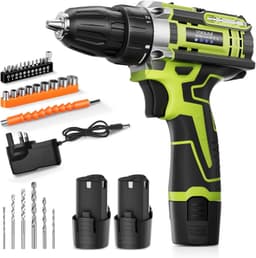
A 3/8 inch chuck, 9.53 mm, sold as 10 mm, covers almost every domestic bit in a 12V drill. Ignore a capacity cell that copies the chuck. The Durofix lists wood and metal both as 9.53 mm. The Dremel states a chuck of 3 inches, which conflicts with the hex bits in the same kit. A 21+1 line is clutch steps, not gears. On the FADAKWALT the table's 22 speeds is that count. Two speeds are a separate claim, on the Durofix and the VOERJIA. About 20-30 Nm is light screwdriving if the number is real torque. The green FADAKWALT has one 1.3Ah pack, so you stop to charge. The VOERJIA lists two 2000 mAh packs. Do not add the blue and green FADAKWALT reviews: they are the same 1,204.

Platform, plug and disposal

Makita CXT, Bosch Professional 12V, DeWalt 12V XR and Milwaukee M12 are stocked as systems. A slide only that seller uses is a weak work tool once the pack dies. Mains are 230 V and the plug is BS 1363. Electrical Safety First says to use the original charger. A two-pin Schuko lead is a buying problem. The Electrical Equipment (Safety) Regulations 2016 start at 75 V DC, so the pack sits outside that scope and the charger sits inside it. One FAHEFANA reviewer reported no charger and no socket on the tool. Charge on a hard flat surface, unplug when full, and do not charge while you sleep. Tape the terminals and take a spent pack to a battery recycling point.

Common questions

Is 10.8V the same as 12V?
Inside one brand's system, 10.8V nominal and 12V maximum are the same compact class. Bosch Professional's UK changeover page says its 12V label is the maximum name for the packs it previously called 10.8V, and compatibility stays inside that system. A 10.8V pack from another brand will not fit, and a 20V MAX pack is not close enough. Read the rail on the battery.
Do I need hammer mode in a brick house?
You need hammer mode if the hole is a masonry plug and you will make more than a couple of them, and only if the listing states a masonry diameter. Bosch DIY's guide puts 12V combis at rawlplugs to about 6 mm. Concrete and a long run of holes need an SDS drill. A drill driver is enough for furniture, plasterboard and light timber.
What does a 2.0Ah battery change?
A 2.0Ah pack is the usual light-duty size, against a 1.3Ah pack that runs out mid-job. On the green FADAKWALT, reviewers stop because there is only one 1.3Ah pack. A second pack matters more than one larger pack if this is your only drill. A spare Bosch Professional 12V 2.0Ah pack was £40.83 including VAT on that brand's UK page.
Can I use another brand's battery?
No. Packs are not shared across brands, and they are not shared across voltage classes inside one brand. Makita CXT, Bosch Professional 12V, DeWalt 12V XR and Milwaukee M12 are separate UK systems. A cheap kit with a unique slide leaves you without a replacement when the pack fails. Buy a bare body only when you already own the matching pack.
What is wrong with a two-pin charger?
UK sockets take a BS 1363 three-pin plug. A Schuko-only or two-pin charger is the wrong plug, and the 230 V charger is the part covered by the Electrical Equipment (Safety) Regulations 2016. Electrical Safety First says to use the original charger. If none arrived, the Consumer Rights Act 2015 covers goods that are not as described.

Related pages

Sources

Public UK sources from the research digest, last checked on 19 October 2026. Shelf prices and star lines are the amazon.co.uk figures in the product display for this comparison.

  1. Bosch Professional: changeover from 10.8V to 12V (retrieved 19 October 2026)
  2. BSI: BS EN 62841-2-1, hand-held drills and impact drills (retrieved 19 October 2026)
  3. HSE: PUWER overview (retrieved 19 October 2026)
  4. Electrical Safety First: drills (retrieved 19 October 2026)
  5. Electrical Safety First: DIY and cables (retrieved 19 October 2026)
  6. GOV.UK: Electrical Equipment (Safety) Regulations 2016 (retrieved 19 October 2026)
  7. GOV.UK: recycling batteries and electrical waste (retrieved 19 October 2026)
  8. Screwfix: best drills guide (retrieved 19 October 2026)