Independent comparisons. We may earn from shop links. More info

How to fit a sliding barn door

Updated: 21 October 2026

You have a top-hung kit, or you are still deciding whether the wall can take one, and the doorway is an internal bathroom, cloakroom or cupboard. How to fit a sliding barn door starts with structure, then a level rail, then a floor guide and stops, and it ends at the point where you put the drill down. The length of that rail should already be settled on the [barn door track length](/hub/door-and-window-security/sliding-door/sub/sliding-door-track-length) page. Product choice sits on the [sliding door comparison](/hub/door-and-window-security/sliding-door). Peter F. followed Häfele, The Sandwich Handyman and the review faults on these amazon.co.uk kits, updated 19 October 2026. There was no lab fit. A qualifying purchase through an amazon.co.uk link can earn a commission at no extra cost to you.

You have a top-hung kit, or you are still deciding whether the wall can take one, and the doorway is an internal bathroom, cloakroom or cupboard.

Our top picks

On this page

Check the wall before you drill

The weight hangs on the rail, so the first question is what the screws will bite. Plasterboard on its own is not that structure. Häfele tells you to find studs or to use a timber batten, and to use masonry plugs in brick. The Sandwich Handyman fits a header board into studs or masonry for the same reason, and says a fixing that only catches plasterboard will not do. If a detector and a pilot hole cannot find a stud, a noggin or solid masonry along the whole run, stop. The rest of this sequence will not make a plasterboard-only fixing safe. Several kits in this comparison supply wooden dowels as wall plugs. Reviewers on the cheaper WOLFBIRD files and on the CCJH silver kit did not trust those dowels in brick, and some of the 15 mm dowels on the 152 cm WOLFBIRD spun in the wall. Swap them for plugs that match the wall you actually have, bought to the screw gauge in the kit, before the rail goes up. A hollow-wall fixing that the bag did not include is a second trip, not a reason to drive the supplied dowel and hope. You also need a clear run of wall beside the opening, about the width of the door, so the leaf can park. Sockets in that zone disappear behind it. Häfele asks for at least 50 mm above the opening. The black WOLFBIRD bullets ask for at least 13 cm from the door top to the ceiling, and that larger figure wins if it is the kit in your hand.

Set the rail, then the leaf

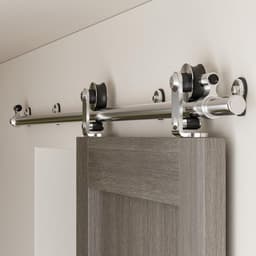
Mark the height from the kit’s own sheet, then check the line with a spirit level longer than a phone. An unlevel rail is why these doors creep. CCJH reviewers said the leaf drifted when the tube was not level, and there was no height adjustment once the holes were drilled. Drill the fixing holes only after that line is right. Two people are stated on the Signstek and WINSOON listings, and a full-size leaf is awkward alone even when a listing is silent. One person holds the door on the hangers while the other watches the floor gap and the stops. Offer the leaf before you commit every screw. WINSOON reviewers found both sides sitting proud until they adjusted the kit, and the leaf tilted when the large rollers were hung on the back of the door. If your sheet shows the hangers on the face, follow that face. The 152 cm WOLFBIRD instructions let the brackets be read either way up, and one buyer’s rail sat too low until they inverted it. Read the diagram against the door in the room, not against the thumbnail on the phone. Hole positions from another brand’s gear, such as Barrier Components’ K075, are not the sizes for these kits. Use the sheet in your box. Where that sheet is tiny, imperial, or at odds with the pictured roller, as TSMST and Signstek reviewers reported, match the parts in your hand to the drawing before you drill the door.

Floor guide, stops, and a spliced rail

Fit the floor guide once the door hangs and you can see where the edge travels. It keeps the leaf from swinging out. Häfele says it carries no weight, and these kits have no threshold track. The Sandwich Handyman uses a floor gap of about 10–15 mm as that fitter’s figure, so the door clears a slight hump. That gap is a practical note, not a British Standard. Deep carpet needs the clearance you can see in the room. Stops are easy to fit on the wrong side. One WOLFBIRD review says the door stops have to go on before the rail is finally fixed, or the rail has to come down again. Put them on the rail, run the door to both ends, and only then drive the last fixing. A missing stop screw, which showed up on the cheaper WOLFBIRD sample, means the door will not stay parked. Check the bag against the parts picture before the rail is on the wall. A spliced rail changes the sequence. CCJH reviewers found a joiner too short, so the tube dipped as a heavy wheel crossed the joint, and TSMST’s 6 ft track arrived in five pieces. Put a structural fixing at the joint if the holes allow it. A hacksaw shortens a rail that is too long. It does not repair a dip. A sheared bolt on the 152 cm WOLFBIRD followed a 3 mm pilot in that sheet only.

Stop and get help

Call a carpenter or a fire-door installer when you cannot hit studs or masonry along the run, when the opening is a certified fire door, when the leaf is glass, or when the door is heavier than every printed rating in the comparison. Rehanging a labelled fire door on this track drops the certificate. The rating belonged to a tested doorset, not to the blank you liked the weight of. An external patio is the same kind of stop: these rails are not an anti-lift device and not a lock. That job is on the sliding patio door security page. A kit that arrives scratched, short of a stopper plug, or with a faulty hanger bolt and no spare is a consumer-rights conversation with the seller before you drill the door to suit the missing part. The fitting sequence assumes the bag matches the listing. If it does not, finish the return while the timber is still undrilled.

Common questions

Can I screw the track straight into plasterboard?
Only if the screws also reach studs, a header fixed into studs, or masonry. Häfele and The Sandwich Handyman both treat plasterboard alone as the wrong substrate. If you cannot find that structure along the run, stop and get a header or a fitter who can. The rest of the sequence will not make a plasterboard-only fixing safe.
Do I need a bottom track?
No. These kits use a floor guide, and the guide does not carry the weight. You still need it, or an equivalent the listing names, so the leaf cannot swing off the wall. A missing guide line on a listing is a reason to confirm the bag before you rely on it. These kits have no threshold rail.
How level does the rail have to be?
Level enough that the door does not creep. CCJH reviewers saw drift when the tube was out, and that kit had no height adjustment after the holes were drilled. Check with a long spirit level before you commit the screws. Mark the height from the sheet in the box, not from another brand’s hole chart.
When do I fit the stops?
Before the rail is finally fixed, then run the door to both ends. One WOLFBIRD reviewer had to drop the rail again because the stops went on too late. A missing stop screw, which also showed up in that sample, leaves the door unable to stay parked. Check the bag against the parts picture first.
What gap should I leave under the door?
The Sandwich Handyman works to about 10–15 mm so the leaf clears the floor. That is one fitter’s figure, not a British Standard. Deep carpet or an uneven floor needs the clearance you measure in the room, and the guide still has to meet the edge. The guide carries no weight.
The kit came with wooden dowels. Should I use them in brick?
Reviewers on these WOLFBIRD and CCJH kits did not trust them in masonry, and some dowels spun. Use plugs suited to brick or to a hollow wall, matched to the screw. Keep the dowels for solid timber if the sheet says so. A hollow-wall fixing the bag omitted is a second trip, not a reason to hope.
When should a carpenter take over?
When the fixings cannot reach structure, when the leaf is glass or heavier than the printed ratings, or when the opening is a fire door or an external patio. Those are different jobs from hanging a timber cupboard door on a sound stud wall. A labelled fire door loses its certificate if you rehang it on this track.

Related pages

Sources

Public UK sources for door hardware and security rules, plus the amazon.co.uk listings in this set. Last checked 21 October 2026.

  1. GOV.UK, Approved Document Q (2015) (retrieved 21 October 2026)
  2. BSI, PAS 24:2022+A1:2024 (retrieved 21 October 2026)
  3. NBS, BS EN 1527:2019+A1:2021 (retrieved 21 October 2026)
  4. Metropolitan Police, door security advice (retrieved 21 October 2026)
  5. Häfele UK, sliding barn door kits (retrieved 21 October 2026)
  6. Runners UK, how to choose sliding door gear (retrieved 21 October 2026)
  7. The Sandwich Handyman, fit a sliding barn door (retrieved 21 October 2026)
  8. TRADA, fire doors (retrieved 21 October 2026)