Independent comparisons. We may earn from shop links. More info

Half step or threshold ramp

Updated: October 2026

A half step and a threshold ramp solve different problems. A half step splits one high rise into two smaller rises for someone who lifts a foot. A threshold ramp is a short slope that lets wheels cross a small upstand. Buying the wrong one leaves the rise untouched or puts a frame on a slope. This page is that choice. It does not rank the twelve half steps. The [doorstep comparison](/hub/door-and-window-security/doorstep) does that, and none of those listings is a ramp. Peter F. compared UK access guidance and those listings in October 2026. This is not a lab test of a ramp. A qualifying purchase can earn a commission at no extra cost to you.

A half step and a threshold ramp solve different problems. A half step splits one high rise into two smaller rises for someone who lifts a foot. A threshold ramp is a short slope that lets wheels cross a small upstand.

Our top picks

Aukimo Aukimo GlowStep

Best overall

Aukimo Aukimo GlowStep
9.4/10about £29.99
Aidapt Aidapt outdoor half step

Best value

Aidapt Aidapt outdoor half step
9.2/10about £14.99
On this page

What each object does

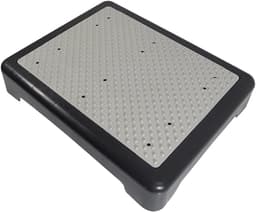
A half step adds a tread so you step up twice, with the two rises similar. Living Made Easy treats a leftover lip as still a hitch. Platforms here are mostly about 9 to 11 cm. The top pick, the Aukimo GlowStep, goes up to 12.7 cm. The best value pick, the Aidapt outdoor half step, is 9 cm. They divide the rise for someone who walks. A threshold ramp is a short slope. Go Access describes a wedge of about half an inch to four inches and says not to stack ramps. A long wheelchair ramp needs a run of path. If you roll, a platform is another kerb.

Wheelchair, frame, or stick

If you use a wheelchair, none of these half steps is suitable. Use a threshold ramp for a small upstand, or a rebuilt entrance for a full house step. Nottinghamshire’s leaflet points wheelchair users to a ramp. That is one council’s guidance, not a statute. The same leaflet says not to use a ramp with a frame because of falls. A half step is the candidate only when the tread fits. Depth is on the half step buying guide. With a stick, the Ramp People say a step often feels safer than a wet slope. A half step will not become a ramp later.
Aukimo Aukimo GlowStep

Testsieger

Aukimo Aukimo GlowStep
9.4/10about £29.99

Space, the door, and rain

A ramp needs more ground than a half step of the same height. Check both sides, the door and the wet grip. A wedge that sits proud so the door can pass is a new lip. Puddles on a step are the outdoor half step page. Own both only if you can store one. Gradients such as 1:12 are for building ramps, not a rubber wedge.

What neither product does to the Building Regulations

Neither product meets the 15 mm accessible threshold just by sitting at the door. Approved Document M allows a raised threshold of not more than 15 mm, and up to 150 mm only where a step is unavoidable, depending on M4(1), M4(2) or M4(3). Scotland, Wales and Northern Ireland use their own guidance. If you are rebuilding the door, ask building control. The NHS says a council assessment is free. If you roll, look at a ramp. If you walk, a half step is the candidate. Placement on the day is the placement guide.

Common questions

I use a wheelchair. Is any half step in this set suitable?
No. Every listing in the comparison is a step, not a slope. A wheelchair needs a threshold ramp for a small upstand or a rebuilt level entrance for a full house step. Nottinghamshire’s leaflet points wheelchair users to a ramp. A 10 cm platform is another kerb. Do not stand the step in front of the door and expect wheels to climb it.
I use a walking frame. Is a ramp safer?
Not by default. Nottinghamshire’s access leaflet advises against a ramp with a walking frame because of falls, and it asks for large level steps instead. That is one council’s guidance, not a statute. A half step is only the better candidate when the tread is wide and deep enough for the frame and the two rises match. A narrow stool fails that test as well.
I use a stick and the path is often wet. Step or slope?
A half step is the candidate if the problem is one high rise and you can lift a foot. The Ramp People say a step often feels safer than a wet slope for someone with a stick, and Approved Document M notes that a wet ramp is more slippery and that some people who walk prefer steps. The step still has to shed water. A puddle on the tread is a separate fault, not a reason to switch to a slope you cannot see when it is wet.
What if I walk now and may need a wheelchair later?
A half step will not become a ramp. The Ramp People suggest allowing for a wheelchair later if that change is likely. You can use a portable step while you walk, provided you do not block the only ground a ramp would need. If the path is too short for a slope, talk to the council before you build the entrance around today’s step.
How is a threshold ramp different from a long wheelchair ramp?
A threshold ramp is a short wedge for a small upstand. Go Access describes that job as about half an inch to four inches in their range, and they say not to stack wedges. A long wheelchair ramp needs a run of path and, where it is building work, a gradient from the approved documents. Do not treat a rubber door wedge as if it had a 1:12 building gradient.
Can I put a step and a ramp at the same door?
You can own both if two people cross the door differently, and you can store the one you are not using. Setting both down together usually blocks the door or the approach. In a public building, Approved Document M expects a choice of steps and a ramp when the ramp rise is large. A house hall rarely has that room. Choose for the person who uses the door daily.
Does a half step meet the 15 mm accessible-threshold figure?
No. Approved Document M describes an accessible threshold as level or raised by not more than 15 mm. A half step is about 9 to 11 cm, and it does not turn the doorway into an M4(1), M4(2) or M4(3) entrance. Volume 1 allows up to 150 mm only in the building-work cases where a step is unavoidable. A portable product is not that work. Ask building control if you are rebuilding the door.

Related pages

Sources

Public UK sources used for this comparison. Last checked 21 October 2026.

  1. Approved Document K (England): protection from falling, collision and impact (retrieved 21 October 2026)
  2. Approved Document M Volume 1: access to and use of dwellings (retrieved 21 October 2026)
  3. NHS: home adaptations (retrieved 21 October 2026)
  4. Living Made Easy: adapting your home, access into and around your home (retrieved 21 October 2026)
  5. Independent Living Centre: outdoor steps and rails (retrieved 21 October 2026)
  6. HMRC VAT Notice 701/7: reliefs for disabled and older people (retrieved 21 October 2026)
  7. Consumer Rights Act 2015, section 20 (retrieved 21 October 2026)
  8. GOV.UK: online and distance selling for businesses (retrieved 21 October 2026)