Independent comparisons. We may earn from shop links. More info

Door peephole buying guide

Updated: October 2026

You are replacing a misted peephole on a UK house or flat door, and the boxes are shouting about 200 degrees. A door peephole buying guide starts with the leaf in front of you, then the hole that is already there, then whether a cover is in the parcel. The [door viewer comparison](/hub/door-and-window-security/door-viewer) ranks the twelve amazon.co.uk listings saved on 19 October 2026. This page is the order of those measurements, not a second ranking. Peter F. used those listings and the review notes. This is not a lab test. A qualifying purchase can earn a commission at no extra cost to you.

You are replacing a misted peephole on a UK house or flat door, and the boxes are shouting about 200 degrees.

Our top picks

On this page

Measure the door before the angle

The number that decides the purchase is the thickness of the leaf, not the widest angle on the title. Optical listings cover about 35–50 mm, 35–55 mm, or 35–60 mm. Hazlemere’s UK door-size guide puts many timber slabs around 44–56 mm and many composite slabs around 44–70 mm. A 60 mm composite leaf drops out of anything that stops at 50 or 55 mm. A thin uPVC slab near 28 mm can fall short of a range that starts at 35 mm. Desenda and XFORT stop at 50 mm. Both Stoppwerk listings stop at 55 mm. The Amig 10013G states 35–60 mm. The EZVIZ DP2C states 35–105 mm and is a camera, so it is not in the lens shortlist. If your leaf is 62 mm, none of the optical bands cover it.

Barrel, cover, and lens

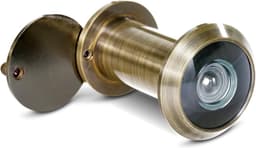
Twelve, fourteen, and sixteen millimetres are not interchangeable. Desenda’s title says 14 mm, and one UK review measured about 19 mm, so measure the tube before you enlarge a door. The Amig states 14 mm. XFORT does not print a barrel. The Stoppwerk antique listing states 16 mm. The decorative cap is wider than the tube. Bit size is on how to fit a door peephole. A cover is the room-side flap. It is worth having, and it is not invisibility. A UK Desenda review says the room was still visible from outside. Ginddy’s non-UK reviews say there is no cover.
Amig Amig 10013G door viewer

Testsieger

Amig Amig 10013G door viewer
9.2/10about £8.50

The angle is the last check

Once the hole matches, glass versus plastic is the clarity argument. Stoppwerk’s reviews praise glass and also describe moisture in the antique lens. The Amig title says brass, and a UK review says the tube is plastic. The degree number is a weak check. Nothing in these files measures a clarity gain from 180° to 200°. Desenda’s title says 200° and a bullet says 220°. DHF TS 002:2009 is the UK performance specification for door viewers. It is not a size chart, and no listing here shows a TS 002 mark you can treat as a fit guarantee.

When this guide is the wrong page

Stop if you cannot say the door is yours to alter. A leasehold flat entrance is often a fire door. Approved Document B treats the fire doorset as the door, the frame, and the ironmongery together. “UL listed” on a Bwintech title is not that evidence. A camera is the other exit. Optical viewers here run from about £3.99 to about £12.99 and need no power. The DP2C is about £95.41 and records. If you only need to see who is there, stay with a lens whose thickness band contains your measurement.

Common questions

What door thickness does a UK peephole usually fit?
In this amazon.co.uk set the optical bands are about 35–50 mm, 35–55 mm, or 35–60 mm. Many UK timber doors are about 44–56 mm and many composite doors about 44–70 mm, so a thick composite leaf can sit outside the shorter bands. A range that starts at 35 mm can also miss a slim uPVC slab nearer 28 mm.
Should I match the old hole or the title diameter?
Match the barrel to the hole you have, then check that the title diameter is what arrived. The decorative cap is wider than the tube. If the old hole is 12 mm and the new barrel is 16 mm, you are enlarging the door, which is a different job from a straight swap.
Is 200° worth more than 180°?
Not on the evidence in these files. Stoppwerk prints 200°, XFORT and two Bwintech finishes print 180°, and Desenda’s title says 200° while a bullet says 220°. No listing here reports a measured sharpness gain from the extra degrees. Buy the angle only after thickness and barrel match.
Do I need a privacy cover?
You want one, and you should not treat it as a guarantee. A cover closes the room side when you are not looking. Desenda includes one, and a UK review still says the room was visible from outside. Ginddy’s bullets claim one-way vision, and the non-UK reviews in that file say there is no cover.
Will a viewer that starts at 35 mm fit a thin uPVC door?
Only if the leaf is at least 35 mm where you fit it. Several listings claim uPVC, wood, and composite. A uPVC question on the XFORT page is not answered in the bullets, and no UK review in the Ginddy file checks that claim. Slim uPVC can be nearer 28 mm. If your measurement is under the stated minimum, the viewer will not tighten across the leaf however wide the angle is.
What if the door might be a fire door?
Do not choose a viewer from this page and do not drill. A certificated doorset only keeps its evidence if the viewer is named in that evidence and fitted as the certificate describes. Marketplace words such as UL listed are not an FD30 approval. The questions for the managing agent are on the fire door peephole page.

Related pages

Sources

Public UK sources for the rules and the DP2C specification, last checked on 19 October 2026. Shelf prices, stars, and review counts are from the amazon.co.uk listings in this category on that date.

  1. GOV.UK: domestic CCTV (retrieved 19 October 2026)
  2. ICO: home CCTV systems (retrieved 19 October 2026)
  3. NBS: DHF TS 002:2009 Door viewers (retrieved 19 October 2026)
  4. Secured by Design: UAP door viewers (retrieved 19 October 2026)
  5. Falcon: dual-scope fire door manual (retrieved 19 October 2026)
  6. GOV.UK: Approved Document B fire safety FAQ (retrieved 19 October 2026)
  7. Rutland: door viewer (retrieved 19 October 2026)
  8. EZVIZ UK: DP2C (retrieved 19 October 2026)