Independent comparisons. We may earn from shop links. More info

How to use wooden skewers

Updated: October 2026

You have cut the peppers, marinated the chicken and opened a packet of bamboo sticks, and the exposed ends can burn before the food is ready. Learning how to use wooden skewers means treating the stick and the food as two jobs: soak the empty stick to limit burning, thread pieces that cook at a similar pace, then turn the kebab by its loaded section. If you are still choosing a length, start with the [wooden skewers comparison](/hub/diy-supplies/wooden-skewers). Peter F. read the listings on 15 October 2026. There was no laboratory cook. A qualifying purchase can earn a commission at no extra cost to you.

You have cut the peppers, marinated the chicken and opened a packet of bamboo sticks, and the exposed ends can burn before the food is ready.

Our top picks

On this page

Soak the sticks before direct heat

For a barbecue, soak empty wooden skewers in cold water for 30 minutes before you thread them. BBC Good Food gives that time so the sticks are less likely to catch fire. A BBC Food satay recipe says at least 20 minutes. Listings here say 10 minutes, 20–30 minutes, or 30 minutes in hot water. Follow a clear packet line, and do not treat 10 minutes as enough for a barbecue when you can allow the longer cold soak. Submerge the sticks, weigh them down if they float, and set a timer. Soak before you thread, or the bath holds raw meat. Length and shape are in the wooden skewers buying guide.

Thread the food, then leave a handle

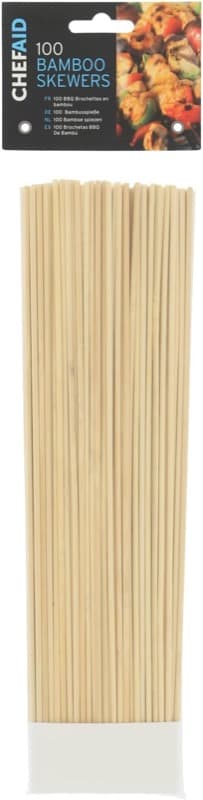
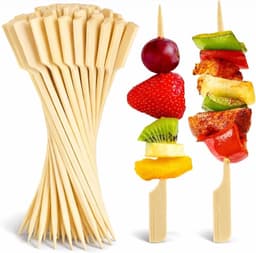
Drain the sticks and do not pack the food into one solid block. Tight pieces shield each other from the heat. Large gaps waste length. A 25–30 cm skewer can hold several pieces and still leave about a hand-width of bare stick. Push through the centre of firmer pieces. Do not force a thin stick through mushrooms or courgette, or it can split the food. Discard a cracked or splintered stick. A splinter-free bullet is not a guarantee. A 12 cm paddle suits a canapé or a burger pin, not a full kebab. Lafefe says its flat handle helps with flipping. That is a listing claim.

Turn the food, not just the bare end

Round bamboo can rotate inside the food, so twisting only the handle may leave the ingredients facing the same way. Use tongs on the loaded section, or turn two neighbouring pieces together, and check the food has changed sides. A short paddle is not a long kebab skewer. Leave room to reach each stick without putting your hand over the heat. Two parallel skewers can steady a piece that keeps spinning. On a crowded grill, cook a smaller batch. Replace a stick that is scorched, split or has touched raw meat. One listing describes disposal after cooking. If replacement is the problem, compare wooden and metal skewers.

Charred ends are a burn, not a doneness test

An exposed tip can blacken after a soak because nothing shields it. That charring does not mean the soak failed, and it does not mean the meat is cooked. Move the kebab off the direct flame or shield the bare ends. Soaking limits burning. It does not remove bacteria from raw chicken. Doneness and separate plates are on wooden skewers for the barbecue. Navoys names ovens and air fryers. Other packs often do not. If the listing and the appliance manual are silent, treat that use as unconfirmed.

Common questions

How long should you soak wooden skewers before a barbecue?
Soak empty wooden skewers in cold water for 30 minutes as a practical barbecue default. That matches BBC Good Food’s barbecue guidance. A packet may specify another method, but a shorter seller line is not proof that the wood cannot burn. Soaking reduces the risk. It does not make bamboo non-flammable.
Why do some packets say 10 minutes and BBC Good Food says 30?
The instructions belong to different products and different cooks. In this set, one amazon.co.uk listing says 10 minutes, another says 20–30 minutes, and another says 30 minutes in hot water. BBC Good Food’s barbecue advice uses 30 minutes in cold water. That is the more cautious default when the packet does not give a dependable barbecue method.
Should you use cold or hot water?
Use cold water for the 30-minute BBC Good Food barbecue method. Aneco’s listing specifies hot water for its own 30-minute instruction, so follow that packet if it is the product in your hand. Do not combine hot from one seller with a time from another and treat the mix as a general rule.
Does soaking wooden skewers make chicken safe to eat?
No. Soaking addresses the stick’s tendency to burn, not food hygiene or whether the meat is cooked. Raw chicken still needs careful handling and thorough cooking, and a charred skewer end cannot confirm that the centre is ready. The Food Standards Agency approach to skewered meat is on the barbecue page.
What should you do if the bare ends still char?
Move the exposed ends away from the strongest direct heat and turn the food with tongs on the loaded section. Some charring can happen after a soak, especially with thin bamboo. Discard a stick if it catches fire, splits or becomes too weak to hold the food. Do not read the colour of the tip as a cooking test.
How do you stop food spinning on a round skewer?
Thread through the centre, balance the weight and turn the loaded food rather than twisting only the bare handle. For a broad piece that still rotates, two parallel skewers can add stability, though they use more sticks. A flat skewer or paddle can resist spinning better. Short paddles suit small bites rather than full kebabs.
Can wooden skewers go in an oven or air fryer?
Use them only when the product information and your appliance manual support it, and when the stick fits without nearing the heating element. Navoys names ovens and air fryers on its listing. That does not make every pack compatible. Where a listing is silent, treat the use as unconfirmed rather than assuming all bamboo skewers are interchangeable.

Related pages

Sources

Public UK sources from the research digest. Listings were read on 15 October 2026.

  1. Regulation (EC) No 1935/2004 (assimilated) (retrieved 15 October 2026)
  2. FSA notice on plastic utensils containing bamboo (retrieved 15 October 2026)
  3. BBQ food safety (retrieved 15 October 2026)
  4. Cooking your food (retrieved 15 October 2026)
  5. Food Standards Scotland, barbecue food safety (retrieved 15 October 2026)
  6. BBC Good Food, perfect BBQ tips (retrieved 15 October 2026)
  7. Single-use plastics bans (retrieved 15 October 2026)
  8. Scobies Direct skewers (retrieved 15 October 2026)