Independent comparisons. We may earn from shop links. More info

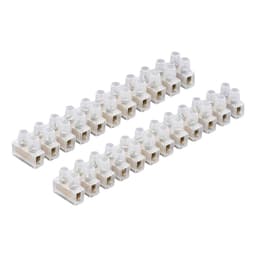
Terminal block for lighting

Updated: October 2026

You are replacing the connector on a light that is already there, in a bedroom or a living room, not beside a bath or a shower. A terminal block for lighting in that situation is a small screw strip or a lever with a mark you can read, inside the rose or a box. It is not a new circuit. The buying order sits on the [terminal block buying guide](/hub/diy-supplies/terminal-block/sub/terminal-block-buying-guide). The twelve listings are on the [terminal block comparison](/hub/diy-supplies/terminal-block). Prove the circuit is dead before you open the rose. Peter F. checked the listings on 16 October 2026. Links to amazon.co.uk are affiliate links.

You are replacing the connector on a light that is already there, in a bedroom or a living room, not beside a bath or a shower.

Our top picks

On this page

An existing light is a smaller job than a new circuit

In England, Approved Document P (2013) sets out regulation 12(6A). Notifiable work is a new circuit, replacing a consumer unit, or an alteration around a bath or shower, or in a room with a pool or sauna heater. Other repairs are not notifiable. The IET’s Part P FAQ gives replacing a light fitting as minor work that is not notifiable. Kitchens and outdoors left that notification list in 2013. This England document is not the law in Scotland, Wales or Northern Ireland. Not notifiable does not mean outside Part P. The work still has to be safe. A pendant sheet that mentions 10 A, or a WAGO 221-413, is that fitting’s instruction, not a rating of these listings. A trade guide that pairs a 3 A strip with 1.0 mm² is that retailer’s rule of thumb. These listings do not print 1.0 mm².

Read the amp cell, not the lighting story in the title

The small end of this set is the SDFIXINGS listing whose current cell says 3 A, at about £3.86. The shared bullets also list 3 A through 60 A, and a spring clamp the connector cell does not support. The 3 A cell is the lighting figure. The 60 A bullet is not. The sibling cell says 5 A, at about £3.92, on the same image and part number. GTSE’s pack includes two 15 A strips and two 3 A strips, and the cell names only 15 A. You can pick up the 3 A piece from the same bag without noticing. A 30 A cell is not the lighting pick. XINXINGDINGSHENG prints 30 A at about £3.19, and UK reviews say the brass splits. Funver prints 30 A and has no reviews. A common UK socket ring at 32 A is a rule of thumb, not this job.

What UK reviewers in this set actually fitted

GTSE’s UK texts include a ceiling light and wall lamps, in 1,304 reviews at 4.6. Separate the 3 A strips from the 15 A strips before you decide which piece is for the light. ZFYQ’s six UK texts mention ceiling lights and a ceiling fan, with a printed range of 0.08–2.5 mm² solid or stranded and 0.08–4 mm² flexible, at 250 V, and no current cell. flintronic’s texts mention lights and levers that snap unless you tug the wire. Blackspur mentions wall lights and holes that were too small, so about £3.60 is not a reason to use it in the rose. HSEAMALL is mostly a model-railway bus. Where permanent live, neutral, switched live and earth land is the rose’s terminals, not a diagram on this page. Cutting is on the how to use a terminal block page, and the lever choice is on the terminal block versus lever connector page.

Bathroom, outdoors, and when you stop

A light around a bath or shower, or in a room with a pool or sauna heater, is notifiable in England and belongs with a registered electrician. Outdoors is not supported either: no listing prints an IP rating. Approved Document P 2013 dropped outdoors from the notification list, which is not the same as a rating for rain. Stop if you cannot prove the circuit is dead, if the cable is scorched, or if you are adding a circuit rather than replacing a connector. Stop if the only strip to hand is a 30 A title with split brass in the reviews. A non-notifiable repair in a bedroom still has to be safe.

Common questions

What terminal block is for an existing ceiling light?
On an existing light outside a bathroom zone, use a small marked current inside the rose or a box. The SDFIXINGS cell that says 3 A, at about £3.86, is the small end if you ignore the bullet that runs to 60 A. ZFYQ is the lever when the rose is tight, with a printed millimetre range and no current cell. A 30 A cell is not the lighting pick.
Is a 3 A strip enough for a lighting circuit?
A 3 A cell is the small lighting end of these listings, not a ring final. A trade guide’s 1.0 mm² pairing is not printed on the SDFIXINGS page, so do not attach it. A socket ring at 32 A is a different circuit and a rule of thumb, not a reason to fit a 3 A strip there.
Is replacing a connector in a bedroom light notifiable in England?
Replacing a connector on an existing bedroom or living-room light is the non-notifiable case here, following Approved Document P (2013) and the IET FAQ’s example of replacing a light fitting. It still has to be safe, and you still prove the circuit dead. A new circuit or a consumer unit is notifiable. This England list is not the law in Scotland, Wales or Northern Ireland.
What changes if the light is in a bathroom?
The room becomes a special location. In England, altering a circuit around a bath or shower is notifiable, and so is work in a room with a pool or sauna heater. That is an electrician’s job. Work that is not notifiable elsewhere is still inside Part P. It is simply not on the notification list.
When do you call an electrician instead of buying a strip?
Call an electrician for a new circuit, a consumer unit, a bath or shower zone, a room with a pool or sauna heater, scorched cable, or a circuit you cannot prove dead. Also stop if you cannot land permanent live, neutral, switched live and earth with confidence. Buying a 3 A strip does not turn those jobs into a shop decision.

Related pages

Sources

Public UK sources on electrical safety and household connecting devices. Listings checked 16 October 2026. Prices on amazon.co.uk move.

  1. Approved Document P (2013) (retrieved 16 October 2026)
  2. Building Regulations 2010, Schedule 1, Part P (retrieved 16 October 2026)
  3. Planning Portal, electrics and building regulations (retrieved 16 October 2026)
  4. HSE, electrical equipment (retrieved 16 October 2026)
  5. BS EN 60998-1, household connecting devices (retrieved 16 October 2026)
  6. BS EN 60998-2-1, screw-type clamping units (retrieved 16 October 2026)
  7. GOV.UK, UKCA and CE marking in Great Britain (retrieved 16 October 2026)
  8. IET, BS 7671 18th Edition (retrieved 16 October 2026)