How to use a tap and die set
The hole in front of you is about to become an M6 thread, and the obvious drill is 6 mm. That drill is too big. The tap will leave a shallow ripple, and the bolt will strip. This page is the hand sequence for a metric set: drill size, a square start, lubricant, and the moment you stop. The twelve kits are on our [tap and die set comparison](/hub/diy-supplies/tap-and-die-set) if you do not own one yet. Stainless practice is on the [tap and die set for stainless steel](/hub/diy-supplies/tap-and-die-set/sub/tap-and-die-set-stainless-steel) page, and form identification is on the [metric or Whitworth](/hub/diy-supplies/tap-and-die-set/sub/tap-and-die-set-metric-or-whitworth) page. Peter F. followed UK charts and a hand-tap sheet, not a laboratory trial. The listing capture is 15 October 2026.
The hole in front of you is about to become an M6 thread, and the obvious drill is 6 mm. That drill is too big. The tap will leave a shallow ripple, and the bolt will strip.
The hole in front of you is about to become an M6 thread, and the obvious drill is 6 mm. That drill is too big. The tap will leave a shallow ripple, and the bolt will strip. This page is the hand sequence for a metric set: drill size, a square start, lubricant, and the moment you stop. The twelve kits are on our tap and die set comparison if you do not own one yet. Stainless practice is on the tap and die set for stainless steel page, and form identification is on the metric or Whitworth page. Peter F. followed UK charts and a hand-tap sheet, not a laboratory trial. The listing capture is 15 October 2026.
Our top picks
| Badge | Product | Taps per size | Dies | What you start with | Note | Price | Offer |
|---|---|---|---|---|---|---|---|
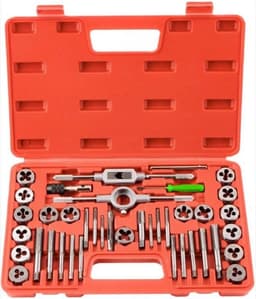
| Best overall |  Mannesmann Mannesmann 32-piece M3–M12 | Three | Solid, not split | Taper, then second, then plug | 8.4 | about £18.92 | View offer |
| Alternative |  Gunpla Gunpla 40-piece OT569 | One per pitch | Coarse and fine pairs | Match the pitch first | 7.9 | about £25.60 | View offer |
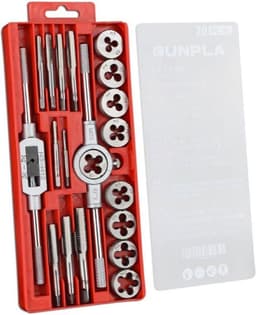
| Preis-Tipp |  Gunpla Gunpla 20-piece M3–M12 | One | One per coarse size | The single tap only | 7.7 | about £16.98 | View offer |

On this page
Drill the tapping size, not the bolt size
Start with the taper and keep it square
Run the die from the chamfered side
When to stop and call someone else
Common questions
What drill do I use for M6, M8 and M10?
Which tap do I start with?
How far do I turn before I back off?
Which way does the die face?
What fluid should I use?
Can I run the tap in a cordless drill?
What if the tap suddenly goes tight?
Related pages
Sources
Public UK sources on thread form, tapping drills, work equipment and satisfactory quality. Listing prices and star counts are from the amazon.co.uk extracts dated 15 October 2026. Prices move.
- HSE, PUWER overview (retrieved 15 October 2026)
- HSE, using the right type of PPE (retrieved 15 October 2026)
- HSE EIS16, gloves and drilling machines (retrieved 15 October 2026)
- Consumer Rights Act 2015, section 9 (retrieved 15 October 2026)
- RoyMech, screw threads and BS 3643 (retrieved 15 October 2026)
- FWB, tapping and thread dimensions (retrieved 15 October 2026)
- Optimas, tapping sizes (retrieved 15 October 2026)
- Protool, thread forms (retrieved 15 October 2026)