Independent comparisons. We may earn from shop links. More info

How to fit a rubble chute safely

Updated: 23 October 2026

You have a skip in place and rubble upstairs, but the chute between them is only safe if its support, joints and landing are properly controlled. How to fit a rubble chute starts with the system you own. Rigid plastic sections hung on chains or wire ropes need a different arrangement from a flexible textile tube secured with straps. If you are still choosing, begin with the [rubble slide comparison](/hub/diy-supplies/rubble-slide). Peter F. checked this sequence against the public UK guides cited below. This desk did not hang a chute. A qualifying purchase can earn a commission at no extra cost to you.

You have a skip in place and rubble upstairs, but the chute between them is only safe if its support, joints and landing are properly controlled. How to fit a rubble chute starts with the system you own.

Our top picks

On this page

Before any section is hung

Confirm that the anchor was designed to carry the loaded chute, not only its empty weight. Lodged rubble can increase the load abruptly. If you cannot establish that capacity, do not improvise with a window frame, a handrail or a convenient scaffold tube. Ask the scaffold designer or another competent person. Secure the receiving area before anyone loads the top. The outlet has to land inside the skip, and barriers have to keep people out. Barrier netting does not make falling material harmless. Agree who controls the top and the bottom. Where the skip may stand is covered in using a rubble slide from a window to a skip.

Fitting rigid plastic sections

Establish the top support first. A scaffold job may use a purpose-made frame with the tubes and couplings the supplier specifies. At a window, a spreader bar transfers the load across the opening rather than onto an unsuitable sill. Connect the hopper or top section with the supplied chains or wire ropes, then add sections in the maker's order. One PSM Hire guide specifies chains for its 20-inch system and wire ropes for its 22-inch and 30-inch systems. Keep each connection on both sides and lower the run in a controlled way. Tie it back at the interval that guide prints for that system. Those intervals are not interchangeable. Before loading, check every joint and keep the outlet inside the fenced container. The plastic or flexible rubble slide guide explains why a textile tube is not hung this way.

Hanging a flexible rubble tube

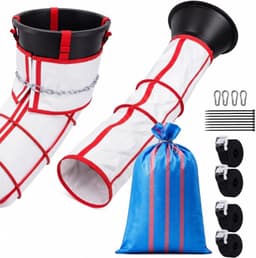
A flexible textile tube hangs from its own straps on a sound anchor, following that maker's instructions. Stortslurf recommends a loading funnel, a solid anchorage and a tube as vertical as the opening allows. That advice does not let you replace the chains, wire ropes or frame of a rigid plastic system. Place the funnel so you are not leaning through the opening or standing under the hang. Avoid a sharp bend that lets rubble bridge, and secure each strap as supplied. The lower end has to discharge inside the container, at the clearance your own manual states. Inspect the fabric, seams, straps and the anchor before the first load. If the listing does not name the fittings, use the rubble slide buying guide and get the missing instructions before you hang it.

When you should stop

Stop if the chute blocks, a tie loosens, a section separates, the outlet leaves the container or the support moves. Stop loading and keep the exclusion zone closed. A blockage is cleared only after the chute is secured, and only by a competent person. Do not climb the run or strike it from beneath. Stop as well if the anchor was never designed for a chute, or if a new route would alter a scaffold. A chute is a better control than throwing ordinary rubble from a roof. Asbestos-cement sheets are lowered whole, under the asbestos guidance, not broken into the tube.

Common questions

Do I fence the skip before the first load?
Yes. Secure the receiving area before anyone puts material into the chute, because rubble can leave the outlet with force or miss the intended pile. Barriers should prevent access to the discharge zone, and the person loading above should know when work below is taking place. Netting is not a substitute for controlling entry.
What is the spreader bar for?
A spreader bar provides a designed suspension point across a suitable opening and distributes the chute load through its supports. It should be the component and arrangement specified for the chute, not an improvised pole resting on a uPVC frame. If the opening or surrounding structure has not been assessed for the load, do not hang the run from it.
How often should a plastic chute be tied back?
Use the interval in the instructions for your exact system. SafeSite publishes every 5 m or every fifth section for its arrangement, while another supplier specifies an additional frame every 10 m for a different system. Do not select the larger interval because it is more convenient. The two figures are not interchangeable rules.
Can I fit a canvas chute like a chain-hung plastic one?
No. A flexible tube normally uses the straps, funnel and solid anchorage specified by its maker, whereas rigid sections may hang from chains or wire ropes attached to a frame or spreader. Follow one complete set of product instructions. Combining an advertised textile method with rigid sections leaves the support and connections unverified.
How close should the outlet be to the skip?
The outlet should remain inside the container and close enough to contain the falling rubble without obstructing discharge. The precise clearance is product-specific. One flexible-chute maker states about 50 cm above the container, and that does not set the distance for every plastic or textile system. Follow your supplier's manual and watch the rising waste pile.
What should I do if rubble bridges inside the chute?
Stop loading, isolate the top and keep everyone outside the receiving area. Do not climb the chute, reach into it or stand below while trying to shake material free. The run must first be secured, after which a competent person can apply the supplier's blockage procedure and inspect the chute and supports before use resumes.
Does a chute make throwing material from a roof acceptable?
No. A chute provides a controlled route into a secured receiving area. It does not permit material to be thrown from a roof, scaffold or loft where someone could be injured. UK work-at-height duties require employers to prevent dangerous throwing or tipping. Even on a domestic job, use the same practical controls and lower unsuitable items separately.

Related pages

Sources

Public UK sources and the amazon.co.uk listings compared on this page. Shelf prices are the raw-file figures in the research digest, not a live re-check. Updated 23 October 2026.

  1. Work at Height Regulations 2005, regulation 10 (retrieved 23 October 2026)
  2. HSE CIS81, chute to the skip (retrieved 23 October 2026)
  3. HSE HSG33, health and safety in roof work (retrieved 23 October 2026)
  4. GOV.UK, apply for a skip permit (retrieved 23 October 2026)
  5. GOV.UK, dispose of household waste (retrieved 23 October 2026)
  6. SafeSite rubbish chute installation guide (retrieved 23 October 2026)
  7. Scaffolding Direct, 20 inch rubbish chute section (retrieved 23 October 2026)
  8. Stortslurf UK, flexible rubble chute 50 cm (retrieved 23 October 2026)