Independent comparisons. We may earn from shop links. More info

How to choose a bottle gully

Updated: 23 October 2026

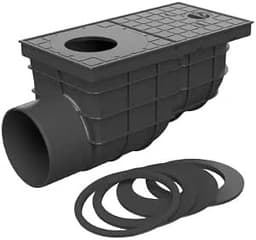
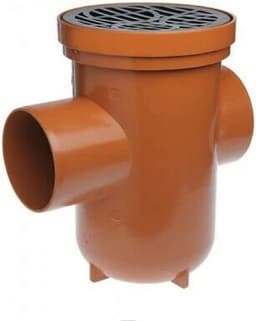
You have a downpipe on the wall and an open hole in the patio, and the basket photos all look like the same black pot. How to choose a bottle gully starts with the pipe and the way water enters, not with the lowest price. The [rain gully comparison](/hub/diy-supplies/rain-gully) keeps four amazon.co.uk listings: a single-inlet pot at £12.47, a back-inlet pot at £12.99, a low horizontal body at £33.44, and a DN70 roof outlet at £43.36. Prices are those saved figures, in pounds, and they move. A qualifying purchase can earn a commission at no extra cost to you. Listings, saved review notes and public UK guidance only. This is not a lab test. Updated 22 October 2026.

You have a downpipe on the wall and an open hole in the patio, and the basket photos all look like the same black pot.

Our top picks

On this page

Outlet, then inlet

110 mm is the underground pipe, not the grid. Both UK Plastics pots are plain ended, so the socket sits on the pipe or a coupler. A DN70 spigot is a roof outlet and does not push into 110 mm pipe. A shoe above the paving needs an open grid. A downpipe tight to the wall needs a back inlet: FloPlast says pull a plug rather than drill the pot, and Brett Martin describes a shoe into the gully or an adaptor into a back inlet. That split is on bottle gully vs back inlet. The horizontal body is for a shallow invert, not a different inlet. A balcony or flat roof belongs on the flat roof gully page.

Trap, grid and load

A foul connection needs a trap. A separate surface-water gully is not always required to hold a seal, though a dry pot smells. Approved Document H wants at least 25 mm of water seal in sanitary pipework. None of these listings prints that depth. The £33.44 gully describes a dry flap, not a measured seal. Only the back inlet prints a grid, 180 mm. The single inlet does not print a diameter. None names a BS EN 124 class. K3 and 300 kg is the seller’s light-duty line, not a car path. Both UK Plastics titles say you can rod them. The horizontal listing does not.

What these four listings do not say

BS 4660 covers ground-level gullies in 110 mm and 160 mm, and BS EN 1401-1 covers PVC-U pipe. FloPlast prints those references on its underground range. The two UK Plastics titles do not. Silence is not a kitemark. The £12.47 file is 4.4 from 48 amazon.co.uk reviews, and the saved UK texts do not agree on the diameters. The back-inlet file is 4.3 from 17. The roof listing’s 4.5 from 23 is the highest star line, and the review texts saved with it are from Germany, Belgium and France. Sorting by stars buys a roof outlet for a patio.

Where the water may go

In England, Approved Document H sends rainwater to infiltration, then a watercourse, then a sewer, unless you store it, and keeps it off the foul sewer where a separate surface-water sewer is available. Scotland’s Technical Handbook 3.6 starts soakaways at 5 metres from the building and the boundary. Do not use the English order there. Wales has its own Approved Document H. Stop for a new public sewer, a chamber you would enter, or a top that cannot sit 150 mm below the damp-proof course. That 150 mm figure is a merchant note.

Common questions

Is 110 mm the grid or the pipe?
110 mm is the underground outlet on the two UK Plastics pots and on the horizontal body. It is not the grid. Only the back-inlet listing prints a grid size, and that size is 180 mm. The single-inlet listing includes a circular grid and does not say how wide it is. A DN70 roof outlet is a different diameter, and it is not a substitute for 110 mm pipe in the ground.
Do I need a trap if the drain is surface water only?
A connection into a foul drain needs a trap. A gully on a separate surface-water system is not always required to be trapped, though an untrapped pot is a common source of smell. Approved Document H’s 25 mm figure belongs to sanitary pipework, and none of these listings prints a seal depth. The horizontal gully describes a dry flap instead. If the run might be foul, ask before you bury an open pot.
What if the title does not name a British Standard?
Then you do not have a claim to quote. BS 4660 covers ground-level gullies at 110 mm and 160 mm, and BS EN 1401-1 covers PVC-U pipe. FloPlast states those on its own range. The UK Plastics titles here do not. You can still buy them if the diameters match the pipe you have. You cannot tell a building inspector the page proved a standard it never named.
What load can these plastic grids take?
None of the four prints a BS EN 124 vehicle class. The only load line is the horizontal gully’s K3 and 300 kg, which is the seller’s light-duty sentence. It is not permission to drive across the cover. Keep cars and vans off these grids. Foot traffic in a yard is the use the listings describe.
Why might a cheap gully be returned for the diameter?
On the £12.47 single-inlet gully, one saved UK text said the inside and outside diameters were way off and the buyer returned it. Another said the item was dimensionally correct. Dry-fit the plain end on your 110 mm pipe before you mix concrete. The return is not a reason to treat every one of the 48 reviews as a pass or a fail.
Does plain ended mean I need a coupler?
Yes, unless the pipe you already own presents the socket. Both UK Plastics gullies are plain ended at 110 mm. The joint is a coupler or a socket on the pipe, not a shove fit. The horizontal listing includes sealing rings stated for 80, 90, 100, 110 and 125 mm. The £12.47 pot does not say that it does.

Related pages

Sources

Public UK sources and the amazon.co.uk listings compared on this page. Scoring method dated 22 October 2026. Updated 23 October 2026.

  1. Approved Document H (England), 2015 (retrieved 22 October 2026)
  2. Scottish Technical Handbook 3.6 (retrieved 22 October 2026)
  3. FloPlast underground drainage (retrieved 22 October 2026)
  4. FloPlast underground drainage FAQs (retrieved 22 October 2026)
  5. Harmer roof brochure (retrieved 22 October 2026)
  6. Northern Ireland roof drainage (retrieved 22 October 2026)
  7. Brett Martin rainwater FAQ (retrieved 22 October 2026)
  8. NHBC Standards 2025, chapter 5.3 (retrieved 22 October 2026)