Independent comparisons. We may earn from shop links. More info

Cutting paste vs cutting oil spray when the can has already run off

Updated: 23 October 2026

You aimed a spray at a vertical hole, the bit squealed, and the vice is wet while the cutting edge is dry. Cutting paste vs cutting oil spray is that choice: a film that stays in the flute, or a can that is quick and then moves. Snapshot prices are in GBP, and we did not adopt a catalogue claim that any paste multiplies drill life. A qualifying purchase can earn a commission at no extra cost to you. The product table is the [drilling and cutting oil comparison](/hub/diy-supplies/drilling-and-cutting-oil). This page only asks what is still on the edge while the tool cuts.

You aimed a spray at a vertical hole, the bit squealed, and the vice is wet while the cutting edge is dry.

Our top picks

On this page

When the spray left the hole dry

Thin oil and a wide spray leave a vertical or overhead edge. The fluid lands on the bench, and the lip of the drill meets bare metal. On a horizontal hole you can sometimes get away with a squirt, because the fluid sits in the countersink for a moment. Turn the same hole to the vertical, or work overhead on a gate, and the moment is gone before the bit has cut a millimetre. Health and Safety Executive guidance says to put fluid where the tool meets the workpiece. A spray that coats the bench still misses the cut. If you are about to buy your first tin, start from the hole you actually have. The cutting oil buying guide keeps the wider order, including metal and pack size. Here the failure is only delivery.

Paste and wax stay in the flute

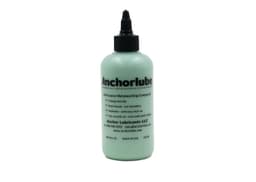
Cling, in this set, is the water-based pastes and the wax. Anchorlube 8 oz, part 3010, is about £18.75 with 4.8 from 579 reviews. Reviews say a dab stays on the bit. You wipe it off steel, because a review reports light rust if water-based paste is left. Part 3116 at about £27.99 is the larger jar. Part 3011 at about £28.12 is the dearer 8 oz bottle when you wanted the longer metal list, not cling alone. Lubri-Cut is the wax, 10 oz at about £36.44, 4.8 from 303 reviews, made in the United States. Reviews say it stays in the flutes and is stiffer than a soft grease, including in a warm room. A chlorine-free bullet is a claim about this paste, not about every UK cutting oil. The how to use cutting fluid page is the dab and the wipe.

Foam and a thin spray are fast, then they move

The OB41 twin pack is two 400 ml tins at about £13.72, 4.7 from 94 reviews. Reviews say the foam clings on a horizontal edge, then dissipates and drips, and that the jet is not directional. Choose it when a drip is acceptable. Skip it when a vertical or overhead hole has to keep a film after the foam collapses. ECO SERVICE, 400 ml at about £6.43, has no star line and recommends aluminium cutting. How that spray stays is not stated. The listing at about £11.37 disagrees with itself: 500 ml in the title, Action Can CT-90 400 ml in a bullet, and 7.53 kg in the weight field. Do not call that row the non-drip compound. An aerosol’s flammability class follows the Aerosol Dispensers Regulations 2009, not the flash point on a neat-oil can.

Which delivery matches the hole

Use paste or wax when the hole is vertical, overhead, or a hand tap that must keep a film in the flute. Use the OB41 foam on a general steel hole when a later drip is acceptable. Use a brushed neat oil when a pillar drill or bandsaw will finish 5 litres. SIP at about £51.95 runs if you only pour it, so the brush is the delivery. Sealey’s 500 ml at about £12.60 claims high viscosity with no grade, so cling is unproven. A Tap Magic spout is not a flute that holds paste. If the edge will shed liquid before the cut finishes, buy cling. Soluble sump coolant is not these pastes, and you do not add water to a neat oil to imitate one.

Common questions

Why did the spray leave the bit dry?
Thin fluid runs off a vertical or overhead edge, and a wide jet lands on the bench instead of the lips of the bit. Reviews of the OB41 foam say it clings and then drips, and that the jet is not directional. The cutting edge is then dry while the vice is wet. Paste or wax is the form sold to stay in the flute when that happens. Aiming more spray at the bench does not put the film back on the edge.
When is a paste or a wax the better delivery?
Choose paste or wax when the hole is vertical or overhead, or when a hand tap has to keep a film in the flute for the whole thread. In this set that is the Anchorlube pastes or Lubri-Cut wax. You still wipe water-based paste off steel, because a review reports light rust if it is left. Wax is the stiffer, dearer tub, at about £36.44 for 10 oz in this snapshot, and it is made in the United States.
Does a foam stay, or does it only look like it stays?
On the OB41 twin pack, reviews say the foam holds on a horizontal edge and then dissipates and drips. It looks like cling at the start of the hole. It is not a film that remains after the foam collapses, which is why a vertical hole is the skip. That description is from buyer comments, not a timed laboratory test of how long the foam lasts.
Is a non-drip compound the same ASIN as the spray in the table?
No. The spray in this comparison conflicts inside its own listing and is not the non-drip compound. The non-drip CT-90 compound is ASIN B005EF7W0C, which is not in this table. An earlier look had seen it near £8.98, and one offer on 21 October 2026 showed £17.99. Do not merge those prices or those ASINs into the spray row.
Does this choice change for a sump or for stainless feed?
Yes. A sump needs a fluid the machine is meant to pump. These pastes are not that fluid, and you do not add water to a neat oil to create one. Stainless feed, dwell and work hardening are a cutting habit, not a choice between a tub and a can. Use the stainless page for that habit once the film is the kind that stays on the edge.

Related pages

Sources

Public UK sources and the amazon.co.uk listings compared on this page. Updated 22 October 2026.

  1. HSE: About metalworking fluids (retrieved October 2026)
  2. HSE: MW series index (retrieved October 2026)
  3. HSE: MW2 skin (retrieved October 2026)
  4. HSE: GB CLP (retrieved October 2026)
  5. Aerosol Dispensers Regulations 2009, Schedule 1A (retrieved October 2026)
  6. GOV.UK: Aerosol Dispensers Regulations 2009 (retrieved October 2026)
  7. MSC UK: Neat cutting oils (retrieved October 2026)
  8. Oil Store: What is cutting fluid? (retrieved October 2026)