Independent comparisons. We may earn from shop links. More info

How to use a drain blaster

Updated: 23 October 2026

The gun or the red pump is in your hand, and the sink has been slow since breakfast. This is how to use a drain blaster on a household waste: what you check before the first charge, how small that charge should be, and when you stop. The first full shot is the one that misses the seal, soaks the floor, or shoves a push-fit joint. A cleaner already in the pipe is a stop, not a step. This uses public UK guidance and the saved amazon.co.uk listings, not a lab. A qualifying purchase can earn a commission at no extra cost to you. The tools are on the [drain blaster comparison](/hub/diy-supplies/drain-blaster).

The gun or the red pump is in your hand, and the sink has been slow since breakfast.

Our top picks

On this page

Check the pipe and the rest of the house first

Look under the basin before you pump. A weeping push-fit joint, a cracked trap, or a waste you cannot see is not a candidate for a stored charge. If you cannot see the joint, do not begin at the top of the pump count. A single slow sink is a household waste. Two rooms backing up, or sewage at a ground-floor gulley, can be a shared drain. Thames Water asks you to report a problem affecting more than one home. Wear gloves and eye protection.

Seal, then a small charge

Block the overflow with a damp cloth or tape so the shot does not vent back through the slot. Remove the plug. Choose the adaptor that sits flat. Press the head down, then pump. Silverline's manual, for a gun that is not an ASIN here, says four pumps on plastic or fragile systems, and not to use the tool with any chemical. Treat that as a ceiling on push-fit plastic. Wonkee Donkee uses about 3 to 8 pumps. A listing that says 12 to 15 or 10 to 20 pumps is that box's instruction. A UK review of the JJX says a high first release can force sink joints apart. Follow the card if you have one, keep the cup seated, pour a jug, and watch.

A force pump and a dual-cup are stroked, not fired

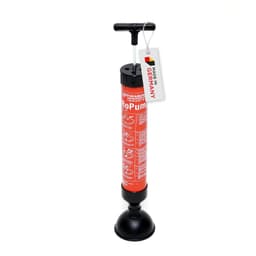
The Rothenberger RoPump 71991 has no trigger and no stored cylinder. You seat the bell and stroke. UK reviews describe a slow sink moving in a couple of pumps, and a bell of about 95 mm that missed a recessed kitchen waste. The listing states 50 psi. Do not copy a 4 bar line from a different Rothenberger cleaner onto this pump. The XREXS is stroked as well. Fit the 6.3 cm cup on a sink or bath, or the 15 cm cup on a toilet, and lean so the cup seals. There is no pressure figure to chase. If the water sits, the blockage has not moved. If water appears at another fitting, stop.

Stop

Stop when air leaks, when the seal misses and water splashes, when a second fitting runs slow, or when sewage appears where it should not. Stop if cleaner is already in the pipe. A blast can throw that liquid back at you. Pan shape and a full bowl stay on the toilet drain blaster page. A gun that will not hold pressure from new is a faulty tool. You have 30 days under the Consumer Rights Act 2015 to reject it. Call someone when more than one home is affected, the trap will not come apart, the waste blocks again within days, or cleaner is already in the pipe. Air will not clear cement, a collapsed pipe, or a mass of wipes.

Common questions

How many times do I pump?
Use the card in that box. If the pipe is plastic and the card is missing, the Silverline pattern for a different gun is a ceiling: to resistance, then about four strokes. Do not treat 12 to 15 or 10 to 20 on XMPEKO, LSDZHK, or HzNzYHD as a higher safe limit. Those numbers are listing instructions. Wonkee Donkee stays around 3 to 8 pumps.
Do I cover the overflow?
Yes on a basin, bath, or sink that has one. A damp cloth or tape stops the shot venting back through the slot. Press the cup down while you do it. A WC has no overflow to block. If you cannot seal both the waste and the overflow, do not add pumps to compensate.
Can I use it if I already poured drain cleaner?
No. Do not plunge and do not blast into a pipe that already holds a corrosive cleaner. The shot can throw that liquid back, and a liquid drain solvent can already be heating the water in a closed drain. Leave this sequence until the pipe is free of cleaner.
What if the gun will not hold pressure?
Stop using it. A leak at the joints, a handle that will not compress, or a charge that dies before the trigger means the tool is not doing the job the listing described. UK reviews of 1ABOVE and of the XMPEKO describe that. You have 30 days under the Consumer Rights Act 2015 to reject goods that are not of satisfactory quality.
How do I know the blockage has moved?
Pour a jug and watch the level. Moving water, and a joint that stays dry, is the sign. A firm stroke with a bowl that still sits full is not a clear. If the sink slows again the same day, one more modest charge is reasonable. A return within days is the point where you stop and call someone.
When do I stop and call someone?
Stop if another fitting is affected, if sewage is where it should not be, if the seal will not hold, or if you have already used a chemical. Stop if the blockage returns within days. Air will not clear cement, a collapsed pipe, or a stack of wipes. Thames Water's warning that a blocked pipe at home can cost more than £200 is not a price to beat with extra pumps.

Related pages

Sources

Public UK sources and the amazon.co.uk listings compared on this page. Listings captured 21 October 2026. Updated 22.10.2026.

  1. Wonkee Donkee: how a power plunger works (retrieved 22.10.2026)
  2. Silverline drain blaster manual (retrieved 22.10.2026)
  3. Approved Document H, drainage and waste disposal (retrieved 22.10.2026)
  4. Thames Water: blockages (retrieved 22.10.2026)
  5. GOV.UK: sodium hydroxide (retrieved 22.10.2026)
  6. NHS Wales: safe use of liquid drain cleaners (retrieved 22.10.2026)
  7. Citizens Advice: who repairs drains and sewers (retrieved 22.10.2026)
  8. Consumer Rights Act 2015, section 22 (retrieved 22.10.2026)