Independent comparisons. We may earn from shop links. More info

Deep hole marker through brackets

Updated: 23 October 2026

The bracket, the hinge, or the back box is already the template. You need a dot or a short line on the surface behind its hole, and the nose has to pass that hole. A deep hole marker only helps when the opening is wide enough and the fitting is not deeper than the nib. This page stays on that job. The listings are in the [deep hole marker comparison](/hub/diy-supplies/deep-hole-marker). A qualifying purchase can earn us a commission at no extra cost to you. Hold the fitting where it will be fixed, then ask two questions. Will the tip enter the hole? Is the stated reach at least the depth of that fitting?

The bracket, the hinge, or the back box is already the template. You need a dot or a short line on the surface behind its hole, and the nose has to pass that hole.

Our top picks

On this page

The fitting is the template

Mark through the hole with the bracket, hinge, or box held in its final place. If you mark the wall first and then offer the fitting up, the dot and the hole drift apart. UK back-box guides say the same for an ordinary pen: hold the box level, mark through the fixing holes, then drill. A deep hole marker is what you use when a stub pencil will not. It still does not choose where the fitting should sit. The limits are the width of the hole and the depth of the fitting. A nose wider than the opening is a stop, even if the packet says 145 mm. A nib shorter than the fitting is a stop. There is no typical hinge thickness in these sources, so measure the leaf and the hole. The chalk-versus-pencil choice is on chalk marker or deep hole pencil. On a finished wall behind a shelf, use chalk you can wipe, not permanent ink.

Width of the hole, then depth

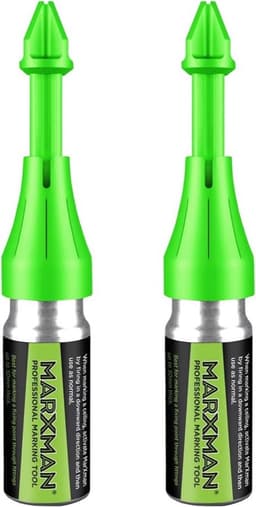
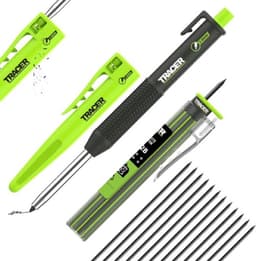
Tracer's pencil rule is 100 mm deep in a 3 mm hole and 145 mm deep in a 6 mm hole. Tighter than 3 mm, the longer figure does not apply, because the lead is 2.8 mm. The Pencil 2.0 states that pair. The Nicpro nose is 45 mm, not a 145 mm pencil. The aluminium Pro is 3.8 from 551 reviews, and the lead will not stay out. The Bentley twin pack states up to 50 mm. The single Marxman listing does not. Trueshot states 100 mm, and Screwfix prints a 5 mm tip, so the hole has to accept that tip. Do not heat that can above 50 °C or pierce it. YLYDMY's 20 mm head misses a deep bracket. The 30 mm packs are still short of that fitting, and one 45 mm title also lists 20/30/45 mm.

Brackets, hinges, and back boxes

A shelf bracket on a finished wall is usually one chalk press, then a wipe. Felt can stain wallpaper, so it is the wrong default. If the hole is about 3 mm or 6 mm and you need a line, use the Pencil 2.0 pair. If the nose will not enter, stop. Measure a hinge leaf. These sources give no standard thickness. Ultimate Handyman's wiring how-to uses about 16 mm for a light switch and about 47 mm for a heavier circuit. Those figures are not a British Standard and not a reason to open a socket. About 16 mm sits inside a 20 mm nib and inside 45–50 mm chalk. About 47 mm is beyond a 20 mm nib and at the edge of a 45 mm nose. Trueshot's 100 mm claim covers that depth only if the 5 mm tip fits. The sequence is on how to use a deep hole marker.

What the marker will not do

It will not find cables or pipes. If the wall may hide services and you cannot prove a safe drill path, stop. The same stop applies at height without a proper platform. A chalk dot is the wrong instrument for setting out a structural fixing. The marker only transfers the hole you already have.

Common questions

Will this marker fit through a bracket hole?
Only if the nose is narrower than the hole. A Tracer pencil's 145 mm figure needs a 6 mm hole, and the 100 mm figure needs a 3 mm hole. Trueshot's Screwfix page prints a 5 mm tip for a 100 mm chalk reach. A hole tighter than the nose is a stop, whatever the packet says.
Is a 20 mm felt nib enough for a shelf bracket?
Not for a deep bracket. YLYDMY states 20 mm. That can mark a shallow opening. A fitting around 45–50 mm needs the chalk class that states that depth, or a longer nose, and a 20 mm pen will not get there. Felt is also permanent, so it is a poor default on wallpaper.
What changes between a 16 mm box and a 47 mm box?
Those depths are examples from a UK wiring how-to, not a regulation. About 16 mm is inside a 20 mm nib and inside 45–50 mm chalk. About 47 mm is beyond a 20 mm nib and at the edge of a 45 mm nose. The tip still has to fit the fixing hole.
Should the mark on a finished wall be chalk or ink?
Chalk, if you intend to wipe it. Permanent felt ink can stain wallpaper and décor, which is the mistake behind a shelf. A pencil line belongs on timber you are scribing. Graphite is not a substitute for a chalk dot at the back of a deep metal hole.
Does a 145 mm pencil help if the bracket hole is under 3 mm?
No. The 145 mm figure is paired with a 6 mm hole, and 100 mm with a 3 mm hole. Under 3 mm, that pencil's lead does not get the stated reach. Do not force a 2.8 mm lead into a tighter slot.
Can I use the marker to find cables before I drill?
No. It marks the surface behind a hole you can already see. It does not locate cables or pipes. If you cannot prove a safe drill path, or the work is at height without a proper platform, stop. A structural fixing is not set out with a chalk dot either.

Related pages

Sources

Public UK sources and the amazon.co.uk listings compared on this page. Updated 22.10.2026.

  1. Tracer deep hole pencil (retrieved October 2026)
  2. Tracer Pro kit (retrieved October 2026)
  3. Tracer Trueshot (retrieved October 2026)
  4. Screwfix Trueshot (retrieved October 2026)
  5. Charles Bentley Marxman (retrieved October 2026)
  6. Selco Marxman (retrieved October 2026)
  7. Consumer Rights Act 2015, section 9 (retrieved October 2026)
  8. General Product Safety Regulations 2005 (retrieved October 2026)
  9. HSE INDG273 solvents (retrieved October 2026)