Independent comparisons. We may earn from shop links. More info

How to use a deep hole marker

Updated: 23 October 2026

The bracket, hinge, or back box is already where it will live, and a normal pencil cannot reach the surface behind the hole. You need the mark on that surface, then a drill in that mark, then a wipe only if you chose chalk. This page is the sequence, not a ranking. If you are still choosing a pen, use the [deep hole marker comparison](/hub/diy-supplies/deep-hole-marker). Prices mentioned below are the amazon.co.uk listings already stored for this set. A qualifying purchase can earn us a commission at no extra cost to you.

The bracket, hinge, or back box is already where it will live, and a normal pencil cannot reach the surface behind the hole.

Our top picks

On this page

Put the fitting in place first

Hold the fitting still, make one mark you can see, and drill that mark. If the nose will not enter the hole, stop and change tool rather than forcing it. Hole width against fitting depth is on marking through fixings. The hole you mark is the hole you will drill, so the fitting has to sit where it will be fixed before any pen goes in. Seat the bracket, the hinge leaf, or the back box, check it is level if the job needs level, and only then put a tip through the opening. A chalk press leaves a green dot. A pencil leaves a short graphite stroke, and you should extend only as much lead as the hole needs. A felt nib leaves permanent ink. The choice between chalk and a pencil is chalk marker or deep hole pencil.

Chalk, lead, or felt

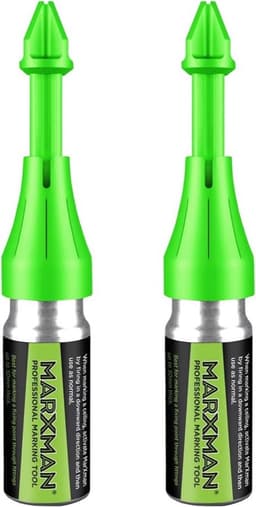
Shake a chalk marker if the spray is intermittent, push the nozzle into the fixing, and press once. One retailer note for ceiling work is to point the pen downwards first, then up. Tracer's site says up to 350 shots for Trueshot and Screwfix says about 250. Neither number is a tested life of this listing. Screwfix also prints H229: do not heat the can above 50 °C, and do not pierce it. Extend only as much 2.8 mm lead as the recess needs. A long stick snaps if you lever it. Tracer's pair is 100 mm in a 3 mm hole and 145 mm in a 6 mm hole. The Nicpro nose is 45 mm. If the lead pushes straight back in, stop. That is the repeated fault on the Tracer Pro, at 3.8 from 551 reviews. Spare leads do not repair a clamp. For felt, nib length is the limit: 20 mm, 30 mm, or 45 mm where a pack states it. The ink is permanent. Cap the pen when you pause. If you cannot see the mark, you do not yet have a drilling point.

After the hole is drilled

Drill the mark you can see, not a guess beside it. Chalk is the mark you then wipe. Toolstation's page for a standard Marxman says the green chalk wipes away without residue on brick, wood, metal, and tile. That is a shop claim for that class of pen. One Bentley review says the dot is UV reactive. Wipe gently. Do not scrub. Graphite may be faint on paint. Do not go over it with a permanent felt pen on a finished wall. If felt ink is already on wallpaper, blot rather than scrub. Solvent pens used all day at work are an HSE INDG273 point, not a shopping step.

When a marker is the wrong tool

A deep hole marker does not locate cables or pipes. If the wall may hide services and you cannot prove a safe drill path, stop. The same stop applies at height without a proper platform. A Marxman that stays silent until you twist the end may only be locked. A Marxman that will not fire after that, or a Pro lead that will not stay out, is a faulty unit, not a technique. Do not drill from a mark you cannot see, and do not heat or pierce a pressurised chalk can to get the last burst.

Common questions

Do I shake a chalk marker before the first hole?
Shake it when the instructions or the reviews say the spray is intermittent. Bentley reviewers say a hard shake is needed, so shake it before you climb. Then press once and look for the dot before you move the fitting. A pen that does nothing may still be locked, not empty.
How far should I stick the pencil lead out?
Only as far as the recess needs. Extending a 2.8 mm lead and then levering it is how leads snap. Tracer's reaches still depend on hole width: 100 mm in a 3 mm hole, or 145 mm in a 6 mm hole. The Nicpro nose stops at 45 mm.
What if the lead pushes straight back in?
Stop using that pencil for the mark. On the Tracer Pro, reviewers report a lead that retracts, will not stay out, or will not feed, at 3.8 from 551 reviews. Spare leads do not fix a clamp that will not hold. If it fails in the first weeks, that is a quality complaint under the Consumer Rights Act 2015, section 9.
Can I wipe the green dot off paint, tile, or wallpaper?
Chalk is sold as removable, and a standard Marxman shop page claims a wipe without residue on brick, wood, metal, and tile. Wallpaper is the weak case. Wipe, do not scrub, and do not assume a UV torch will find nothing afterwards. Permanent felt ink on wallpaper is a different problem and often will not come off.
Does the marker tell me the wall is free of cables?
No. It only puts a dot or a line where the fitting hole already is. It does not scan for cables or pipes. If you cannot show a safe drill path, stop. Height without a proper platform is the same kind of stop.
When should I stop and call a tradesperson?
Stop when services may be in the wall and you cannot prove the drill path, when you are at height without a proper platform, when staff use solvent pens in a closed room with no safety data sheet, or when a chalk dot is standing in for structural setting-out.

Related pages

Sources

Public UK sources and the amazon.co.uk listings compared on this page. Updated 22.10.2026.

  1. Tracer deep hole pencil (retrieved October 2026)
  2. Tracer Pro kit (retrieved October 2026)
  3. Tracer Trueshot (retrieved October 2026)
  4. Screwfix Trueshot (retrieved October 2026)
  5. Charles Bentley Marxman (retrieved October 2026)
  6. Selco Marxman (retrieved October 2026)
  7. Consumer Rights Act 2015, section 9 (retrieved October 2026)
  8. General Product Safety Regulations 2005 (retrieved October 2026)
  9. HSE INDG273 solvents (retrieved October 2026)