Independent comparisons. We may earn from shop links. More info

Windscreen de-icer buying guide

Updated: 23 October 2026

You are choosing a bottle before the first hard frost, and the aisle mixes a morning melt, a night film, a pump and a can. A windscreen de-icer buying guide puts those choices in order so you do not pay for a very low temperature when you needed more liquid, or for an overnight claim when you only scrape at dawn. The twelve amazon.co.uk listings sit on the [de-icer comparison](/hub/diy-supplies/de-icer). Peter F., editor for DIY & tools, used those listings and the saved reviews on 21 October 2026, not a cold-chamber test. A qualifying purchase can earn a commission at no extra cost to you.

You are choosing a bottle before the first hard frost, and the aisle mixes a morning melt, a night film, a pump and a can.

Our top picks

On this page

Start with the job

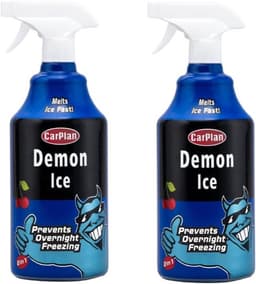
Decide the job before the brand. A morning melt goes on ice already on the glass. An overnight film goes on dry glass, and in this set only CarPlan Demon Ice is sold as both. A 7am street car needs a melt plus a scraper. Rain still washes a night film off. That limit is on the overnight de-icer page. Mirrors, lamps and the number plate still ice up when the front screen is heated. Highway Code rule 229 expects them clear. Do not pour de-icer into the washer, the coolant, or a fridge.

Trigger or aerosol

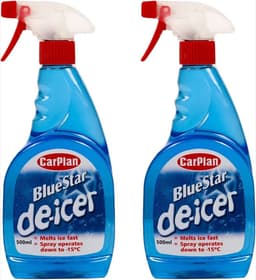
A trigger has no propellant. Blue Star reviewers say the plastic pump stays warmer than the metal can, and that the can empties sooner. An aerosol is the jet for a frozen lock you can reach from outside. The can goes cold, and part of what leaves the nozzle is gas. The trigger or aerosol de-icer page stays on that question. Triggers here include Blue Star, Bluecol, Autoglym DI500 and Demon Ice. Aerosols include the Prestone 600 ml packs, Quebec, Goodyear and the Blue Star six-pack. Prestone prints −40°C and “no de-icer works faster” on both formats. Pumps still leak.
Autoglym Autoglym De-Icer 500 ml

Testsieger

Autoglym Autoglym De-Icer 500 ml
9.4/10about £7.00

What the temperature on the label means

The label number is the maker’s stated floor, not the forecast outside your house. Listings run from about −15°C on ANGIX to −50°C on Autoglym, Bluecol at −36°C, several aerosols at −20°C or −40°C, and Goodyear with no temperature. The Met Office UK record low is −27.2°C. The 1991–2020 winter average is 4.09°C. A colder number does not prove a faster British morning. Autoglym’s DI500 is water-free and sprayed neat. The Blue Star bullet says down to 15C with no minus sign. Do not read that as −15°C.

How much liquid you are actually buying

A 300 ml can can die on one small car. One Goodyear review emptied a can halfway round a Honda Jazz, with no stated temperature and 3.4 from nine reviews. Twin 500 ml triggers and 1 litre bottles cover more mornings. About £5 to £8: Blue Star trigger £5.12, Bluecol £6.00, Autoglym £7.00, ANGIX £7.99, Demon Ice 1 litre × 2 £8.00. About £9 to £12: Quebec £8.99, Goodyear £9.99, Prestone −36°C three-pack £10.17, Blue Star aerosol £11.40. About £15: Prestone multipacks £15.48 and £15.49, and the other Demon Ice listing £15.49. The dearer Demon Ice title says 1 litre (pack of 1) (6) at 1.08 kg. The £8.00 row is 1 litre × 2 at 2.28 kg. Do not assume six litres.

Faults worth reading before you pay

Leaks, empty cans, smashed caps, short counts, brown spray and thick ice that turns to slush keep showing up beside high star lines. Quebec reviews describe a brown or off-yellow spray on a white car. Two Prestone 600 ml × 6 reviews say one can arrived, at a listed 660 g. A 4.8 from 17, LOYAS244UK, should not outrank a 4.7 from 1,695. The Blue Star title says trigger and Item Form says Aerosol. Believe that conflict until you see the bottle.

Common questions

What should I decide before I look at brands?
Decide the job, then the format, then the stated temperature, then the pack, then the review sample, and finally where the spray may land. A brand name sits on both a morning melt and a night film in this set, so the logo does not answer the first question. Path salt and winter screenwash are different products even when they share a shelf.
Does −40°C or −50°C matter on a British morning?
It is the maker’s formula floor, not the temperature outside your house. The Met Office record low for the UK is −27.2°C, and the 1991–2020 winter average is 4.09°C. A −40°C or −50°C line can still be an honest concentrate claim, as on Autoglym’s water-free bottle, and it does not prove a faster clear on a typical frost.
Is a 300 ml can enough for one car?
Often it is not, once propellant and a thick sheet are in the picture. One Goodyear review emptied a whole 300 ml can halfway round a Honda Jazz. Twin 500 ml triggers and 1 litre bottles cover more mornings. A six-pack of small cans helps only when the lids arrive intact and the carton matches the title.
Is de-icer the same as winter screenwash?
No. Screenwash stays in the washer bottle and is there for the spray while you drive. De-icer is for ice already on the outside of the glass, or, in Demon Ice’s case, a film on dry glass the night before. Do not pour a de-icer into the washer reservoir, the coolant, or a freezer. ANGIX reviews include people who bought it as an appliance defroster and then found a car spray.
Will a normal melt spray stop ice overnight?
Prestone’s own note says a normal de-icer sprayed the night before may stop ice sticking and make the scrape easier. It will not entirely stop ice forming. Demon Ice is the only product in this set sold as a preventer, and even that film is washed off by rain.
Why do some listings look like antifreeze or a freezer spray?
Amazon’s best-seller line for one Demon Ice listing sits in antifreeze and coolants. The title is still a glass ice preventer and de-icer, and the weight does not support a six-litre reading of the pack line. ANGIX is a windscreen trigger that some buyers mistook for a fridge or freezer product because of the way the listing presented it.

Related pages

Sources

Public UK sources and the amazon.co.uk listings compared on this page. Updated 22 October 2026.

  1. Highway Code rules 226 to 237 (retrieved 22 October 2026)
  2. Highway Code Annex 5, penalties (retrieved 22 October 2026)
  3. Construction and Use Regulations 1986, regulation 30 (retrieved 22 October 2026)
  4. RAC: how to de-ice your car (retrieved 22 October 2026)
  5. Met Office winter resources (retrieved 22 October 2026)
  6. Met Office: winter (retrieved 22 October 2026)
  7. Autoglym De-Icer DI500 (retrieved 22 October 2026)
  8. MyMotorWorld: CarPlan Demon Ice (retrieved 22 October 2026)