Copper sulphate safety handling
You are about to open a blue pack in a kitchen, a shed, or a school prep room, and the amazon.co.uk listing often prints no signal word at all. Copper sulphate safety handling, for the eleven packs in our [copper sulfate comparison](/hub/diy-supplies/copper-sulfate), starts from the public class for copper(II) sulphate pentahydrate, not from a missing label. The salt is CuSO4·5H2O, CAS 7758-99-8. This page is storage, protection, and who to call. It does not give a spray strength, a footbath strength, or a crystal-growing method. A qualifying purchase can earn us a commission at no extra cost to you. If you have not chosen a pack yet, use the [buying guide](/hub/diy-supplies/copper-sulfate/sub/copper-sulfate-buying-guide) first.
You are about to open a blue pack in a kitchen, a shed, or a school prep room, and the amazon.co.uk listing often prints no signal word at all.
You are about to open a blue pack in a kitchen, a shed, or a school prep room, and the amazon.co.uk listing often prints no signal word at all. Copper sulphate safety handling, for the eleven packs in our copper sulfate comparison, starts from the public class for copper(II) sulphate pentahydrate, not from a missing label. The salt is CuSO4·5H2O, CAS 7758-99-8. This page is storage, protection, and who to call. It does not give a spray strength, a footbath strength, or a crystal-growing method. A qualifying purchase can earn us a commission at no extra cost to you. If you have not chosen a pack yet, use the buying guide first.
Our top picks
| Badge | Product | Hazard line | Stated pack | Hydrate stated | Note | Price | Offer |
|---|---|---|---|---|---|---|---|
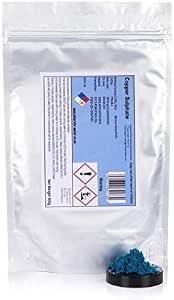
| Best overall |  Minerals-water.ltd 500 g copper sulphate pentahydrate | Follow recommended guidance. No CLP word | 500 g pouch | Pentahydrate | 8.8 | about £7.97 | View offer |
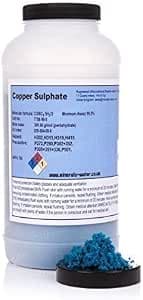
| Best value |  MAIGORAY 1 kg copper sulphate pentahydrate | Warning. Harmful if swallowed; skin and eye irritation | 1 kg | Pentahydrate | 8.6 | about £7.97 | View offer |
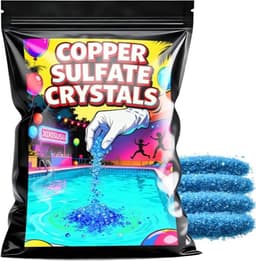
| Alternative |  XIXISUSU 4 oz copper sulphate crystals | Gloves and goggles in the bullets | 4 oz | Pentahydrate | 6.4 | about £19.51 | View offer |
On this page
The hazard these packs inherit
Storage and protection before you open it
Eyes, swallowing, and who to call
Spills, drains, and school kits
Common questions
Is this Warning or Danger?
Where should the closed pack live in a home with children, pets, or food?
What if crystals or solution reach an eye?
What if someone may have swallowed some?
Can a spill or a leftover solution go down the sink, onto the garden, or into a pond?
Which number is for England if the spill reaches a ditch or a drain that leads to water?
Related pages
Sources
Public UK sources and the amazon.co.uk listings compared on this page. Listings stored 20 October 2026.
- HSE: garden and allotment pesticides (retrieved 20.10.2026)
- HSE: active substance register (retrieved 20.10.2026)
- HSE: amateur garden pesticide database (retrieved 20.10.2026)
- NHS: poisoning (retrieved 20.10.2026)
- GOV.UK: report water pollution (retrieved 20.10.2026)
- GOV.UK: pollution prevention for businesses (retrieved 20.10.2026)
- Fisher Scientific UK: copper(II) sulphate pentahydrate safety data sheet, part C/8520 (retrieved 20.10.2026)