Copper sulphate footbath
You keep cattle, or you have read a horse-hoof review, and you are comparing crystal packs on amazon.co.uk as if they were a footbath product. A copper sulphate footbath in published UK dairy guidance is a concentration and a waste problem. In this set, almost none of that is printed. Our [copper sulfate comparison](/hub/diy-supplies/copper-sulfate) is still loose crystals, lime kits, and traditional-name packs. None shows a veterinary marketing authorisation. This page does not tell you how to acidify a bath, how to dissolve the crystals, or how to pack a hoof. A qualifying purchase can earn us a commission at no extra cost to you. Mass and price per kilogram are on the [buying guide](/hub/diy-supplies/copper-sulfate/sub/copper-sulfate-buying-guide).
You keep cattle, or you have read a horse-hoof review, and you are comparing crystal packs on amazon.co.uk as if they were a footbath product.
You keep cattle, or you have read a horse-hoof review, and you are comparing crystal packs on amazon.co.uk as if they were a footbath product. A copper sulphate footbath in published UK dairy guidance is a concentration and a waste problem. In this set, almost none of that is printed. Our copper sulfate comparison is still loose crystals, lime kits, and traditional-name packs. None shows a veterinary marketing authorisation. This page does not tell you how to acidify a bath, how to dissolve the crystals, or how to pack a hoof. A qualifying purchase can earn us a commission at no extra cost to you. Mass and price per kilogram are on the buying guide.
Our top picks
| Badge | Product | Listing use | Assay claim | Stated pack | Note | Price | Offer |
|---|---|---|---|---|---|---|---|
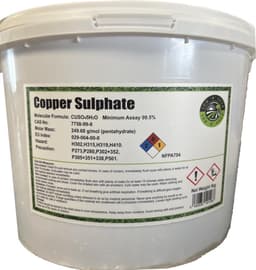
| Best overall |  SOW 'N' GROW 5 kg copper sulphate pentahydrate | Fungicide, algaecide, footbath, pool (seller) | Minimum 99.5% | 5 kg | 6.5 | about £69.95 | View offer |
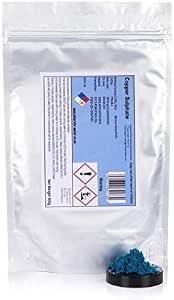
 Minerals-water.ltd 500 g copper sulphate pentahydrate | Garden, paths, water features, demonstrations | High purity, no number | 500 g pouch | 8.8 | about £7.97 | View offer | |
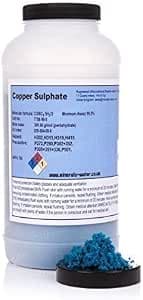
| Best value |  MAIGORAY 1 kg copper sulphate pentahydrate | Lab chemical. Gardening named in title and Q&A | High purity, no number | 1 kg | 8.6 | about £7.97 | View offer |
On this page
What these listings print about a footbath
The AHDB band, and what a pack can cover
Spent solution
Horse-hoof reviews and a lame animal
Common questions
What strength does AHDB publish for a cattle footbath made with copper sulphate crystals?
Why might the bath stay cloudy even when the crystals are in the water?
Can I tip the used bath onto pasture or into a ditch?
A review says copper sulphate fixed a horse’s hoof. Is that a licensed use of these packs?
My cow or horse is lame. Can this page tell me what is wrong?
Related pages
Sources
Public UK sources and the amazon.co.uk listings compared on this page. Listings stored 20 October 2026.
- HSE: garden and allotment pesticides (retrieved 20.10.2026)
- HSE: active substance register (retrieved 20.10.2026)
- HSE: amateur garden pesticide database (retrieved 20.10.2026)
- NHS: poisoning (retrieved 20.10.2026)
- GOV.UK: report water pollution (retrieved 20.10.2026)
- GOV.UK: pollution prevention for businesses (retrieved 20.10.2026)
- Fisher Scientific UK: copper(II) sulphate pentahydrate safety data sheet, part C/8520 (retrieved 20.10.2026)