Independent comparisons. We may earn from shop links. More info

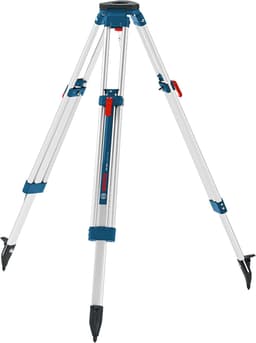
Construction tripod for a laser level

Updated: 23 October 2026

You are fitting a kitchen, lining up brackets, or setting a tile course, and the laser is already chosen. The stand still has to put the line where the sockets and the worktop are. A construction tripod for a laser level is a screw and a low working height, not a steel bar for floods. This page stays on the laser stands in our [construction tripod comparison](/hub/diy-supplies/construction-tripod), captured on amazon.co.uk on 20 October 2026. We did not run a lab, and a qualifying purchase can earn us a commission at no extra cost to you. The full check order is on the [construction tripod buying guide](/hub/diy-supplies/construction-tripod/sub/construction-tripod-buying-guide).

You are fitting a kitchen, lining up brackets, or setting a tile course, and the laser is already chosen. The stand still has to put the line where the sockets and the worktop are.

Our top picks

On this page

The screw on the laser, not the word construction

Read the thread on the laser before the height on the stand. Laser Levels Online describes 5/8 inch-11 as the usual rotary and dumpy thread, and 1/4 inch-20 as the usual small cross-line thread. In this set the Bosch BT 150 and the BT 250 state 1/4 inch. The Bosch BT 160 states 5/8 inch. Both Huepar stands state a 1/4 inch-20 plate plus a 5/8 inch-11 adapter nut. If your cross-line is 1/4 inch, the BT 160 is the wrong first choice. Auto-level lasers want a flat head. A dumpy is the case for a domed head.

How low the line can sit

For sockets, tiling, and a worktop, the bottom of the window decides the stand. The BT 150 is listed at 55–157 cm. A reviewer said it will not go lower than 550 mm, so it missed boxing out sockets. The Huepar TPD14B states 0.48–1.46 m, the lowest printed start in the laser group. Choose it when that 48 cm start is the point. Choose the BT 150 when 55 cm clears the work and you want the long review file. The BT 160 opens at 97 cm, which is high for sockets or a 900 mm worktop. Who should skip each stand is on the best construction tripod page.

When the tall stand is the wrong kitchen tool

A 2.5 m column misses a kitchen if the beam cannot come down. The BT 250 is 1/4 inch and 97.5–250 cm. Once the laser was mounted, a UK reviewer put the beam near 106 cm, above a 900 mm worktop. Skip it for the worktop and for socket boxes. The Huepar PT250 states a 250 cm maximum and no minimum in the specification table. A reviewer quotes 95.5 cm, and that number is not in the table. A tall maximum does not fix an unknown minimum. If the beam has to meet a 900 mm worktop, stay with the BT 150 or the TPD14B.

Indoor feet, and the stands to leave out

Finished floors want rubber. The TPD14B lists rotatable rubber feet, which suit a kitchen. The PT250 bullets describe a rotation from rubber to a metal spike, so leave the rubber down indoors. Leave the SabreCut SCLEDTRIPA and the Maclean MCE583 out of a laser buy. One SabreCut reviewer reported a male M8 stud. That is not a laser thread. The lamp branch is the construction tripod for site lights page. The Grettz pole can brace a laser indoors if you have measured the ceiling and you know the screw. GOV.UK allows “eye-safe” for Class 1 only. Call a professional for structural set-out and for Class 3B or Class 4.

Common questions

What thread is on a typical cross-line laser?
A small cross-line laser is often 1/4 inch-20. Larger line lasers, rotaries, and dumpy levels are often 5/8 inch-11, and some instruments carry both. Laser Levels Online states that split. Your laser’s base is the check, because a line laser can be either thread. In this set the BT 150 and BT 250 are 1/4 inch, the BT 160 is 5/8 inch, and both Huepar stands add a 5/8 inch adapter to a 1/4 inch plate. The Grettz listing does not state a size.
Is 55 cm low enough for sockets and a kitchen worktop?
It is low enough when your line sits at or above 55 cm. One UK reviewer boxing out sockets said the BT 150 stops at 550 mm. That is not a national socket height, and it is still a reason to measure your box. A 900 mm worktop is above 55 cm, so the BT 150 can serve it if the laser body does not push the beam higher than the column. The TPD14B’s stated start is 0.48 m if the printed spec has to go lower.
When do I need the BT 160 instead?
When the laser is 5/8 inch and the working window of 97–160 cm is high enough. It is £42.16, 4.1 kg, with 4.6 from 1,337 reviews. You do not need it for a 1/4 inch kitchen cross-line, and you should not buy it to solve a socket that sits under 97 cm. The adapter on a Huepar stand is the alternative only if you accept that it is an adapter, not a native 5/8 inch building head.
Can I use a floor-to-ceiling pole for tiling?
You can if the pole reaches your ceiling, the bracket fits the laser’s screw, and the line can sit where the tiles need it. The Grettz G-GTP is £99.99, and the capture states neither ceiling height nor thread. Two UK reviews describe a stable lock, from a listing first shown on 3 September 2026. For a printed 55–157 cm window on a 1/4 inch plate, the BT 150 is the stand with the figures on the page.
Does the tripod change the laser class?
No. Class follows the laser, under BS EN 60825-1. GOV.UK says “eye-safe” is for Class 1 only, and a Class 2 beam can dazzle. BS EN 50689’s consumer-laser limit stays on the laser as well. A BT 150, a Huepar column, or a Grettz pole does not change any of that. None of these stand captures shows a UKCA mark. Call a professional for structural set-out and for Class 3B or Class 4. The stand is also not a step.

Related pages

Sources

Public UK sources and the amazon.co.uk listings compared on this page. Updated 22.10.2026.

  1. Bosch Professional GB tripods (retrieved October 2026)
  2. Laser Levels Online: thread types (retrieved October 2026)
  3. Laser Level Review: tripods, rods and accessories (retrieved October 2026)
  4. Laser Levels Online: tripod shop table (retrieved October 2026)
  5. HSE: site lighting (retrieved October 2026)
  6. PUWER 1998 (retrieved October 2026)
  7. GOV.UK: General Product Safety Regulations 2005 (retrieved October 2026)
  8. GOV.UK: laser radiation safety advice (retrieved October 2026)