Independent comparisons. We may earn from shop links. More info

Post base or decking pedestal

Updated: 23 October 2026

You have a piece of timber, a concrete pad, and two amazon.co.uk listings that both call themselves a building support. Choosing a post base or a decking pedestal is the fork between a steel plate under the end of a post and a plastic foot under a joist. The [building support comparison](/hub/diy-supplies/building-support) lists both families, with shelf prices captured on 19 October 2026. Peter F. compared those listings with UK trade sheets. This is not a lab test. A qualifying purchase through the links can earn a commission at no extra cost to you.

You have a piece of timber, a concrete pad, and two amazon.co.uk listings that both call themselves a building support.

Our top picks

On this page

The fork

If the end grain sits on the plate, the family is a steel post base. If the timber lies across the head, the family is a polypropylene decking pedestal. They do not share a fixing or a height band. A post base here is a threaded stand-off or a bolt-down U about 250 mm tall. A pedestal is a screw foot with a cradle. Put a joist across a 75 mm steel plate and the joist has no cradle. Stand a post in a plastic head meant for a 45 mm bearer and the end grain is not on a plate.

When it is a post

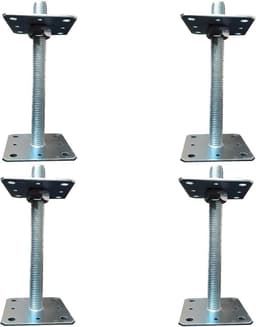
A restrained post on a hard pad points to an elevated steel base or a bolt-down support. FWEEK, QWORK and AHAQU use an upper plate of 75 × 75 mm in a 100–150 mm band, so a 100 mm post overhangs it. Aleawol runs 15–23 cm, with an upper plate of 8.3 × 10 cm. LLB is 80 × 80 × 250 mm with an M24 bolt. Trade APB and PPRC plates are quoted at 100 × 100 mm. Surefix lists an adjustable elevated base at £54.45 and, with Fountain Timber, warns against a post whose top is free. A free fence post fails that test on every plate in this set.

When it is a joist

A joist on a slab or sound paving points to a plastic pedestal: the five-piece 30–60 mm title at £10.98, UGEBROGH’s 24-pack at £43.99, or Ceta’s ten-pack at £33.99 titled 60–140 mm. Set the collar before you screw the joist down. One Ceta review says the head suits beams of about 45 mm. Millboard keeps this riser on a solid substrate. LLB’s bolt-down U stays a steel post fitting. If the frame is joists across a pad, read spacing on the decking pedestals for a shed base page. If the shed sits on soil, neither family is the foundation.

One recommendation

If the timber ends on the fitting, use a post base and match the plate to the post. A 75 mm plate is a poor match for a 100 mm post, and the top still needs a frame. If the timber lies across the fitting, use a pedestal on a slab, in the height you measured. Soft ground, a lone fence post, a balcony or a deck tied to the house needs a design. Steel listings here state no design load. The order of anchors and collars is on the how to fit a building support page.

Common questions

The timber is a post. Which family?
Use a steel post base when the end of the post sits on the fitting. In this set that is an elevated jack, mostly 100–150 mm or 15–23 cm, or LLB’s bolt-down support at 80 × 80 × 250 mm. The post needs a hard pad and a frame that restrains the top. A 75 × 75 mm upper plate leaves a 100 mm post overhanging. A plastic cradle is the wrong family for end grain.
The timber is a joist on a slab. Which family?
Use a polypropylene decking pedestal when the joist lies across the head on a sound slab or sound paving. The low packs are titled 30–60 mm, at £10.98 for five or £43.99 for 24. Ceta’s ten-pack at £33.99 is titled 60–140 mm. Set the collar before you screw the joist down. A steel post plate has no cradle for a joist on its side.
Why is a 75 mm plate a poor match for a 100 mm post?
FWEEK, QWORK and AHAQU list an upper plate of 75 × 75 mm. A 100 mm post overhangs that square, so the end grain bears on part of the plate and the overhang sits in the weather. Trade APB and PPRC bases are cited with a 100 × 100 mm top. Aleawol’s upper plate is 8.3 × 10 cm, which you still measure against your timber.
Can an elevated base hold a fence post on its own?
Fountain Timber and Surefix both say an adjustable elevated base is not recommended when the top of the post is unrestrained, and a fence post is the example they give. Surefix lists that base at £54.45. The post needs a frame at the top. LLB’s 80 × 80 mm bolt-down support is the same limit. It is not a shoe for a lone fence post in soil.
Is a bolt-down U support the same as a pedestal?
LLB’s four-pack is a galvanised bolt-down post support, 80 × 80 × 250 mm, with an M24 bolt, at £49.99. The timber ends in the U. A pedestal is a plastic foot, and the joist lies across a cradle. The U can level a restrained newel on a pad. It does not replace a 30–60 mm or 60–140 mm joist foot, and the components line is No, so anchors are a separate buy.

Related pages

Sources

Public UK sources and the amazon.co.uk listings compared on this page. Shelf prices read 19 and 20 October 2026. Updated 22.10.2026.

  1. Planning Portal decking permission (retrieved 22.10.2026)
  2. GOV.UK householder technical guidance (retrieved 22.10.2026)
  3. Approved Document K (retrieved 22.10.2026)
  4. Dorset Council decking note (retrieved 22.10.2026)
  5. Approved Document A (retrieved 22.10.2026)
  6. HSE temporary works (retrieved 22.10.2026)
  7. EGGA galvanizing specification guidance (retrieved 22.10.2026)
  8. Simpson Strong-Tie elevated post base PPA (retrieved 22.10.2026)