Independent comparisons. We may earn from shop links. More info

Decking pedestals for a shed base

Updated: 23 October 2026

You are levelling joists for a shed or a low deck on a slab or paving that is already there. Decking pedestals for a shed base work when the foot sits on that hard surface, the title height covers the gap, and the platform stays inside the planning conditions that apply to your home. The [building support comparison](/hub/diy-supplies/building-support) lists the pedestal packs, with shelf prices captured on 19 October 2026. Peter F. used those listings, UK review notes, the Planning Portal and Timber Decking and Cladding Association guidance. This is not a lab test. A qualifying purchase through the links can earn a commission at no extra cost to you.

You are levelling joists for a shed or a low deck on a slab or paving that is already there.

Our top picks

On this page

Where a pedestal is the method

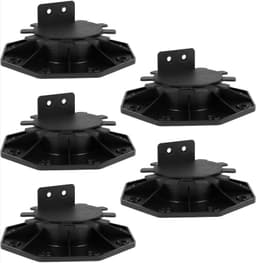
A decking pedestal is a polypropylene screw foot under a joist that lies across the head, used to take the fall out of a slab or sound paving. Grass and soft soil are a different job. Millboard’s DuoLift guidance keeps this foot on a solid substrate and moves you to posts when the site is soft or the deck is high. One UK review left a 12-foot shed standing after a year on uneven concrete. That review is not evidence for soil. Steel under a post end is on the post base or decking pedestal page.

Heights in this set

Measure the gap in millimetres at the high corner and the low corner. The low packs are titled 30–60 mm: five pieces at £10.98, and UGEBROGH’s 24-pack at £43.99, at 4.5 from 11 reviews. A five-piece bullet prints centimetres beside that millimetre title. One review said the lowest UGEBROGH setting still added about an inch. Ceta’s ten-pack at £33.99 is titled 60–140 mm, at 4.6 from 211 reviews, while the material field prints 60–135 mm. The seller line of 1662 kg/m² is not an independent test. One review says the head suits beams of about 45 mm. If the gap exceeds the title, you are into a post-and-beam substructure.

Spacing without a false rule

This set does not support one spacing number. A Ceta review placed feet about 300 mm apart under a 12-foot shed that was still standing after a year. That describes that shed. It is not a span table, and it is not the England planning height. The Timber Decking and Cladding Association points to Use Class 4 for exterior structural timber and joists around 150 × 50 mm at centres of 400–600 mm. Those centres are for the boards above, not for how many plastic feet sit along each joist. Use a grid only when it is the grid for the foot you bought.

300 mm planning and 600 mm guarding

In England, for a house, the Planning Portal allows a platform no more than 30 cm above the ground, covering no more than 50 per cent of the garden with other buildings and extensions, and sitting no further forward than the principal elevation. GOV.UK uses the same line: a platform over 0.3 m is raised. Flats are outside that allowance. Scotland, Wales and Northern Ireland are not this figure. Building regulations are separate. Dorset Council treats a deck used with the building as the sort of work Approved Documents A and K contemplate. Stop when the deck is tied to the house, when the load is a hot tub, or when the ground is soil.

When the pedestal method stops

Use a plastic pedestal when the joist lies on a sound slab and the title band covers the high corner and the low corner. Treat 400–600 mm as joist centres for the boards, not as a foot spacing. A platform over 300 mm in England, a fall past 600 mm, soil, or a hot tub, needs a competent person. Set the collar before you screw the joist.

Common questions

Can plastic pedestals sit on grass?
These pedestals belong on a sound slab or sound paving. Grass and soft soil give the foot nothing flat to bear on. Millboard’s guidance keeps this riser on a solid substrate and moves you to posts when the ground is soft or the deck is high.
How did buyers in this set space them?
One Ceta review set feet about 300 mm apart under a 12-foot shed that was still standing after a year. Another said beams of about 45 mm centred best in the head. A UGEBROGH review said 24 feet covered about 2 m by 2 m. Those are buyer descriptions, not a span table. Use the spacing published for the pedestal you bought.
Does a deck over 300 mm need planning permission in England?
In England, for a house, decking more than 30 cm above ground falls outside the Planning Portal’s height condition. You still check the 50 per cent garden limit and the principal elevation. Flats are outside the allowance. The figure does not automatically apply in Scotland, Wales or Northern Ireland. A lower deck can still need permission if it fails coverage or sits forward of the house.
Is 300 mm the same rule as the 600 mm guard height?
The 300 mm line is the England householder planning threshold for a raised platform, from the Planning Portal and GOV.UK. The 600 mm line is Approved Document K’s trigger for guarding where people could fall further than that. Guard height is then 900 mm or 1100 mm. A review that spaced feet at 300 mm is a third, unrelated use of the number.
When is a hot tub or a deck fixed to the house no longer a pedestal job?
A hot tub, a balcony, or a deck fixed to the house is beyond these marketplace feet. Dorset building control treats a deck used with the building as work where structure and guarding apply. Soil is the same stop. A seller load of 1662 kg/m² is not a design.

Related pages

Sources

Public UK sources and the amazon.co.uk listings compared on this page. Shelf prices read 19 and 20 October 2026. Updated 22.10.2026.

  1. Planning Portal decking permission (retrieved 22.10.2026)
  2. GOV.UK householder technical guidance (retrieved 22.10.2026)
  3. Approved Document K (retrieved 22.10.2026)
  4. Dorset Council decking note (retrieved 22.10.2026)
  5. Approved Document A (retrieved 22.10.2026)
  6. HSE temporary works (retrieved 22.10.2026)
  7. EGGA galvanizing specification guidance (retrieved 22.10.2026)
  8. Simpson Strong-Tie elevated post base PPA (retrieved 22.10.2026)