Building support buying guide
You have a concrete pad, a timber post or a joist, and a search page that calls every fitting a building support. A post base, a decking pedestal and a telescopic rod do different work. This building support buying guide puts the job first, then the gap in millimetres, then the plate or the head, then the coating and the screws. The [building support comparison](/hub/diy-supplies/building-support) lists the amazon.co.uk packs, with shelf prices captured on 19 and 20 October 2026. Peter F. read those listings. This is not a lab test. A qualifying purchase through the links can earn a commission at no extra cost to you.
You have a concrete pad, a timber post or a joist, and a search page that calls every fitting a building support. A post base, a decking pedestal and a telescopic rod do different work.
You have a concrete pad, a timber post or a joist, and a search page that calls every fitting a building support. A post base, a decking pedestal and a telescopic rod do different work. This building support buying guide puts the job first, then the gap in millimetres, then the plate or the head, then the coating and the screws. The building support comparison lists the amazon.co.uk packs, with shelf prices captured on 19 and 20 October 2026. Peter F. read those listings. This is not a lab test. A qualifying purchase through the links can earn a commission at no extra cost to you.
Our top picks
| Badge | Product | Support type | Height range | Top bearing | Note | Price | Offer |
|---|---|---|---|---|---|---|---|
| Best overall |  Ceta Composite Decking Ceta Composite Decking pedestal, pack of 10 | Decking pedestal | 60–140 mm | Fixed head | 8.9 | about £33.99 | View offer |
| Alternative |  FWEEK FWEEK 4-piece elevated post base, 100–150 mm | Elevated post base | 100–150 mm | 75 × 75 × 3 mm | 8.9 | about £23.99 | View offer |
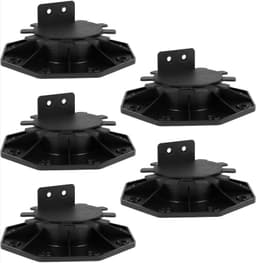
| Best value |  Generic 5-piece decking pedestal, 30–60 mm | Decking pedestal | 30–60 mm | Fixed joist head | 7.6 | about £10.98 | View offer |


On this page
Three supports, three jobs
Height and bearing
Coating and fixings
When the listing is not enough
Which family to open first
Common questions
Which height band matches a 40 mm gap, a 120 mm gap and a ceiling?
Will a 75 × 75 mm plate cover a 100 mm post?
Does galvanised on these listings mean EN ISO 1461?
Are the screws in the box concrete anchors?
Is a 40 kg or 70 kg rod an acrow prop?
Related pages
Sources
Public UK sources and the amazon.co.uk listings compared on this page. Shelf prices read 19 and 20 October 2026. Updated 22.10.2026.
- Planning Portal decking permission (retrieved 22.10.2026)
- GOV.UK householder technical guidance (retrieved 22.10.2026)
- Approved Document K (retrieved 22.10.2026)
- Dorset Council decking note (retrieved 22.10.2026)
- Approved Document A (retrieved 22.10.2026)
- HSE temporary works (retrieved 22.10.2026)
- EGGA galvanizing specification guidance (retrieved 22.10.2026)
- Simpson Strong-Tie elevated post base PPA (retrieved 22.10.2026)