Independent comparisons. We may earn from shop links. More info

Electric or flame branding iron

Updated: 23 October 2026

You have ten boards this afternoon, or a hundred before a market, and someone has told you an electric branding iron is simply the better tool. It is not. An electric or flame branding iron is a choice about how many marks you will make before the heat fades. The five prices stay on the [branding stamp comparison](/hub/diy-supplies/branding-stamp) and on [best branding stamp](/hub/diy-supplies/branding-stamp/sub/branding-stamp-best). A qualifying amazon.co.uk purchase can earn us a commission at no extra cost to you.

You have ten boards this afternoon, or a hundred before a market, and someone has told you an electric branding iron is simply the better tool. It is not.

Our top picks

On this page

What changes when you leave the flame

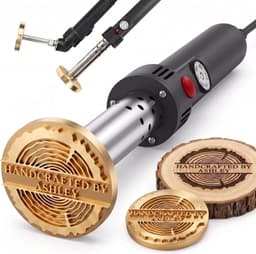
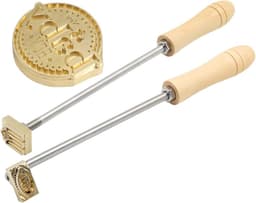
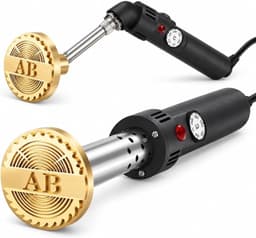
A flame head is metal you heat from the outside. One side can be hotter if the flame sat there, and the next press may need the torch again. UK reviewers of the Zopmopae head, at £7.89, say the artwork can match the file and the heat is still hard to judge. An electric iron heats the head from an element and, on the better pages, gives you a dial. LOVEVEN describes a rotary control up to 500°C and a brass head you preheat on a stand. Ashley0921’s title says temperature-controlled, at 300 W, with the same 500°C ceiling. Outpost, a Liverpool maker, says you still test on scrap. The press itself is in how to use a branding iron.

Short runs

Hamilton Rand, in Birmingham, points flame irons at one-offs and short runs, and electric irons at batches you want to repeat. Ten boards, with a pause to reheat between groups, is a flame job if you will practise. In this set the flame tools are Zopmopae at £7.89, SWTHM at £29.99, and WADY at £13.19. Only Zopmopae is a custom logo head. SWTHM is letters and is listed as not for food. WADY is letters for steaks and burgers. You heat Zopmopae with a flame gun, charcoal, or a fireplace, with no temperature on the specification. If you have not chosen a type yet, use the branding iron buying guide.

Longer runs

A longer run is where the torch starts to dominate. Once you are branding a batch, stopping to reheat every few minutes costs more than the difference in the tool price. Outpost’s electric method is a 240 V heater, about 5–20 minutes to come up to heat, then a stand and a light press. The electric irons here are not that Outpost heater. Ashley0921 is £45.96, 300 W, upper rating 500°C, with 4.4 from 245 ratings whose saved texts are not from the UK. Those texts mention even heat after practice, and a heating element dead on arrival. LOVEVEN is £69.99, with brass and a rotary control to 500°C, no reviews in the extract, and 200 W on the specification while a bullet also offers 300 W.

The condition on the recommendation

Choose a flame iron for occasional marks you will practise, and an electric iron when reheating would dominate the run. The plug and the instructions have to be credible. Electric is not safer by default. A torch can burn you and can scorch the bench. The Electrical Equipment (Safety) Regulations 2016 are the Great Britain framework, and a UK plug is the BS 1363 pattern. Do not buy the corded iron on the dial alone if the lead is a two-pin plug, the leaflet is for a different tool, or you cannot see a voltage. Outpost sells a brass head that can sit on a wooden handle or on their own 240 V heater.

Common questions

Which is the better choice for ten boards, and which for a hundred?
Ten boards, with time to test and to reheat, suit a flame head if you will practise. A hundred, or any batch where stopping every few minutes is the problem, suits an electric iron, provided the plug is credible. Hamilton Rand draws the same line: torch for short runs, electric when you want the result to repeat. The question is whether reheating would take over the session.
Does electric mean you can skip the scrap test?
No. Outpost’s electric guide still tells you to test on scrap after the 5–20 minute heat-up. A dial sets the heater. It does not know whether you are on ash, oak, or leather, or whether yesterday’s oil is still on the face. The first press belongs on a scrap of the same material. A flooded logo is just as permanent with a dial as with a torch.
Why does a flame mark fade after several presses?
The head is cooling. Hamilton Rand’s note is that a torch iron needs heat again after a few minutes. The first board can be dark and the fourth board pale without you changing pressure at all. Reheat, test on scrap, and carry on. If that cycle is most of the job, you have outgrown the flame for that batch.
What should you check on the plug before the first session?
Confirm a BS 1363 plug, a fuse, and a stated voltage around the UK 230 V supply. Do that before you switch on. Ashley0921’s bullet says plug in and does not name the standard. LOVEVEN’s part number includes UK and does not show a fuse or a voltage. If the plug is not the UK pattern, do not improvise an adaptor.
Why do these electric listings not state 230 V?
The extracts do not contain the figure. Ashley0921 states 300 W and 500°C. LOVEVEN states 200 W on the specification line, offers 300 W in a bullet, and states 500°C. Country of origin on LOVEVEN is China. Absence of a voltage is a reason to ask before you rely on the iron, not a reason to invent 230 V from the fact that the page is on amazon.co.uk.

Related pages

Sources

Public UK sources and the amazon.co.uk listings compared on this page. Prices stored 19 October 2026. Updated 22 October 2026.

  1. Bowers & Freeman: branding irons (retrieved October 2026)
  2. Outpost Workshop: electric branding iron (retrieved October 2026)
  3. Outpost Workshop: fire-heated branding iron (retrieved October 2026)
  4. JH Machining: frequently asked questions (retrieved October 2026)
  5. GOV.UK: Electrical Equipment (Safety) Regulations 2016 (retrieved October 2026)
  6. Plugs and Sockets etc. (Safety) Regulations 1994 (retrieved October 2026)
  7. GOV.UK: Food contact materials regulations (retrieved October 2026)
  8. Retained Regulation (EC) 1935/2004, article 15 (retrieved October 2026)
  9. Consumer Rights Act 2015, section 9 (retrieved October 2026)
  10. Consumer Contracts Regulations 2013 (retrieved October 2026)
  11. OPSS product safety report 2312-0010 (retrieved October 2026)