How to organise screws
The drawer is a mix of 4 × 40 mm woodscrews, a handful of M6 machine screws and the wall plugs from last month’s bracket, and you cannot see which is which without tipping the lot onto the bench. How to organise screws, in a lidded assortment box, comes down to one rule you can finish this afternoon: sort by the choice you make at the bench, write that choice on the cell, and leave the cell below the wall of the divider. The boxes themselves are compared on the [assortment box comparison](/hub/diy-supplies/assortment-box). If you buy through our links, a qualifying purchase can earn us a commission at no extra cost to you. This is not a lab test, and the fill level below is a rule of thumb. Updated 23 October 2026.
The drawer is a mix of 4 × 40 mm woodscrews, a handful of M6 machine screws and the wall plugs from last month’s bracket, and you cannot see which is which without tipping the lot onto the bench.
The drawer is a mix of 4 × 40 mm woodscrews, a handful of M6 machine screws and the wall plugs from last month’s bracket, and you cannot see which is which without tipping the lot onto the bench. How to organise screws, in a lidded assortment box, comes down to one rule you can finish this afternoon: sort by the choice you make at the bench, write that choice on the cell, and leave the cell below the wall of the divider. The boxes themselves are compared on the assortment box comparison. If you buy through our links, a qualifying purchase can earn us a commission at no extra cost to you. This is not a lab test, and the fill level below is a rule of thumb. Updated 23 October 2026.
Our top picks
| Badge | Product | Layout | Adjustable dividers | Compartments | Note | Price | Offer |
|---|---|---|---|---|---|---|---|
| Best overall |  Stanley FatMax Stanley FatMax deep organiser 1-97-518 | Removable cups | Removable cups | 10 | 9.0 | about £22.79 | View offer |
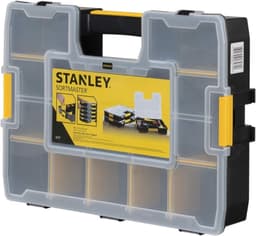
 Stanley Stanley SortMaster 1-94-745 | Divider case | Yes | 12 (bullets; table says 1) | 9.4 | about £9.99 | View offer | |
| Best value |  Amtech Amtech S6463 double-sided box | Double-sided dividers | Yes | 34 | 8.6 | about £13.35 | View offer |


On this page
Sort by the choice you make at the bench
Labels that still make sense next month
Filling and carrying without mixing
Jars, drawers and when a box is the wrong tool
Common questions
How should I sort screws in a box?
What do I write on the label?
Are jam jars good enough?
What do I do with one-off odd screws?
Where do long screws and drill bits go?
Related pages
Sources
Public UK sources and the amazon.co.uk listings compared on this page. Updated 22.10.2026.
- General Product Safety Regulations 2005 (retrieved 22.10.2026)
- GOV.UK: General Product Safety Regulations 2005 (retrieved 22.10.2026)
- Consumer Rights Act 2015, section 9 (retrieved 22.10.2026)
- Stanley UK SortMaster 1-94-745 (retrieved 22.10.2026)
- Stanley UK FatMax 1-97-518 (retrieved 22.10.2026)
- Screwfix organisers (retrieved 22.10.2026)
- Kistenberg NORS14 KNO35255S (retrieved 22.10.2026)