Independent comparisons. We may earn from shop links. More info

How to use side cutters

Updated: October 2026

The first squeeze on a new pair is usually a cable tie on a loom, a sprue on a kit, or a copper tail that sticks out of a connector. How to use side cutters is a matched edge, a square bite further back on the jaw, and a stop if the handles meet and the wire is still whole. A harder squeeze is how a flush tip snaps. The [side cutters comparison](/hub/cutting-tools/side-cutters) is for choosing a tool. This page is the procedure. A qualifying purchase can earn a commission at no extra cost to you.

The first squeeze on a new pair is usually a cable tie on a loom, a sprue on a kit, or a copper tail that sticks out of a connector.

Our top picks

On this page

Set the cut before you squeeze

Name the material first. Nylon ties, model sprue and florist wire want a flush face. Soft copper wants a cutter whose listing actually names copper or a millimetre or AWG limit. Steel, piano wire, nails, pins and copper-coated steel are how UK reviews in this batch describe broken jaws and chewed edges. Put the flat face of a flush cutter toward the piece you are keeping, so the pinch sits on the offcut. A bevelled diagonal cutter pinches both ends and leaves a small point. Cut further back on the jaw, not on the tip. The tip is the weakest section and the first to snap. HOUSERAN reviewers who otherwise like a flush cut on 1.5 mm² copper still say not to use the tip on copper. Wide nylon ties raise friction. You can still trim a thin tie with a flush pack, but you square the jaws, take a short bite, and you do not twist. If the cable might be live, stop and read side cutters for electricians before you cut. Ordinary wiring is isolated and proved dead, then cut. Eye protection is reasonable when the wire is springy or the edge is already chipped. If the handles meet and the wire has not parted, stop.

Check the edges meet

Close the cutter on a scrap of paper or on a thin cable tie before you trust copper. The edges should meet along the cutting length. Sharp-tec reviews in this folder describe misaligned jaws, edges that meet only at the tip, a gap when closed, burrs, and at least one pair that arrived rusty. BOENFU reviews include blades that do not meet at the tips. Two UK reviews on the US PRO three-size set say the edges do not cut. That is a tool fault, not a warm-up. A gap will not wear in. It will crush, chew, or leave a burr. Under the Consumer Rights Act 2015, section 11, goods have to match their description. A cutter sold to cut wire, whose edges never meet, can go back. Do not dress the gap with a file as your first move. If the close is clean on paper and then fails on a paperclip or on 0.8 mm copper-coated steel, you have left the listing. KH008 reviews report broken jaws on speaker cable and on that copper-coated steel. BOENFU reviews report 0.8 mm paperclip wire chewing the edge and thin garden wire chipping it. A burr on the kept piece means you either used the bevelled face against the keep side, or the edges are already notched. Turn a flush cutter the right way round and cut again further back if you have length. If the notch is in the steel, retire the cutter for hard work. A chipped edge throws particles and it will not shear cleanly.

Springs, oil and storage

Several flush cutters in this batch are spring-open with no lock. BOENFU reviewers say the jaws stay open and the sleeve is only a plastic wrap. Two of twelve UK reviews on KAIHAOWIN KH004 say there is no cover or clip. One HOUSERAN review says the spring tends to fall out. Store them in a pouch or with a wrap on the head. Sharp open jaws are a storage hazard in a drawer, in a bag, and around children. A sprung cutter with no sheath is not a defect on those listings. The spring is the feature, and the missing latch is the cost. Factory oil on a new pair is common. One BOENFU reviewer said to leave the oil on the steel. Wipe the grips so the tool does not slip. Do not oil a cracked plastic sleeve and call it insulation. If the spring drops out, stop using the cutter as a one-handed tool. Do not tape a spring into a jaw as a permanent fix if it can migrate into the cut.

When to stop

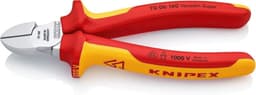
Stop on steel, piano wire, nails, pins, pattress screws and copper-coated steel unless the listing names that class. The Knipex 70 06 160 names soft and hard wire, and even then a UK review says not to cut pattress screws, and another reports a tip snapping on 1.0 mm cable after about three months. Flush packs that say not for hard electrical wire mean that. A paperclip is already over the BOENFU edge in one note. Stop if you were about to shear a whole twin-and-earth oval in the tip. Cut one dead conductor at a time, further back on the jaw. Stop if the handles close and the wire remains. Get a cutter with a printed capacity, or a different tool: cable cutters for a whole cable, snips for sheet, a junior hacksaw for a screw. Stop if the insulation on a marked 1000 V pair is nicked. That tool comes out of the bag. Live conductors are not a how-to. They are a competent-person job under regulation 14, with isolation as the normal plan. Flush versus bevel sits on side cutters vs flush cutters.

Common questions

Which way round do flush cutters go?
Put the flat face toward the piece you are keeping. The pinch then sits on the offcut. A bevelled pair will leave a small point on both ends no matter which way you turn it.
Why will the cutters not close on this wire?
Either the wire is thicker or harder than the listing, or you are cutting on the tip. If the handles meet and the wire is still whole, stop. A harder squeeze snaps the tip.
The blades do not meet. Will they wear in?
No. A gap crushes or chews. Check on paper, and return a tool whose edges never meet rather than filing it in.
Where should I cut a cable tie?
Square to the tail, with a flush face toward the head you are keeping, further back on the jaw. Wide ties raise friction. A 160 mm diagonal cutter is not a dedicated plastic cutter.
What do I do if the tip has already snapped?
Stop using that pair on wire. A chipped edge throws particles. Replace the cutter, and move the next cut back from the tip on the new pair.
Should I wipe the oil off a new pair?
Wipe the grips. One BOENFU reviewer left the oil on the steel. Degreasing the joint for appearance is not required, and oil is not insulation.
How do I store spring cutters that will not latch?
Use a pouch or a wrap on the head. Several listings in this batch have no lock. Open jaws in a drawer are a puncture hazard, and a loose HOUSERAN spring is a reason to stop one-handed use.

Related pages

Sources

Sources listed in the research digest for this comparison, retrieved 20 October 2026. Prices and review counts are amazon.co.uk listing lines. This is not a lab test.

  1. Electricity at Work Regulations 1989, regulation 14 (retrieved 20 October 2026)
  2. HSE HSG85, Electricity at work: safe working practices (retrieved 20 October 2026)
  3. HSE INDG291, Providing and using work equipment safely (retrieved 20 October 2026)
  4. ISO 5749:2004, Pliers and nippers — Diagonal cutting nippers (retrieved 20 October 2026)
  5. Maun Industries, Is VDE a legal requirement for insulated tools? (retrieved 20 October 2026)
  6. Knipex 70 06 160 diagonal cutters (retrieved 20 October 2026)
  7. Digital Toolbelt, Side cutters vs diagonal cutters (retrieved 20 October 2026)
  8. Toolsmith, Wire cutters: flush, side, end and cable (retrieved 20 October 2026)