Independent comparisons. We may earn from shop links. More info

How to cut copper pipe with a pipe cutter

Updated: October 2026

Pinching a 15 mm slice hard under a basin is how the end goes oval. How to cut copper pipe with a pipe cutter is a light first groove, a square track, then a ream. The cutter is not the joint. Isolate the supply, mark the cut, finish the bore, and stop. Choosing a tool is the [pipe cutter comparison](/hub/cutting-tools/pipe-cutter). This page is the procedure. If the pipe is gas, you do not start. We used amazon.co.uk listings and did not run a lab test. A qualifying purchase can earn a commission at no extra cost to you.

Pinching a 15 mm slice hard under a basin is how the end goes oval. How to cut copper pipe with a pipe cutter is a light first groove, a square track, then a ream. The cutter is not the joint.

Our top picks

On this page

Isolate and mark before you clip on

Shut the relevant valve and drain the run until the cut is dry. A wheel that skates on wet copper will wander. Mark the outside with a pencil so you notice a spiral before the wheel has travelled 10 mm. A slice has to orbit. BuildWiz uses about 60–70 mm around the pipe as a rule of thumb. Against a tile or the basin waste, move the cut or use a smaller mini. Do not solve clearance by forcing the feed. A copper wheel on Speedfit scores the skin. A plastic shear on copper will not leave a round end for an olive. If you are still choosing, use the pipe cutter buying guide. If the cutter already matches, clip it on the dry mark and keep the rollers square.

Rotate a pipe slice

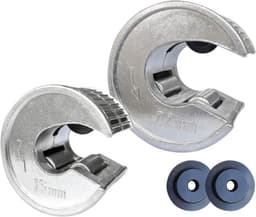
A 15 mm or 22 mm slice is a spring-fed clip. Open it, set the wheel on the mark, and close it so the rollers sit on the copper. If the rollers never sit, the cut spirals. Take a rocking slice off and reset. Do not start on a tilted wheel. Rotate one way only. The spring feeds the wheel. BuildWiz talks about eight to fifteen rotations as a rule of thumb, not a lab count. Reversing every half turn can start a second score. If the body walks along the pipe, stop and reset on the pencil line. Catch the offcut. The end should be square and still round. A flat is a failed cut. If it is oval, re-round annealed tube or cut again further back if you still have length.

Feed a wheel a little per turn

An adjustable cutter has a knob, and that is the tool you can over-tighten. Kiss the copper so the wheel just marks it, then make one full orbit before you add feed. A single line means you are tracking. A spiral means the body is not square. Reset before you go deeper. BuildWiz’s quarter-turn per orbit is the habit: a small knob movement after each full turn, not a clamp. Toolwiz and the Sharp-tec minis both draw the same complaint. A hard first feed ovals thin tube, and the olive will not sit. 22 mm on a 3–22 mm mini sits at the stop. If the knob needs mole grips, as one Sharp-tec mini review said, you are past a light feed. The 1.2 kg top pick is the same method on a bench and the wrong shape in a cupboard. If you cannot complete an orbit, you do not have access.

Ream the bore, then stop

Every wheeled cut leaves a burr, even when the outside looks clean. BPEC’s copper-pipe note says ream after the cut, or you get noise and scale. Mueller’s domestic note matches it: cut square, remove the burr, keep the outside free of deep scratches, and re-round crushed annealed tube. A pencil reamer, the deburrer from a Sharp-tec or SHALL set, or a dedicated pipe reamer is enough. One SHALL reviewer preferred sandpaper to the included tool. That is finish, not a reason to skip the burr. Then stop. Olives and inserts are the next tools. Olive notes sit on pipe cutter for copper pipe. A plastic shear is a different motion: hold the pipe perpendicular to the blade and close in one square bite. A hacksaw on a live fitting sends filings down the run.

Common questions

How do I use a 15 mm pipe slice?
Clip it on a dry, marked 15 mm copper so the rollers sit, then rotate one way. The spring feeds the wheel. After eight to fifteen turns as a rule of thumb the tube parts. Check the end is still round, then ream.
How tight should the feed knob be on the first turn?
Only tight enough to mark a single groove. One full orbit, then a small feed. A hard first pinch ovals thin copper. If you need mole grips on the knob, you have already gone too far.
Why did the wheel spiral along the pipe?
The body was not square, the rollers were off the tube, or you reversed direction. Stop, open the cutter, and reset on the pencil line. Do not deepen a spiral and hope it comes back.
Do I still need to deburr after a clean-looking cut?
Yes. The outside can look square while a ridge sits in the bore. Compression fittings and inserts both want that ridge gone. The cutter does not finish the joint.
What if the pipe comes out oval?
You over-tightened or the slice crushed the wall. Re-round annealed tube if you can, or cut again further back. An oval end will not take an olive. A flat from a cheap 15 mm slice is the same failure.
When is a hacksaw the wrong fallback?
On a live or newly isolated run where filings can travel, and any time you still need a square, round end. A saw is slower to finish than a wheeled cutter used lightly. It is not a gas procedure, and it is not a fix for jaws that will not open.

Related pages

Sources

Public UK sources from the research digest, retrieved 20 October 2026. Listing prices, stars and review counts are the amazon.co.uk lines used for this comparison.

  1. Water Supply (Water Fittings) Regulations 1999 (retrieved 20 October 2026)
  2. Gas Safety (Installation and Use) Regulations 1998, regulation 3 (retrieved 20 October 2026)
  3. HSE — Gas safety for employers (retrieved 20 October 2026)
  4. John Guest Speedfit technical guide, July 2024 (retrieved 20 October 2026)
  5. Yorkshire Copper technical guide (retrieved 20 October 2026)
  6. Mueller Europe — copper tube in domestic water services (retrieved 20 October 2026)
  7. BPEC — essential plumbing skills, copper pipe (retrieved 20 October 2026)
  8. BuildWiz — pipe cutter (retrieved 20 October 2026)