Independent comparisons. We may earn from shop links. More info

Glass cutting oil: what to put in the handle

Updated: October 2026

The wheel is dry, or the handle has dumped a puddle on the pane, and the kit either left the oil out or gave you a reservoir with nothing to wick it. Glass cutting oil is the light fluid that keeps a score open and stops the axle gumming, not a full handle. You should leave knowing which fluid to buy in the UK, how many drops to use, and how to tell a missing wick from ordinary wetting. Shelf prices are on the [glass cutter comparison](/hub/cutting-tools/glass-cutter). We did not run a lab test. A qualifying purchase through an amazon.co.uk link can earn us a commission at no extra cost to you.

The wheel is dry, or the handle has dumped a puddle on the pane, and the kit either left the oil out or gave you a reservoir with nothing to wick it.

Our top picks

On this page

Why the score wants oil

A glass cutter does not saw. The carbide wheel presses a fissure into annealed glass, and you snap along it. Oil helps that fissure stay open and reduces chips. A dry axle also wears the wheel. Verrier, writing for stained-glass cutters, puts the score first and the axle second, and treats a light mineral oil as acceptable. Dry cutting is possible on a wooden handle with no reservoir. The edge still chips more, and the wheel lasts less. A flood hides the line and, on a hollow handle, runs out of the end. HaroKing’s listing says a few drops, not a full fill, because a full handle leaks. The one-pass score is on the how to use a glass cutter page.

What to put in the cutter

Use the cutting fluid a glass supplier sells, or a light mineral oil of similar thickness. Commercial cutter oil is often a white mineral oil. Workshop notes put sewing-machine oil, lamp oil and baby oil in that light family, with mixed results. Baby oil used only on the tip is a complaint on Toyo reviews, not a method. Paraffin is lighter still. If it pours out of a sound head, it is too light. If the wheel stays dry, it is too thick to wick. Vegetable oil oxidises and gums the axle.

How much, and what a leak means

Put a few drops in a hollow handle, wheel down so the wick can wet, then store the cutter so the reservoir does not drain onto the bench. You want a film at the wheel, not a drip when you tilt the tool. A leak is not one fault. Oil that is too thin runs out of a healthy head. No wick lets the reservoir empty straight through, which is what one HaroKing reviewer found. If there is no fibre in the head, dip the wheel. A missing wick is a reason to return a cutter sold as an automatic feed.

Oil in this comparison’s kits

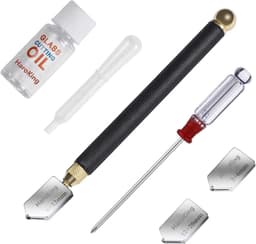
HaroKing at about £9.98 is the kept listing that states a bottle of cutting oil. Open the head before the good pane, because a no-wick failure still shows up in reviews. Camdios at about £8.97 describes an automatic oil feed, and the bullets say oil is not included. Buy a small bottle, or dip. The head screw often will not undo, which does not change the fluid. HRLORK at about £6.49 does not mention oil. A reviewer found an empty container and no guidance. That kit is the best value only if you already know how to oil a wheel. Rustark includes a dropper, not a bottle. That set is the top pick when you want the pliers rather than fluid in the box. Choosing the cutter is on the glass cutter buying guide.

Common questions

What oil should you buy in the UK?
A small bottle of glass cutting oil from a stained-glass or glazing supplier, or a light mineral oil of similar thickness. Toyo pencils from Warm Glass are not pre-filled, so the fluid is a separate purchase at about the £17 pencil as well as on a £9 kit. You need drops, not a workshop drum.
Can you use sewing-machine oil, paraffin or baby oil?
Sewing-machine oil and similar light mineral oils are what hobby notes and some reviewers use, with mixed results. Paraffin is lighter. It can suit a wick that clogs on thick oil, and it can pour out of a loose head. Baby oil is in the same family. It is not an approved cutter fluid, and oiling only the tip is a known way to get a poor score. If the wheel stays dry or the head floods, change viscosity or dip instead.
Is vegetable oil all right in a pinch?
No. Vegetable oil oxidises and gums the wheel axle. The cutter then skates, and cleaning the gum out is harder than buying a proper fluid. Use a light mineral oil or leave the wheel dry for one scrap cut rather than filling the handle with kitchen oil.
How full should the handle be?
A few drops, not a full handle. HaroKing’s own bullets say a full handle leaks. You want the wick wet and the wheel showing a film. Store the cutter so the reservoir does not drain onto the bench. If oil pours out as you tip it, you have over-filled or there is no wick.
Why does oil pour out without wetting the wheel?
Usually there is no wick, the oil is too thin, or a plastic joint is damaged. One HaroKing review describes oil running straight through. Look for a fibre in the head. If it is missing, dip the wheel or return the cutter. Thicker oil will not create a wick that was never fitted.
Which kits in this comparison include oil?
Only HaroKing’s bullets include a bottle. Camdios says oil is not included. HRLORK does not mention oil. Rustark includes a dropper, not a bottle. FIXTEK has no oil feed stated. A dropper or an empty container is not cutting oil.

Related pages

Sources

Public UK sources from the research digest. Listing prices, stars and review counts are the amazon.co.uk lines used for this comparison, retrieved 20 October 2026.

  1. HSE — Glass and glazing (retrieved 20 October 2026)
  2. HSE — Automotive glazing (retrieved 20 October 2026)
  3. Approved Document K (retrieved 20 October 2026)
  4. IQ Glass — Can toughened glass be cut? (retrieved 20 October 2026)
  5. Pilkington Gl@ssary (retrieved 20 October 2026)
  6. Consumer Rights Act 2015 notes (retrieved 20 October 2026)
  7. Wholesale Glass Company — oil-reservoir cutters (retrieved 20 October 2026)
  8. All About Framing — how to cut glass (retrieved 20 October 2026)