Independent comparisons. We may earn from shop links. More info

How to use an air nibbler

Updated: October 2026

The first sheet is where most air nibblers get blamed. You set the regulator by guess, skip the oil, start in the middle of an unclamped panel, and then decide the tool is weak when it stalls or the line walks off. The punch is cutting just ahead of the metal you can see, and the waste comes off as sharp crescents. This page is the sequence for that first cut: pressure, oil if the model asks for it, a clamp, a start you can see, and what to do when the punch stops. It does not rank the six listings. Those rows are on the [air nibbler comparison](/hub/cutting-tools/air-nibbler).

The first sheet is where most air nibblers get blamed. You set the regulator by guess, skip the oil, start in the middle of an unclamped panel, and then decide the tool is weak when it stalls or the line walks off.

Our top picks

On this page

Air, water and oil

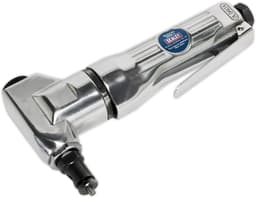
Set the regulator so the tool sees about 90 psi, which is about 6.2 bar, and do not wind it past that because the cut has stalled. Sealey's SA28 instructions are explicit: do not exceed 90 psi, drain water from the tank daily, and fit a short leader hose rather than hanging a quick coupler on the inlet. A few drops of air-tool oil in the inlet before you start is what Sealey asks for. That instruction is for a tool that wants oil. Hearing protection is the default. Sealey declares about 99 dB(A) and 88 dB(A) depending on the measure, and the 325B's maker sheet declares about 96 dB(A) and 107 dB(A). Those are tool declarations, not your daily dose. Eyes and gloves stay on because the waste is a small blade. The buying guide is where you confirm the inlet is BSP before any of this setup.

Clamp, start and follow

Clamp the sheet so it cannot flap. A flap changes the gap at the die, and the punch then skates or stalls. From an edge, you align the die with the line and let the tool feed. You do not push so hard that the motor note drops. In the middle of a panel, drill a hole large enough for the head, start there, and come round to the marked line. That is the same start window fitters use on a van skin, with the vehicle limits on the van conversion page. On the Ingersoll Rand 325B, reviewers say the cut only becomes visible about a quarter of an inch after it is made, so an unguided line wanders. Holding a straight edge against the snout is what produced the smooth straight cuts in those reviews. Mark the line on the side you can watch, on the thickness you will actually use.
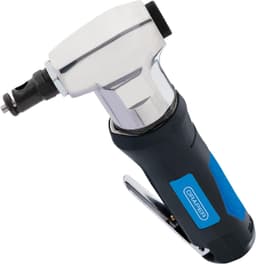
Draper Draper 70835 air nibbler

Testsieger

Draper Draper 70835 air nibbler
8.0/10about £35.56

When it stops or the edge is saw-toothed

If the punch stalls, back it out. Do not raise the regulator to push through. Back out, clear the crescent that is jammed in the die, and start again on a line the head can follow. If the tool dies a few seconds after a strong start, the tank has emptied faster than the pump refills it. That is airflow, and the sums are on the compressor size page. A saw-toothed edge means the punch is dull, the feed is too fast, or the sheet is at the limit of that head. Change the punch when the tool stalls at a thickness it used to finish, and disconnect the airline before you open the head. Walfront's own bullet is to unscrew the button on the head, open the lid and replace the blade.

Crescents, ears and hands

The waste is a stream of small crescents, and they are sharp. Reviewers on the 325B and the Walfront both describe chips flung around the work. Pick them up with a magnet or a brush once the airline is disconnected. Do not blow swarf off your hands or your face with the air line. Sealey's instructions are plain about that. At work, PUWER 1998 expects equipment that is suitable and maintained, including control of parts the tool ejects. Stop and get a professional when the line meets structure, a seat-belt anchorage or a bonded-glass system you have not fitted, or when you are on a roof without fall protection already in place.

Common questions

Where do I set the regulator?
Set it so the tool sees about 90 psi, and do not exceed that if you are following Sealey's SA28 instructions. Makers round the same pressure to 6 bar or 6.2 bar. If the gauge is only on the tank, remember the hose will lose some of that pressure before the inlet, especially on a long narrow line. A 10 mm hose is what Draper and Ingersoll Rand ask for.
Do I oil the inlet every time?
Oil it when that model's instructions say so. Sealey asks for a few drops of air-tool oil in the inlet and sells oils under its own part numbers. A tool that is not specified for oil should not be flooded because another brand's sheet said a few drops. Drain water from the compressor daily either way.
Why does the line wander?
The punch cuts ahead of the metal you are looking at. On the 325B, reviewers put that lag at about a quarter of an inch, and a straight edge against the snout is what kept the cut straight. Walfront reviewers report the same trouble seeing the head. Mark a line you can watch, clamp the sheet, and make the first pass on scrap.
What do I do if it stalls?
Release the trigger, back the head out, and clear the die. Check that the regulator is still near 90 psi and that you have not crept above it. If the compressor is hunting, stop and read the air-volume page rather than striking the tool. A blunt punch is the other usual cause, and you change it with the airline off.
When do I change the punch?
Change it when the tool stalls on a thickness it previously cut, or when the edge turns saw-toothed and a steadier feed does not fix it. Disconnect the airline first. Use the maker's kit where one exists: Sealey's is SA28PDKV2. On a Walfront, follow the listing's own step and unscrew the button on the head.

Related pages

Sources

Maker specifications, HSE and legislation pages, a fittings guide, and a compressor guide named in the digest. Listing prices, stars, and review counts are from amazon.co.uk on 19 October 2026.

  1. Ingersoll Rand 325B air nibbler (retrieved 19 October 2026)
  2. Sealey SA28.V2 instructions (retrieved 19 October 2026)
  3. Draper 70835 air nibbler (retrieved 19 October 2026)
  4. HSE — PUWER overview (retrieved 19 October 2026)
  5. Control of Noise at Work Regulations 2005, regulation 4 (retrieved 19 October 2026)
  6. HSE — Pressure Systems Safety Regulations (retrieved 19 October 2026)
  7. Hosemaster — air hose fittings (retrieved 19 October 2026)
  8. Sealey — guide to compressors (retrieved 19 October 2026)