Independent comparisons. We may earn from shop links. More info

What size compressor for an air nibbler

Updated: October 2026

The nibbler starts, punches a few crescents, then stalls while the tank gauge still looks healthy. That is a flow shortage. The tank stores air. It does not make it. What size compressor for an air nibbler means free air delivery at about 90 psi, plus a margin, not the litre badge on the side. The six listings, from about £34.32 to about £133.60 on the amazon.co.uk snapshot of 19 October 2026, are on the [air nibbler comparison](/hub/cutting-tools/air-nibbler). This page does not rank them. It tells you whether the compressor you own can keep the punch moving.

The nibbler starts, punches a few crescents, then stalls while the tank gauge still looks healthy. That is a flow shortage. The tank stores air. It does not make it.

Our top picks

On this page

Pressure, flow and the tank

Pressure is how hard the air pushes. Flow is how much arrives each minute. The tank sits between them as a reservoir. A gauge at 90 psi with the trigger closed only shows a charged tank. Once the punch starts, the compressor has to replace what the tool uses. Read free air delivery, FAD, at the working pressure rather than pump displacement. A bigger tank only lengthens the cut before the gauge slides. If the pump never catches the tool, extra litres will not make a window opening continuous. That is why one hobby compressor cannot be assumed to feed every row in the air nibbler buying guide.

Three air figures in this cluster

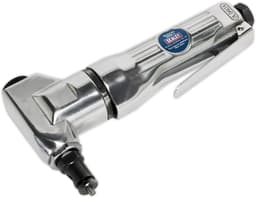
Sealey states 4 cfm at 90 psi for the SA28, listed at about £43.19. Sealey's compressor guide adds about 50 percent, so 4 cfm points at about 6 cfm of output, and sketches a tank of tool cfm times six, about 24 litres. That sketch is a supplier rule of thumb. Draper's amazon.co.uk listing for the 70835, at about £35.56, does not print cfm. Draper's page states 9.8 cfm, about 278 litres a minute, at 90 psi, with a 3/8 inch hose. Half again is about 15 cfm. Tooled-Up puts most professional nibblers at 4–6 cfm and suggests a 50 litre tank. The Ingersoll Rand 325B, at about £133.60, prints two figures. Average use is about 4 cfm, about 113 litres a minute. At load the sheet states 17 cfm, about 481 litres a minute, and a 10 mm hose. A long cut with the punch kept in the metal is the load figure. The cut sequence is on the how to use an air nibbler page.
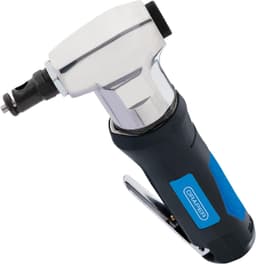
Draper Draper 70835 air nibbler

Testsieger

Draper Draper 70835 air nibbler
8.0/10about £35.56

Hose bore and the inlet thread

Draper asks for a 3/8 inch hose. Ingersoll Rand states 10 mm, the same bore. The Hosemaster fittings guide treats about 10 mm as the usual workshop hose and shows that a restrictive hose can halve the pressure at the tool while the tank gauge still looks fine. Sealey's instructions allow a minimum 1/4 inch hose and ask for more compensation past about 8 metres. UK couplers are BSP. Sealey and Draper state a 1/4 inch BSP inlet. The 325B inlet is 1/4 inch NPTF. NPT will not seal in a BSP port, so buy the adapter before the first cut. More than one Draper review says the connector supplied was not a standard 1/4 inch BSP fitting. Which nibbler to buy once the air matches is on the best air nibbler page.

A rule of thumb, labelled as one

Sealey's method stays a rule of thumb: add about half again to tool cfm, and sketch the tank as cfm times six. That is about 6 cfm and 24 litres for the SA28, about 15 cfm and 59 litres for the Draper, and about 26 cfm and 100 litres for the 325B at its 17 cfm load figure. Use the load figure for a long cut. A 50 litre tank on a 4 cfm compressor still cannot feed 9.8 cfm as a continuous cut. If FAD at about 90 psi does not cover the tool plus the margin, do not buy that nibbler yet. Walfront and Cocoarm state no air consumption, so they cannot be put through the sum. A qualifying purchase can earn a commission at no extra cost to you.

Common questions

What cfm does an air nibbler need?
There is no single cfm for every air nibbler. Sealey states 4 cfm at 90 psi, Draper states 9.8 cfm on its own page, and Ingersoll Rand states about 4 cfm on average and 17 cfm at load. A supplier rule of thumb adds about half again, so those tools point at roughly 6 cfm, 15 cfm and, on the load figure, about 26 cfm of compressor output.
Is 90 psi the same as 6 bar?
Ninety psi is about 6.2 bar. Makers round that to 6 bar or 6.2 bar, so a compressor rated at 6 bar is in the same band. The gauge has to hold that pressure while the punch is cutting, not only while the tank is full. Sealey's instructions say not to exceed 90 psi.
Does a bigger tank give more cfm?
Tank litres are storage. Free air delivery is what the pump can put out, and a larger tank does not increase it. A bigger tank lets you cut for longer before the pressure drops, then you wait while it refills. If FAD is below the tool's demand, that wait comes back on every long cut.
What hose size should I use?
Draper specifies a 3/8 inch hose and Ingersoll Rand specifies 10 mm, the same bore. Hosemaster treats about 10 mm as the usual workshop hose, because a thinner bore can cut pressure at the tool sharply, in the case they describe by about half. Sealey allows a minimum 1/4 inch hose and asks for extra compensation beyond about 8 metres.
Why does the 325B quote both 4 cfm and 17 cfm?
Ingersoll Rand prints an average of about 4 cfm and a load figure of 17 cfm for the 325B. The average describes lighter, interrupted cutting. The load figure, about 481 litres a minute, is what the tool can ask for while the punch stays in the metal, on a stated 10 mm hose. Size a continuous opening to the load number.

Related pages

Sources

Maker specifications, HSE and legislation pages, a fittings guide, and a compressor guide named in the digest. Listing prices, stars, and review counts are from amazon.co.uk on 19 October 2026.

  1. Ingersoll Rand 325B air nibbler (retrieved 19 October 2026)
  2. Sealey SA28.V2 instructions (retrieved 19 October 2026)
  3. Draper 70835 air nibbler (retrieved 19 October 2026)
  4. HSE — PUWER overview (retrieved 19 October 2026)
  5. Control of Noise at Work Regulations 2005, regulation 4 (retrieved 19 October 2026)
  6. HSE — Pressure Systems Safety Regulations (retrieved 19 October 2026)
  7. Hosemaster — air hose fittings (retrieved 19 October 2026)
  8. Sealey — guide to compressors (retrieved 19 October 2026)