Independent comparisons. We may earn from shop links. More info

Compressed air blow gun safety

Updated: 21.10.2026

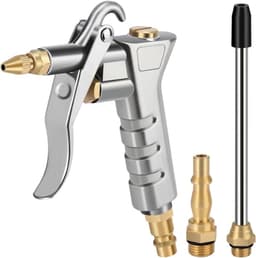
You have heard 30 psi on a US label, and you want to know what actually applies when you blow dust off a bench in the UK. Compressed air blow gun safety, on HSE's pages, is vacuum first, a low exit pressure, and no jet on skin or clothing. HSE does not ban the gun. The [compressed air gun comparison](/hub/compressors/compressed-air-gun) scores three pistols. This page does not. Products Compared editorial team used HSE's cleaning FAQ, HSG39 and MW1, plus the Noise Regulations and PSSR. We did not measure a gun. A qualifying amazon.co.uk purchase can earn a commission at no extra cost to you.

You have heard 30 psi on a US label, and you want to know what actually applies when you blow dust off a bench in the UK.

Our top picks

ABAC ABAC G-503

Best overall

ABAC ABAC G-503
8.6/10about £7.37
oumuik oumuik OD-1

Best value

oumuik oumuik OD-1
8.3/10about £7.99
MEANLIN MEASURE MEANLIN ML-291

Alternative

MEANLIN MEASURE MEANLIN ML-291
4.5/10about £31.99
On this page

What HSE actually says about cleaning

The engineering FAQ on hse.gov.uk lists the harm in plain terms. Compressed air can enter the bloodstream. Swarf can blind. Metalworking fluid blown onto clothing can cause dermatitis. Mist can contribute to asthma. Noise can cause permanent hearing loss. The precautions start with a vacuum, an extracted enclosure, a tamper-proof regulator, training and protective equipment. The cleaning number people quote is a guide, not a statute. HSE says cut the exit pressure as low as practicable, and that 30 psi, about 2.1 bar, is effective at cleaning. Try the vacuum before you reach for the pistol. OSHA's dead-end rule is US law. PUWER 1998 applies at work to the gun as work equipment, and it does not state a 2 bar figure. The numeric cleaning guide is the HSE FAQ.

Skin, clothing and eyes

HSG39 says compressed air should never be used to clean clothing. Use a vacuum with a brush head. MW1 repeats the line: never allow compressed air for cleaning skin and clothing. A safety nozzle, a star tip or a rubber end does not turn a clothing blow into an acceptable job. The air can still inject through skin, and fluid on overalls is a dermatitis problem, not a stain you blast off before the car park. Aim at nobody, and do not block the tip against a palm or a sleeve. If you think air has entered the skin, stop and get medical help. The how to use an air blow gun page puts the same limits into the order of work: glasses on, tip clear, loose debris only.
ABAC ABAC G-503

Testsieger

ABAC ABAC G-503
8.6/10about £7.37

Noise and the hose

The Control of Noise at Work Regulations 2005, regulation 4, sets employer exposure values. The lower action value is 80 dB(A), with a peak of 135 dB(C). The upper action value is 85 dB(A), with a peak of 137 dB(C). The exposure limit is 87 dB(A), with a peak of 140 dB(C), and hearing protection is counted only when you assess that limit. HSE's employers page treats these as daily or weekly personal exposure, not as a sticker on a pistol. HSG39 points to a self-venting connector when the hose is above 10 mm bore, longer than 10 m, or above 7 bar. A short hose on a small compressor may not meet that line. A long reel across a workshop often does. Flammable dust and toxic dust stay on a vacuum. The coupling family stays on the air blow gun buying guide.

The tank is not the gun

PSSR 2000 regulation 8 can require a written scheme of examination for a qualifying receiver. HSE's INDG178 is the plain-English note. A hire bulletin that cites L122 uses 250 bar litres as a worked threshold. That figure is about the vessel, not about the pistol you screwed on the hose. Buying a blow gun does not, by itself, put a home user under a written scheme. A workplace receiver near that line is a question for a competent person, not a conclusion you draw from the gun's title. Call a professional for a burst or whipping hose, for any injury where air may have entered the skin, and for flammable or toxic dust. Do not finish those jobs with a lower regulator setting. The Consumer Rights Act 2015, sections 9 and 11, covers a title that does not match the parcel. That is a buying problem when aluminium is printed and plastic arrives. It is not a safety method.

Common questions

Is 2.1 bar the law?
No. HSE's cleaning FAQ gives about 30 psi, 2.1 bar, as a guide to an exit pressure that still cleans after you have tried a vacuum. It is not a section of PUWER, and it is not OSHA restated as UK law. At work, PUWER still requires suitable equipment, maintenance and training. At home, the same pressure guide is the sensible ceiling for loose dust, and it does not make clothing or skin a permitted target.
Can I blow dust off my overalls?
No. HSG39 says compressed air should never be used to clean clothing, and MW1 says never to use it on skin or clothing. Use a vacuum with a brush head. Metalworking fluid on fabric is a dermatitis risk, and air driven at the body can inject. A safety nozzle does not lift that ban. If the dust is ordinary household dirt, brush it or vacuum it with the compressor switched off.
What eye protection do I need?
Safety glasses on before the first burst, because HSE treats swarf and dust in the eye as a foreseeable injury from this job. Glasses do not replace a vacuum for fine or toxic dust, and they do not make it acceptable to aim at another person. If you already wear prescription glasses, add rated eyewear rather than assuming the lenses are impact protection.
Does a safety nozzle make a clothing blow acceptable?
No. A vented tip, a star tip or a rubber nozzle reduces the chance of a dead-ended jet. It does not authorise blowing skin or overalls. HSE's clothing line is about the practice, not about one shape of tip. If the end may be blocked against a surface while you clean a bench, a vented tip is the hardware point. The clothing ban stays in force either way.
What are the noise action values?
For an employer, regulation 4 of the Control of Noise at Work Regulations 2005 sets a lower action value of 80 dB(A), an upper action value of 85 dB(A), and a limit of 87 dB(A), with peak values of 135, 137 and 140 dB(C). Hearing protection counts towards the limit assessment, not towards the action values. These are personal exposure figures over a day or week. They are not a decibel claim on a blow-gun listing.
Does my home compressor need a written scheme because I bought a gun?
Not from the gun. PSSR can require a written scheme for a qualifying receiver. The pistol is not that vessel. A hire bulletin's 250 bar litre example is about the tank, and a home user who only bought a pistol has not created the duty by that purchase. A workplace receiver near the line needs a competent person. If the hose bursts or whips, stop using it and get it examined rather than taping the split.
Is an OSHA mark a UK requirement?
No. OSHA is United States law. A logo on a blow gun, or a sentence that says OSHA compliant, does not replace the HSE cleaning FAQ, HSG39 or MW1. The UK guide people are usually reaching for is the 2.1 bar cleaning figure, plus the ban on skin and clothing. Read those HSE pages, and treat an OSHA badge as a US claim you can ignore when you are matching a UK hose.

Related pages

Sources

Public UK sources from the research digest, last checked on 19 October 2026. Prices, stars, and review counts are the amazon.co.uk lines captured that day.

  1. HSE engineering FAQ on blowing swarf (retrieved 19 October 2026)
  2. HSE HSG39 compressed air safety (retrieved 19 October 2026)
  3. HSE COSHH MW1, compressed air (retrieved 19 October 2026)
  4. HSE PUWER overview (retrieved 19 October 2026)
  5. Control of Noise at Work Regulations 2005, regulation 4 (retrieved 19 October 2026)
  6. Pressure Systems Safety Regulations 2000, regulation 8 (retrieved 19 October 2026)
  7. Consumer Rights Act 2015, section 9 (retrieved 19 October 2026)
  8. BCAS advice on working safely with compressed air (retrieved 19 October 2026)