Independent comparisons. We may earn from shop links. More info

How to mount an air hose reel

Updated: 21.10.2026

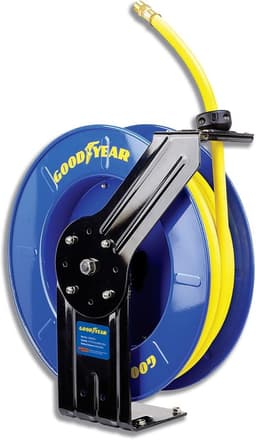
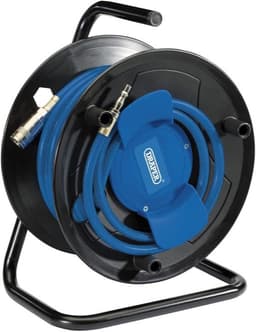
The reel is in the garage, the bracket is still in the box, and the wall in front of you is plasterboard over a void. That is the moment a 9 kg or 17 kg spring case becomes a problem, because the bolts supplied with many of these reels are meant for masonry and pull straight out of a hollow skin. This is how to mount an air hose reel so the first tug does not end with the case on the floor. We wrote it on 19 October 2026 from manufacturer warnings and the listings in our [20 m air hose reel comparison](/hub/compressors/air-hose-reel-20m). We did not fit these four reels ourselves. The weights are 9 kg for the Goodyear hybrid, 11.8 kg for the INCENDIOS and 17.4 kg for the steel Goodyear. The Draper 70838 is 4.04 kg and freestanding, so this page is not its fitting guide. If you are still choosing bore and coupling, use the [buying guide](/hub/compressors/air-hose-reel-20m/sub/air-hose-reel-20m-buying-guide) first. A qualifying purchase can earn us a commission at no extra cost to you.

The reel is in the garage, the bracket is still in the box, and the wall in front of you is plasterboard over a void.

Our top picks

On this page

Choose a structure, not a plasterboard skin

Fix the reel to masonry or to structural timber. A plasterboard garage wall, a thin panel or a single plasterboard screw is not a structure. Goodyear hybrid reviews describe anchors that failed on panelling. That matches the weight: 9 kg is already more than a picture hook, and the steel reel is nearly twice that before the hose is under tension. On brick or block, use masonry anchors that suit the bracket holes, and drill into the solid leaf rather than the render. On a stud wall, the lag screws need to find the studs. If the bracket misses the timber, a piece of plywood across two studs gives the bolts something continuous to hold. That is a workshop method people use, not a UK building regulation. For a ceiling, the same idea applies between joists: extra blocking, then the bracket, rather than screws into plasterboard alone. One review of the heavy steel reel added timber across ceiling joists before hanging it. At 17.4 kg that is the sensible reading of the listing. Sealey’s instructions for the shorter SA811 to SA814 reels, a different model family, say to fix the reel to a sound structure. Treat that as the clearest UK manufacturer warning in this class, and do not copy screw sizes from it onto these Amazon brackets. The listings here do not publish a torque or a screw schedule. If you cannot find a joist or solid masonry, stop.

Fit the bracket and the lead-in

Take the bracket off the case before you offer it to the wall, if the design allows it. Reviews of these spring reels say that is easier than holding the whole weight while you mark the holes. Hang the bracket, tug it by hand, and only then bolt the case back on. A tug that moves the bracket will move it harder once the hose is full. The hose that joins the compressor is not the 20 m working hose. The Goodyear hybrid includes about 0.9 m of lead-in, the INCENDIOS includes 2 m, and the steel Goodyear includes none. Put the reel where that short hose reaches the compressor outlet without a kink, which usually means the same wall as the compressor or the bay beside it. If 0.9 m will not reach, buy a longer lead-in before you drill. With the steel reel that purchase is certain, because the box does not contain one. Keep the inlet coupling the same profile as the compressor, BSP and either PCL or Euro, not a mix. A lead-in that looks connected and then separates under pressure is the whip HSE guidance in HSG39 describes when a hose or fitting fails. Eye protection is the sensible minimum while you test. Do not point the air at your skin or use it to blow dust off your clothes.

Pull, lock and walk it back

Pull the hose out along the route you will actually use, lock the ratchet, and fit the tool only after that lock has held for a moment. The Goodyear hybrid bullets claim an auto guide. Several reviews say the hose still stacks on one side and then jams. If you see a ridge building on one cheek of the drum, walk the hose back in a flatter line instead of letting the spring snatch it. Do not let go of a spring hose at full stretch. CEJN’s UK guidance prefers overhead reels and a controlled retraction speed so a released hose does not strike people or cars. None of the kept Amazon listings states that slow speed. One non-UK review of the hybrid describes a pawl that jumped and a hose that whipped. UK reviews more often describe jams and locks. Either way, you walk the hose back with a hand on it. Over-extension is a stated cause of retract failure in the Sealey manual for the shorter family. Stop before the hose goes tight against the stop, even if you still need another half metre. That half metre is a mounting position problem, which the garage reach page covers. The first rewind test is with the tool off the end and the pressure low enough that a slip is a nuisance rather than a strike. If the latch will not hold on that test, do not leave the hose deployed across the floor.

When to stop and call someone

Stop if the latch lets the hose go, if you cannot find a joist or solid masonry, or if the only way to reach the spring is to open the case. Do not open a spring case. The stored spring is the part these consumer listings do not invite you to service, and Sealey’s shorter-reel manual says the same for its own range. A slipping latch on a 20 m hose is a reason to take the reel out of service, not a reason to tie the hose back with a knot. Also stop if the compressor receiver is large enough that a written scheme under PSSR 2000 may apply. A 50 litre receiver at 8 bar is 400 bar litres, over the 250 bar-litre line where that scheme rule drops away. A 24 litre receiver at 8 bar is 192, under the line, and operation duties still apply. That is a vessel question for a competent person. If the reel you bought is the Draper crank, you are on the wrong page for fixings. It stands on the floor. PUWER 1998 applies when the reel is work equipment rather than a domestic garage tool. A home bay is not automatically a workplace. If it is, the duty sits with the employer, and a consumer listing is not the risk assessment.

Common questions

Can I use the plugs in the box on a plasterboard garage wall?
Not as the only fixing. The spring reels in this set weigh about 9 kg, 11.8 kg and 17.4 kg, and hybrid reviews describe anchors pulling out of panelling. Use masonry or find the studs or joists. If the bracket misses the timber, bridge two studs with plywood. That is a method, not a building regulation, and it still fails if there is no timber to find.
Where should the reel sit relative to the compressor?
Close enough for the lead-in you actually have. That is about 0.9 m on the Goodyear hybrid, 2 m on the INCENDIOS, and nothing in the box on the steel Goodyear. The working 20 m then runs towards the car. A lead-in that kinks at the inlet is a leak waiting for the first full pressure, so move the bracket before you lengthen the hose with an adapter stack.
How do I stop the hose piling up on one side?
Walk it back instead of letting the spring snatch it, and watch the first few layers. Hybrid reviews say the hose stacks on one cheek even when the listing claims an auto guide. A ridge on one side is the jam forming. Feed the hose across the drum with your hand until the layers sit flatter.
What do I do if the latch will not hold?
Take the reel out of use. Do not leave 20 m of hose across the floor, and do not open the case to bend the pawl. A latch that dumps the hose is the point where a professional, or a return to the seller, replaces a home repair. Tie-backs and knots are not a latch.
Should I open the case to fix the spring?
No. The spring is stored energy, and the consumer listings do not give a service method for opening the case. Sealey’s manual for a shorter reel family says not to open the case either. If the rewind has failed, stop using the reel.
Do I connect the tool before the first rewind test?
Connect the lead-in and prove the latch first, with the tool off the end and the pressure modest. Fit the tool once a short pull stays locked. A tool on a hose that then whips is heavier than the hose alone, which is the wrong way to learn that the pawl does not hold.
When is the ceiling the better mount?
When a wall reel would leave the hose across the bay, and you have joists you can block between. A high mount uses some of the 20 m on the drop to the tool, so measure that before you drill. It is the worse mount if you cannot find the joists and you are hoping plasterboard screws will hold 17.4 kg.

Related pages

Sources

Public UK sources and the Sealey list page below. amazon.co.uk listings checked on 19 October 2026.

  1. legislation.gov.uk: Pressure Systems Safety Regulations 2000 (retrieved 19 October 2026)
  2. HSE: Written schemes of examination (INDG178) (retrieved 19 October 2026)
  3. HSE: Compressed air safety (HSG39) (retrieved 19 October 2026)
  4. HSE: Provision and Use of Work Equipment Regulations 1998 (PUWER) (retrieved 19 October 2026)
  5. BCAS: PSSR compliance fact sheet (retrieved 19 October 2026)
  6. The Hosemaster: air hose fittings, connectors and couplings (retrieved 19 October 2026)
  7. Sealey: retractable hose reels, list prices including VAT (retrieved 19 October 2026)
  8. amazon.co.uk listings B096SMG5H6, B07CMJTRXJ, B0GGH5YR6T and B07CMN21R5 (retrieved 19 October 2026)