Independent comparisons. We may earn from shop links. More info

10 bar air compressor buying guide

Updated: 21.10.2026

You have typed 10 bar into a UK search and the results mix a £25 boot pump with a 50 litre garage receiver. The pressure number is a ceiling, not a score for how well the machine will fill a tyre or run a nailer. This 10 bar air compressor buying guide sorts the six amazon.co.uk listings in our comparison into three jobs, then covers airflow, the plug, noise, and the workplace rule on tank size. Shelf prices and star lines sit on the [Air compressor 10 bar](/hub/compressors/air-compressor-10-bar) comparison. Products Compared checked the listings on 19 October 2026. This is not a lab test.

You have typed 10 bar into a UK search and the results mix a £25 boot pump with a 50 litre garage receiver. The pressure number is a ceiling, not a score for how well the machine will fill a tyre or run a nailer.

Our top picks

On this page

Three products share the 10 bar label

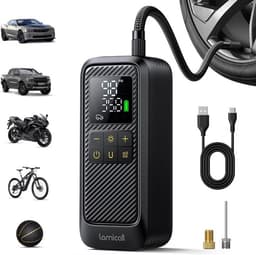
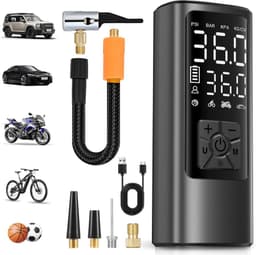
A cordless inflator, a 5 litre portable, and a 50 litre receiver can all wear a 10 bar or 150 psi title. They do not do the same work. HOVVIDA at £24.99 and Lamicall at £37.96 are battery pumps rated to 150 psi, about 10.3 bar. FORTEM at £39.99 is the same class of direct pump, with 230 V mains and a 12 V lead instead of a battery. None of them stores air. Stanley’s DN200/10/5 at £133.27 is the only 5 litre, 10 bar receiver here, listed at 1,100 W. ABAC’s Ease-AIR 50V at £195.99 and Einhell’s TC-AC 240/50/10 OF at £212.95 are vertical 50 litre oil-free tanks at 10 bar. If the job is a car tyre on the drive, the inflators are the relevant machines. The 10 bar tyre inflator page stays with that job. A staple gun or a blow gun needs air stored in a receiver, and a pump stated at 20 to 25 litres per minute will not replace a tank. A 5 litre tank reaches 10 bar quickly and the motor starts again almost at once if the tool keeps drawing. A 50 litre tank gives a longer pause between refills, which is why a garage buyer is choosing between the Einhell and the ABAC.

Airflow before maximum pressure

Ten bar is the highest pressure the tank or the pump is rated to reach. The tool almost always wants less. TEH Tools, a UK seller, says most of its pneumatic tools sit around 5 to 8 bar. That is a seller guide, not a test of these six listings. The figure to trust is free air delivery, the air still supplied at a stated pressure, not the displacement or the word aspirated on the title. Einhell’s amazon.co.uk page prints 240 litres per minute. A Tooled-up sheet for the same TC-AC 240/50/10 OF prints suction of 240 litres per minute and output at 7 bar of 76 litres per minute, with motor duty marked S3 25 per cent. Use 76 litres per minute only as that retailer’s figure at 7 bar. We did not measure it. ABAC prints 220 litres per minute aspirated, which means air drawn in, not air delivered at 7 bar. Stanley prints 180 litres per minute beside a 5 litre tank, which still is not free air delivery. If you are asking whether an 8 bar machine with a published delivery figure would feed the tool better, that sits on the 10 bar vs 8 bar air compressor page.

Socket, plug, and noise

UK mains are 230 V and the domestic plug is BS 1363. In this set, only the ABAC listing includes a Type G adaptor. Stanley’s United Kingdom reviews repeatedly describe a European plug, sometimes with a separate adaptor and sometimes without one. FORTEM’s voltage field says 230 V and the description also says 110–240 V AC plus 12 V DC, but the specification table does not name BS 1363. Einhell’s table does not either, and one United Kingdom review describes a damaged plug. Check the lead in the photos before you assume it will go into a UK socket. Electrical Safety First says a cable reel should be unwound so it can shed heat, and a 13 A reel is still limited by the fuse. Air Supplies tells buyers to keep the compressor near the socket and to lengthen the hose rather than run a long coiled extension. Catalogue noise on the amazon.co.uk pages is 80 dB for the FORTEM, 95 dB for the Einhell, 97 dB for the ABAC, and 98 dB for the Stanley. Tooled-up prints 77 dB(A) sound pressure for the Einhell while Amazon prints 95 dB. Those are different claims. Do not average them. Employer action values under the Control of Noise at Work Regulations 2005 are 80 dB(A) and 85 dB(A). A catalogue figure is not your personal exposure, but a pump listed at 95 to 98 dB is loud enough that hearing protection belongs beside it.

The 250 bar litre line

Pressure systems law is aimed at work, not at a private householder with no employees. The Health and Safety Executive leaflet INDG178 treats an air receiver as likely to need a written scheme of examination when pressure in bar times volume in litres is 250 or more. Fifty litres at 10 bar is 500 bar litres. Five litres at 10 bar is 50, under that line. The inflators have no receiver, so the sum does not apply to them. If staff use the 50 litre machine, the written scheme is an employer duty. If you are inflating tyres at home, it is not. Either way, leave the safety valve and the pressure switch alone, and do not treat compressor air as breathing air. Oil-free does not mean the air is dry. Water still condenses in the tank. A driver who only wants a boot pump can ignore the 500 bar litre sum. A garage user who wants stored air should pick a receiver, then read the plug line before checkout.

Common questions

Is 150 psi the same as 10 bar?
150 psi is about 10.3 bar. Sellers print it on cordless and 12 V inflators. A workshop listing that says 10 bar is usually also printed as 145 psi. The numbers are close and the machines are not. An inflator has no tank. A 10 bar receiver stores air up to that ceiling, and you then set the tool below it on the regulator.
Do I need a 50 litre tank for car tyres?
No. A car door placard is typically around 30 to 36 psi, far below 150 psi. HOVVIDA, Lamicall, and FORTEM are the listings in this set built for that job. A 50 litre receiver is for tools that need a store of air. It is heavier, louder on the catalogue figures, and the wrong thing to keep in a boot.
What airflow number should I trust?
Trust a free-air or output figure that names the pressure, such as the Tooled-up line of 76 litres per minute at 7 bar for this Einhell. Do not treat Einhell’s 240 litres per minute, ABAC’s 220 litres per minute aspirated, or Stanley’s 180 litres per minute as the air a spray gun will receive. The cordless pumps state 20 or 25 litres per minute, which is tyre-pump air, not workshop air.
Will it run from a normal UK socket?
The mains machines are listed at 230 V. Only ABAC states a Type G adaptor in the box. Stanley reviews often report a European plug. Einhell and FORTEM do not state BS 1363 on the specification table. Check the lead before you pay, and do not run the compressor at the end of a coiled extension reel.
Does a homeowner need a written scheme?
PSSR duties apply to pressure systems used at work. A private householder with no employees is not that user. A 50 litre tank at 10 bar is 500 bar litres, so a workplace that uses it is in the range where HSE expects a written scheme. Five litres at 10 bar is 50 bar litres, below that 250 bar litre line.
Why are some 10 bar machines so loud?
The catalogue figures here run from 80 dB on the FORTEM to 95, 97, and 98 dB on the Einhell, ABAC, and Stanley. Oil-free direct-drive pumps are noisy, and a higher bar rating does not make them quieter. Another Einhell model advertised elsewhere at about 70 dB is a different listing and is not in this set. Do not copy that figure onto the TC-AC 240/50/10 OF.

Related pages

Sources

Public UK sources below. amazon.co.uk listings checked on 19 October 2026.

  1. HSE, PSSR overview (retrieved 19 October 2026)
  2. HSE, INDG178 written schemes (retrieved 19 October 2026)
  3. Control of Noise at Work Regulations 2005 (retrieved 19 October 2026)
  4. GOV.UK, Pressure Equipment (Safety) Regulations 2016 (retrieved 19 October 2026)
  5. GOV.UK, Supply of Machinery (Safety) Regulations 2008 (retrieved 19 October 2026)
  6. BSI, BS EN 1012-1:2010 (retrieved 19 October 2026)
  7. Electrical Safety First, extension leads (retrieved 19 October 2026)
  8. Sealey oil-free 50/100 L instructions (retrieved 19 October 2026)