Independent comparisons. We may earn from shop links. More info

PCP compressor vs hand pump

Updated: 21.10.2026

You can put air in a PCP three ways: a stirrup pump on the kitchen floor, a small electric compressor, or a charged cylinder you collected from a shop. The hand pump is cheap and hard work past about 150 bar. The compressor costs more, needs a socket you have actually checked, and must be watched. The cylinder is fast and useless if the test stamp is out of date. This page chooses the method. It does not pick an ASIN. Those rows are on the [300 bar compressor comparison](/hub/compressors/300-bar-compressor).

You can put air in a PCP three ways: a stirrup pump on the kitchen floor, a small electric compressor, or a charged cylinder you collected from a shop. The hand pump is cheap and hard work past about 150 bar.

Our top picks

On this page

What each method is for

Air Arms, writing for UK PCP owners, sets out the same three options and does not crown one of them. A stirrup pump is a three-stage hand pump, often around 2 kg, with a stated maximum that can read 300 bar on the box. A compressor in this amazon.co.uk set is an electric pump from £132 to £259, mostly 5–16 kg, claiming the same sort of ceiling. A charging cylinder is a bottle that someone else filled, usually to 300 bar, which you then decant into the rifle through a hose and a gauge. All three still stop at the rifle’s fill, not at 300 bar. BSA’s R12 manual states 232 bar. The method does not change that. Moisture, effort and what happens when you are tired are the real differences. A hand pump puts whatever is in the room into the rifle, and you feel every bar. A cheap compressor can put oil mist and water into the line unless a separator is doing its job, and a separator is still not breathing air. A shop cylinder is only as dry as the shop’s fill. Geoff Wilson’s, a UK retailer, describes shop air-cooled compressors as often £400 and up, which is above every listing in this set.

When the hand pump is the better tool

Choose the stirrup pump if you shoot occasionally, you can finish the last part of the fill, and you may be away from a socket. Vector Air’s note on a three-stage pump is blunt about effort past 150 bar: it is not the tool if you cannot sustain the work. The last 50 bar is where people stop, rest, and then overshoot because they are rushing the gauge. If that sounds like you, the pump is the wrong saving. A seller such as Uttings quotes about 15 minutes from empty to 200 bar on a Bisley Air Pump One, and about 5–7 minutes from 100 to 200 bar, at a stated 300 bar maximum and about 2 kg. Those are seller figures, not a time we measured, and that pump is not an ASIN in this comparison. Use them only as a picture of a quarter of an hour of work, not as a promise. The hand pump wins when the rifle is a small cylinder, you top up from 100 bar rather than from empty, and you want no plug, no fan and nothing that can be the wrong voltage. It loses when your shoulder or your knees will not do that quarter-hour every weekend. A compressor does not remove the rifle’s fill limit. It only removes the stirring.

When the compressor is the better tool

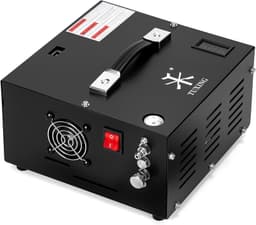
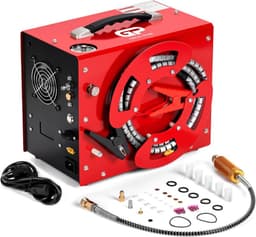
Choose a compressor if you fill at home most weeks, you will stay in the room, and you have checked the live listing for 230 V rather than a 110 V table. The eight pumps we compared cost £132–£259 on 19 October 2026. That is less than the £390–£980 shop machines, and it buys a smaller review file, a voltage argument on several ASINs, and seller support that UK owners on forums describe as thin. The top pick inside the set is the £169 TUXING whose table says 220 V, with the failure reviews left in the score. The best-value file is the £152.99 TUXING with 737 ratings, a 110 V table, and no auto-stop in the reviews. Neither is cheaper over a lifetime in a sum we can stand behind. Parts, a dead fan, or a move to a Hill can wipe the saving. The voltage and stop checks are in the buying guide. You still bleed the hose, you still stop at the rifle manual, and you still do not breathe the air. A 40 A clamp lead is not a cigarette-lighter fill in a lay-by. If you want the pump for the car and the hand pump for a peg in the woods, that split works, provided the compressor has a voltage you can use at home. People who should not buy the compressor are the ones who need a large cylinder from empty, or who will leave the pump running. Who each listing is for is on the best 300 bar compressor page.

When a tested cylinder wins

A 300 bar charging cylinder wins when you want the rifle full in seconds and a dive shop or gun shop will fill the bottle. You carry the weight, you pay per fill, and you cannot ignore the stamp. Talarms, a UK cylinder service, notes that a surface valve is often on a five-year hydrostatic interval, while a scuba valve often has a shorter visual inspection as well. That is their description of common practice, not a single rule for every valve you might buy. Drapers tells owners that shops look for a test history before they refill. If the stamp is out of date, the shop should refuse, and you should not just use the compressor on it either. The cylinder is the wrong tool if you have nowhere to refill it, or if you shoot so little that a hand pump from 100 bar is a few minutes and the bottle hire is not. It is the right tool if you are filling several rifles on a range day and you do not want a hot 350 W pump in a clubhouse that has not agreed to it. Our conditional pick is this: occasional fills you can physically finish, a stirrup pump; regular home fills you will supervise, a compressor from this set after the voltage check; a fill in seconds and a shop nearby, an in-test cylinder. Products Compared did not time a pump or a stirrup against a clock. A qualifying purchase can earn a commission at no extra cost to you.

Common questions

Is a hand pump enough for a PCP?
Yes, if the cylinder is the rifle’s own small reservoir, you are topping up rather than filling a large bottle from empty, and you can keep pumping past 150 bar without rushing the gauge. It is a poor choice if that last stretch already hurts, or if you are filling several rifles. Air Arms treats the hand pump as one of three valid methods, not as a beginner toy you must replace. A stated 300 bar on the pump box is the pump’s ceiling. The rifle manual is still the stop.
How hard is the last part of the fill?
Harder than the first 100 bar. Three-stage stirrup pumps take much more effort as you pass about 150 bar, which is the point Vector Air flags. Seller times of several minutes for the top of the fill are marketing measurements, not ours. If you have to stand on the pump or rest every few strokes, you are more likely to misread the gauge. That is the moment to stop and choose a compressor or a cylinder, not to force the last 30 bar.
When does a compressor pay for itself?
There is no honest break-even we can print. A £132–£259 pump can replace a year of shop fills if you shoot often and the pump keeps working. It does not pay if it fails in months, which is a pattern in some TUXING reviews, or if you then buy a £900 shop compressor anyway. Count your actual shop-fill receipts, not a forum average. If those receipts are already high and you will watch the pump, the compressor is the method. If you shoot monthly, the hand pump may remain the cheaper tool.
Is a 300 bar cylinder easier?
Yes, at the moment of filling the rifle. You open a valve, watch a gauge, and bleed, and the rifle is full in seconds if the cylinder has pressure. The work moved earlier: getting the cylinder tested, filled and carried. A cylinder at 300 bar is also stored energy that a hand pump never holds. Keep the stamp in date, do not leave it in a hot car boot as your storage plan, and do not fill it from a small fan-cooled pump as if it were a rifle reservoir.
How often is a cylinder tested?
There is no single interval for every valve. Talarms describes a surface valve as often five years between hydrostatic tests, and a scuba valve as often needing a shorter visual check as well. Shops such as those Drapers describes will look at the stamp before a refill. If you do not know which valve you have, ask the filler who stamps that bottle. Do not copy a five-year figure onto a scuba cylinder, and do not use an out-of-test bottle with a home compressor to dodge the shop.
Which is quieter?
The hand pump is as quiet as your breathing and the stirrup. The compressors in this set quote about 78–85 dB on the listing, which is seller text, not a measurement we made, and one water-cooled unit is listed at 85 dB with a review that calls the fan noisy. A cylinder fill is a short hiss. If you are in a terrace and the only slot is early morning, the hand pump or a cylinder filled elsewhere is the considerate choice. Do not buy the compressor for a decibel claim.
What if I only shoot occasionally?
Use the hand pump if you can finish a top-up from about 100 bar, or take the rifle to someone with a cylinder if you cannot. A £169 compressor that needs supervising is a lot of machine for a tin of pellets a month, and it still has the voltage and failure caveats on the best-of page. Occasional use is the hand pump’s best case. Regular use, with you in the room, is the compressor’s. The cylinder sits between them when a shop is close and the stamp is current.

Related pages

Sources

Public UK sources listed below. amazon.co.uk listings for these eight ASINs were captured in October 2026.

  1. Pressure Systems Safety Regulations 2000, Schedule 1 (retrieved 19 October 2026)
  2. HSE INDG178: written schemes of examination (retrieved 19 October 2026)
  3. Plugs and Sockets (Safety) Regulations 1994 (retrieved 19 October 2026)
  4. OPSS product recall: Vevor PCP air compressor 2208-0358 (retrieved 19 October 2026)
  5. Firearms (Dangerous Air Weapons) Rules 1969 (retrieved 19 October 2026)
  6. Home Office firearms licensing guide, September 2026 (retrieved 19 October 2026)
  7. HSE DVIS 9: breathing air and BS EN 12021 (retrieved 19 October 2026)
  8. BSA R12 PCP rifle instructions (retrieved 19 October 2026)