Independent comparisons. We may earn from shop links. More info

How to use a 300 bar compressor

Updated: 21.10.2026

The pump is on the bench, the rifle is unloaded, and the hose is still empty. The mistake that hurts is filling to the number on the compressor, walking off, or pulling a live hose apart. This is how to use a 300 bar compressor for a PCP rifle or a small bottle: set the stop at the rifle or bottle rating, stay in the room, and bleed before the coupling comes off. The steps below do not rank the eight listings. Prices are on the [300 bar compressor comparison](/hub/compressors/300-bar-compressor).

The pump is on the bench, the rifle is unloaded, and the hose is still empty. The mistake that hurts is filling to the number on the compressor, walking off, or pulling a live hose apart.

Our top picks

On this page

Before you switch it on

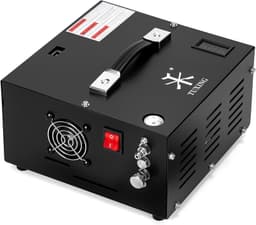
Unload the rifle and point it in a safe direction. Fit the probe the rifle actually uses. An 8 mm quick connector on the pump is not automatically the Foster fitting or the thread on your gun. A UK review of one TUXING in this set needed an adaptor and thread tape for an Air Arms S410. If the whip does not seat, stop and change the fitting. Forcing it is how a hose leaves a valve under pressure. Check the voltage on the live listing against the lead in your hand. UK mains are 230 V with a BS 1363 plug. Several pumps in this comparison show 110 V in the specification table. A travel adaptor does not convert that. If you are on 12 V clamps, the bullets that say about 40 A mean a battery, not the cigarette-lighter socket, and you do not connect mains and 12 V together. Start the fan, or the water pump on the one water-cooled listing, before you ask the compressor for pressure. ShootingUK’s charging notes and the BSA R12 instructions both assume you use the gauge on the filling kit and that you know the rifle’s maximum before the first stroke. The fill pressure, if you are still unsure of it, is on the PCP air rifle page. These steps do not change the rifle’s legal power.

During the fill

Open the rifle valve slowly and watch the charging gauge, not only the gauge on the rifle. ShootingUK makes that point because the rifle gauge can lag or disagree. A UK review in this set found the same mismatch. Believe the lower safe figure and the number in the manual. BSA’s R12 states 232 bar as a maximum, and Gamo PCP manuals state 232 bar as well. Other rifles differ. Do not fill to 300 bar because the pump’s title says it can. Stay in the room. On the £139 TUDIVING, a UK review says the advertised preset is not on the machine. On the heavily reviewed £152.99 TUXING, reviewers say there is no on/off switch and no auto-stop even where an advert suggested one. On the £169 TUXING, a reviewer says you set a needle on the analogue gauge and the screen shows temperature only. If you have not seen the pump stop by itself on a previous fill, treat this fill as manual. High-pressure air can penetrate skin, which is why the Health and Safety Executive’s guidance on compressed air treats a leak as an injury risk, not a draught. Keep your hands off a hissing coupling.

Bleed, cool, store

When the charging gauge reaches the rifle or bottle limit, stop the pump. Close the rifle valve. Bleed the hose with the bleed on the filling kit before you uncouple anything. ShootingUK and the BSA instructions both put the bleed before the hose comes off. A pressurised whip is the part people rush. If your pump’s own sheet describes a different order, follow that sheet for that machine, and still do not pull a coupling that is holding pressure. Let the case cool before another bottle. Seller lines about a rest after a run are listing text, not a test we repeated, and they do not agree. There is no single temperature cut-off we can give for every ASIN in this set. If the fan is not turning, or the water pump on the cooled model is not moving water, switch off. A UK review of the cheapest SDKEHUI said the case was too hot to touch within two minutes, which is a reason to stop, not a duty cycle to copy. Store the pump dry, with the lead unplugged.

When you stop and get help

Stop and do not restart if the case smells of burning, the fan has smoked, or a gauge has left the housing. Two UK reviews of the £132 SDKEHUI describe a blown gauge and exposed live connections. That is a reason to unplug from a safe position and leave the listing, not a reason to tape the gauge back on. A burst disc that has opened, as one reviewer of the £152.99 TUXING reported while testing, is a maintenance part. Bypassing it is not. Do not use these steps to fill a scuba tank or anything you will breathe. Listings in this set are not BS EN 12021 compressors. A bullet that mentions an external carbon filter also says the filter is not included. If the cylinder is out of test, dented, or you do not know its rating, take it to someone who fills that kind of bottle for a living. What to buy, if you are still choosing the pump, is in the buying guide.

Common questions

Do I fill the rifle to 300 bar?
No, unless the rifle manual states 300 bar, which the common PCP examples do not. BSA’s R12 and Gamo’s PCP manual both state 232 bar as a maximum. Many owners fill lower, around 180–200 bar, for the shot count they want. The pump’s 300 bar or 4,500 psi title is the machine’s claimed ceiling. Set the needle, or stop your hand, at the rifle’s number. Overfilling an unregulated rifle can even reduce power until the pressure falls, which ShootingUK explains.
What do I do before I uncouple the hose?
Stop the pump, close the rifle or bottle valve, and open the bleed on the filling kit until the hose gauge falls. Only then release the coupling. ShootingUK and the BSA filling notes both use that order. If you skip the bleed, the whip is still a charged hose. Keep your face and hands clear of the vent. If you cannot find a bleed on the kit you own, do not improvise by cracking a joint under pressure. Get a filling adaptor that has one.
Can I leave a 300 bar compressor running?
No. Stay where you can see the gauge and hear the fan. Several listings in this set are manual-stop, or the auto-stop in the advert did not match the machine reviewers received. A pump that is supposed to stop can still fail to stop. Heat builds quickly on the small fan-cooled units. If you need to leave the room, switch it off first. A water-cooled listing still needs you there, because six ratings do not prove its shut-off.
What if the fan does not start?
Switch off and unplug before you look inside. A fan that is stopped, or that has already smoked in the way some £169 TUXING reviews describe, is not a pump you keep using for one more bottle. Check that you have not blocked the intake, then stop. Do not open the case while it is plugged in. Exposed conductors are already a review theme on the cheapest listing. If the plug, the fuse or the earth looks wrong, leave it and use another fill method.
How do I know the pump has really auto-stopped?
Watch a fill once with your hand near the switch. On the £169 TUXING, a UK reviewer says the control is a needle you set on the analogue gauge, and the screen is temperature only. On the £139 TUDIVING, a reviewer says there is no preset at all. A title that says auto-stop is not proof. If the motor is still running after the charging gauge passes your set point, switch it off yourself. The next fill is manual until you have seen a true cut-out.
Can I fill a scuba tank with the same steps?
No. The bleed-and-watch sequence is for a PCP rifle or a small bottle you are allowed to fill, not for breathing air. These listings do not meet BS EN 12021. A carbon-filter sentence on a TUXING page says the filter is extra and still does not turn the pump into a dive compressor. Large cylinders are a competent-person job on purpose-built machines. If the tank is for diving, take it to a dive shop that stamps and fills that cylinder.
When do I stop and get help?
Stop if you smell burning, the gauge has left the housing, the plug looks counterfeit or the earth is missing, or the cylinder is dented or out of test. Also stop if you are about to fill breathing apparatus. The Office for Product Safety and Standards has recalled other PCP compressors for shock and counterfeit plugs. That recall is a different brand. It still describes the failure you should not investigate with the cover off. A gun shop or a cylinder filler is the next call, not another attempt on the same hose.

Related pages

Sources

Public UK sources listed below. amazon.co.uk listings for these eight ASINs were captured in October 2026.

  1. Pressure Systems Safety Regulations 2000, Schedule 1 (retrieved 19 October 2026)
  2. HSE INDG178: written schemes of examination (retrieved 19 October 2026)
  3. Plugs and Sockets (Safety) Regulations 1994 (retrieved 19 October 2026)
  4. OPSS product recall: Vevor PCP air compressor 2208-0358 (retrieved 19 October 2026)
  5. Firearms (Dangerous Air Weapons) Rules 1969 (retrieved 19 October 2026)
  6. Home Office firearms licensing guide, September 2026 (retrieved 19 October 2026)
  7. HSE DVIS 9: breathing air and BS EN 12021 (retrieved 19 October 2026)
  8. BSA R12 PCP rifle instructions (retrieved 19 October 2026)