Independent comparisons. We may earn from shop links. More info

12V tyre inflator for a van

Updated: 21.10.2026

The pump that topped up the car at about 35 psi is now loud, hot or already dead on a van or motorhome tyre. A 12V tyre inflator for a van has to move more air, often to a higher placard, through a longer body, without cooking the cigarette-lighter fuse. This page stays with that job. The [12V air compressor comparison](/hub/compressors/12v-air-compressor) holds the nine amazon.co.uk listings compared on 19 October 2026. We have not timed these pumps. The figures below are listing claims and review reports. A qualifying purchase can earn us a commission at no extra cost to you.

The pump that topped up the car at about 35 psi is now loud, hot or already dead on a van or motorhome tyre.

Our top picks

On this page

Why a car inflator runs out of puff

A 150 psi badge is a ceiling. It does not say how many litres per minute the pump moves once the tyre is already above a car pressure. A large van tyre holds more air than a 185-section car tyre, and a motorhome placard is often far above the mid-thirties. Both problems arrive together. The light socket pumps in this set do not state litres per minute, so a 150 psi line is not a promise that they will finish a motorhome tyre. UK writing outside this comparison makes the same split. Out and About Live found a compact socket unit slower on a motorhome, and described a clamp compressor with a long hose, a Ring RAC900 that is not in this set, as the one that could feed a high current and still reach the wheels. One auto-stop on a unit they tried undershot by about 2 psi. That is their result, not a test of the GSPSCN. On MotorhomeFun, an owner who needs about 70 psi reports pumps that claim 100 psi struggling after 65 psi, while another cites a unit that still works past 80 psi. Ring’s RAC830, also outside this set, is sold for motorhomes at 180 W, 0–100 psi, with a 3.5 m fused lead. These are other people’s reports, not a timed test of our own.

What owners in these reviews actually inflated

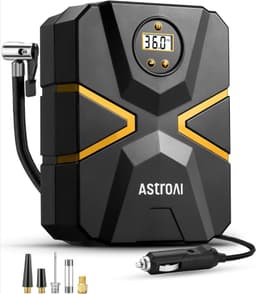
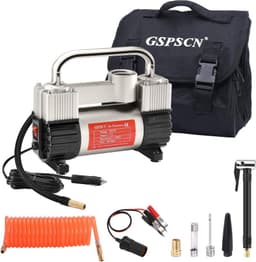
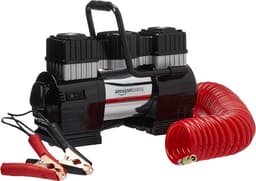
Two listings are the ones reviewers pick up after a small pump has failed. The GSPSCN is listed at 70 litres per minute, 150 psi (10 bar), 20 A and 240 W, with a 3 m hose and a weight of 2.72 kg, at £54.99, and 4.5 stars from 11,168 amazon.co.uk reviews. Review texts include a motorhome tyre at 80 psi, a figure of 5.4 bar, a top-up from 76 to 79.5 psi in under a minute per tyre, and a van tyre from flat to 40 psi in about two minutes. Auto shut-off is not in the bullets, so you watch the gauge. A capacity line of 68.04 kg on that listing is not a credible spec and is ignored here. The Amazon Basics dual-cylinder is the other heavy listing: battery clamps, a 120 psi title ceiling, 60 litres per minute in the title, 3.29 kg, £56.99, and 4.3 stars from 1,122 reviews. Reviewers bought it after smaller pumps failed on motorhome tyres around 65–80 psi. One unit stopped after three to four weeks of frequent use up to 110 psi, so repeated high-pressure runs are the risk in that review. A details field mentions 50 litres and an air receiver tank, which does not match a unit of this size. Ignore that tank line. The AA stops at 100 psi and does not state a high flow. If your van’s cold placard sits near a car figure and the handbook socket can feed a light pump, a socket digital can still be the lighter tool. Once the placard climbs toward 65–80 psi, these two are the listings with review evidence in this set.

Hose, clamps and the fuse

A long-wheelbase van puts the compressor a long way from the far valve if you stand at the battery. The GSPSCN’s listed hose is 3 m, which can still leave you short on a large coachbuilt motorhome if you refuse to move the unit. The Amazon Basics title says 5 m and a details field says 2.26 ft, about 0.7 m, so the reach is not one figure you can plan a pitch around. Treat the longer number as unconfirmed until you measure. Current travels with that reach. The GSPSCN lists 20 A, and a reviewer says not to use its cigarette-lighter lead. The cigarette lighter or battery clamps page is the fuse argument, including why you do not fit a larger fuse to finish a tyre. Prefer the clamps on the GSPSCN unless the handbook already shows that the socket can cover the draw. The Amazon Basics unit is clamps from the start. Out and About Live’s Ring example is the same pattern on a different product. It is not a score for either listing here.

The placard, then a damaged tyre

The number you set is still the placard for that vehicle and that load, read cold. TyreSafe’s habit applies here too: handbook or sticker, before the tyres have heated up, not the sidewall maximum and not 150 psi because the box can say it. Products Compared will not invent a legal van pressure. A panel van on a car-like sticker and a motorhome at 80 psi are different jobs, and only your plate decides. The Out and About Live note of about 2 psi undershoot was on a different unit. Recheck with the pump’s gauge, or a separate gauge, before you drive. Do not add a fixed 2 psi to every tyre. A damaged tyre is not an inflation problem. A bulge, a cut or a casing that will not hold air needs a tyre fitter, and a live road needs a breakdown service first. Tread rules in the Highway Code are not identical for every large vehicle, so the 1.6 mm line for cars and light vans should not be pasted onto every motorhome without checking the class. Pressure fitness still sits under regulation 27: the tyre has to be inflated so it is fit for the use. The 12V tyre inflator buying guide is the decision order if you have not bought yet.

Common questions

Will a £15 car inflator do a motorhome tyre?
Sometimes it will add a little air. It is a poor bet once the placard is around 65–80 psi or the tyre is large. The socket pumps near that price in this set do not state litres per minute, and reviewers who failed with a small inflator moved to a clamp unit. A 150 psi ceiling does not mean a useful flow at motorhome pressures. A lightly fused socket can also open before the tyre is done.
What pressure should I set on a van or motorhome?
Set the cold placard for that axle and that load, from the sticker or the handbook. TyreSafe’s rule is the vehicle maker’s figure, not the maximum on the tyre and not the maximum on the pump. A car at about 35 psi and a motorhome at 80 psi are both correct only if that is what the plate says. There is no universal van pressure in this comparison. Recheck after the pump stops.
Why do people end up with battery clamps?
The pumps reviewers use on these tyres draw more than many accessory sockets can feed. The GSPSCN lists 20 A and includes clamps as well as a socket lead. The Amazon Basics unit is clamps only. Out and About Live describes the same pattern on a Ring compressor that is not in this set, supplied with clamps because most cigar sockets cannot cope. Use clamps unless your handbook shows the socket can cover the stated draw.
How long a hose do I need on a long van?
Long enough to reach the furthest valve from where the pump sits, which on clamps is often beside the battery. The GSPSCN lists a 3 m hose. The Amazon Basics title says 5 m and a details field says 2.26 ft, about 0.7 m, so do not plan the pitch on the longer figure alone. Measure the van if the listing gives two lengths.
Is 150 psi on the box the motorhome pressure?
No. 150 psi, or 10 bar on the GSPSCN listing, is a claimed ceiling. Review examples in this set sit around 65–80 psi, and one cites 5.4 bar, which is in that band rather than near 150. The Amazon Basics title ceiling is 120 psi. You still set the placard. A pump that can reach 150 psi is not a reason to inflate a tyre to 150 psi.
Which two listings are the heavy ones, and when is it a fitter’s job?
The heavy pair are the GSPSCN, at a stated 70 litres per minute and 20 A, and the Amazon Basics dual-cylinder, at 60 litres per minute in the title, with clamps and auto shut-off. The AA stops at 100 psi and does not state a high flow. Call a fitter, or a breakdown service if you cannot move safely, when the tyre is bulging, cut or losing air as fast as you add it.

Related pages

Sources

Public UK sources first. amazon.co.uk listings for the nine ASINs checked on 19 October 2026.

  1. Construction and Use Regulations 1986, regulation 27 (retrieved 19 October 2026)
  2. Highway Code annex 6: vehicle maintenance, safety and security (retrieved 19 October 2026)
  3. TyreSafe: car tyre pressure (retrieved 19 October 2026)
  4. TyreSafe: tyre pressures explained (retrieved 19 October 2026)
  5. General Product Safety Regulations 2005 (retrieved 19 October 2026)
  6. ATO ATC: 12V socket dead after a tyre inflator (retrieved 19 October 2026)
  7. Parkers: tyre inflator compressors (retrieved 19 October 2026)
  8. amazon.co.uk listings for the nine ASINs (retrieved 19 October 2026)