Independent comparisons. We may earn from shop links. More info

12V tyre inflator buying guide

Updated: 21.10.2026

You are looking at one Amazon shelf where a £13 socket pump, a 20 amp clamp unit and a lithium handheld all use the same words. A 12V tyre inflator buying guide has to separate those tools before it names a brand. The [12V air compressor comparison](/hub/compressors/12v-air-compressor) holds the prices and the full table for the nine amazon.co.uk listings kept on 19 October 2026. This page is the order of the decision: what feeds the pump, what the door sticker says, and whether anyone has stated a flow. Products Compared has not run a lab test. A 150 psi badge is a ceiling, not the pressure you set.

You are looking at one Amazon shelf where a £13 socket pump, a 20 amp clamp unit and a lithium handheld all use the same words. A 12V tyre inflator buying guide has to separate those tools before it names a brand.

Our top picks

On this page

Three ways these pumps get 12 volts

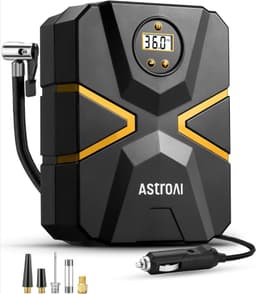
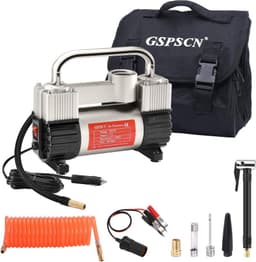
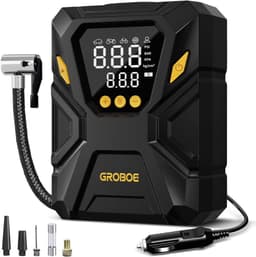
Every listing in this set is sold as 12 volt, and that phrase covers three power sources. A socket pump plugs into the accessory outlet. Here that group is the toptrek Q21, the GROBOE QB001-1, the AstroAI CZK-3676 and the AA AA5502. Parkers says a pump on the car’s socket wants the engine running, so the alternator feeds it. The AstroAI is the only one of those four that states a wattage, at 100 W. The others do not state amps or watts. A clamp pump connects to the battery posts. The Amazon Basics unit is clamps only. The GSPSCN lists 20 A and 240 W and includes both a 3 m socket lead and battery clamps. A reviewer says not to use the socket lead. Do not fit a larger fuse to make a 20 A pump fit a smaller socket. If a fuse blows, replace it like for like, and stop if the new one blows as well. The cigarette lighter or battery clamps page is that fork. A cordless pump carries its own pack. The ProChosen is sold as 7000 mAh and charges by USB. Reviewers often get about one car tyre per charge. The NOCO Air AL5 is USB-C, listed at 17 litres per minute, and its bullets say there is no 12V outlet to plug into. The OHFAMO claims a battery and a 12V adapter. Its file is 16 texts behind 4.0 from 83 reviews, and some units show ERR and stop. A cordless pump works with a flat car battery only while its own pack is charged. Stop if a lithium pack swells or overheats.

Pressure, flow and reach

Read the placard before you compare ceilings. Cars are often around 30–40 psi. Van and motorhome reviewers here talk about roughly 65–80 psi. The AA measures up to 100 psi, so a sticker above that is outside it. The cheap socket pumps print 150 psi. That does not mean they move air quickly at 70 psi, and it does not mean you should set 150. TyreSafe’s conversion is about 14.5 psi to 1 bar. Where airflow exists, use it. The NOCO states 17 litres per minute, the Amazon Basics title 60, and the GSPSCN 70. Everyone else leaves flow blank. A line such as under a minute from 30 to 36 psi is a manufacturer claim, not a time we timed. A lead around 3 m reaches a rear wheel. A hose of about half a metre, on the toptrek, AstroAI and GROBOE, means the pump sits by the valve. The GSPSCN’s 3 m hose is a different job. Auto shut-off only helps if the display unit matches the sticker, and the GSPSCN does not state it. Ignore the Amazon Basics 50 litre tank line on a 30 x 22.5 x 21.5 cm unit, and the NOCO weight of 27 g beside a much larger body.

Which type to shortlist for a car

For a car, a live 12V socket and a placard around 30–40 psi, shortlist a light digital with auto shut-off and a long review history. That is the AstroAI at £17.99, 4.5 from 11,896 reviews, 100 W, a 3 m lead and a 48 cm hose. The AA at £25.60 has 4.4 from 17,053, a screw-on connector and a 100 psi ceiling. The GROBOE at £16.39 is the cheaper socket pump without a repeated failure report, on 117 reviews. The toptrek at £13.26 is cheaper still, and a minority report a burning smell and a jam. The best 12V tyre inflator page says who should skip each one.

Which type to shortlist for a van

For a van, caravan or motorhome, do not assume the car pump will finish. Reviewers who already cooked a small inflator ended up on the GSPSCN or the Amazon Basics, at about £55 to £57, with stated flow and clamps. The GSPSCN states 70 litres per minute and has motorhome examples around 80 psi. It is listed at 20 A, so the socket lead is not a free pass. The NOCO at £67.99 and 17 litres per minute can do a small top-up if the adaptor holds. It is a weak substitute for a clamp pump on a large tyre. Before you pay, the power source has to match what you will do at the roadside, the ceiling has to sit above the placard, and the review count has to be more than one unboxing. We have not measured these pumps.

Common questions

Is a 12V air compressor the same as a cordless tyre inflator?
No. On this shelf, 12V covers a cigarette-lighter plug, battery clamps, a rechargeable pack sold as 12V, or a mix. The AstroAI and the AA are socket pumps. The NOCO’s own text says it does not use a 12V outlet. The ProChosen is a lithium handheld with a USB lead in the box, not a plug for the car.
What should I check before the brand?
Check the power source, then the placard pressure, then whether airflow is stated. A familiar brand does not fix a 20 A pump on a small fuse, and a 150 psi title does not tell you the door-sticker number. After those three, look at lead length, hose length and whether auto shut-off is actually listed.
Is 150 psi the pressure I set?
No. That figure is the pump’s ceiling on the toptrek, GROBOE, AstroAI, OHFAMO and GSPSCN. You set the vehicle maker’s cold pressure for the load, from the handbook or the placard. A car is often about 30–40 psi. The AA will not display above 100 psi, which is a different limit and still not a target.
Do I need a flow figure in litres per minute?
You need one when the tyre is large or the pressure is high. For a slow car top-up, several of these socket pumps ship with no flow figure and still satisfy reviewers. For a van, the only stated flows in this set are 17, 60 and 70 litres per minute, on the NOCO, the Amazon Basics title and the GSPSCN.
When is a £15 socket pump the wrong buy?
It is the wrong buy when the last one blew a fuse, when the placard is a van or motorhome pressure, or when the review file is full of faults. The OHFAMO at £15.99 has ERR reports in a short file. The toptrek at £13.26 has a burning-smell report. A cheap socket pump can still be enough for an occasional car top-up if the socket is live.
Does the engine need to be running?
For a socket pump, Parkers says yes: run the engine so the alternator feeds the outlet. Clamp pumps also draw from the vehicle battery, so the same habit avoids a flat battery. A cordless pump does not use the car’s electrics. Its own pack has to be charged before you kneel down. Do not run an engine in a closed garage.
Where do I read the correct pressure?
Use the handbook or the placard on the vehicle, for the load you are carrying, and read it in the unit printed there. TyreSafe says check at least monthly and before long journeys, cold, before about two miles. The Highway Code wants a weekly cold check. The maximum on the tyre sidewall is not that number.

Related pages

Sources

Public UK sources first. amazon.co.uk listings for the nine ASINs checked on 19 October 2026.

  1. Construction and Use Regulations 1986, regulation 27 (retrieved 19 October 2026)
  2. Highway Code annex 6: vehicle maintenance, safety and security (retrieved 19 October 2026)
  3. TyreSafe: car tyre pressure (retrieved 19 October 2026)
  4. TyreSafe: tyre pressures explained (retrieved 19 October 2026)
  5. General Product Safety Regulations 2005 (retrieved 19 October 2026)
  6. ATO ATC: 12V socket dead after a tyre inflator (retrieved 19 October 2026)
  7. Parkers: tyre inflator compressors (retrieved 19 October 2026)
  8. amazon.co.uk listings for the nine ASINs (retrieved 19 October 2026)