Independent comparisons. We may earn from shop links. More info

Where to put a rain gauge

Updated: October 2026

A fence, a tree, a gutter or the sprinkler will change the catch by more than the logo on the plastic. You can buy a well-reviewed cone and still record the rain shadow of the shed. This page is where to put a rain gauge in a small UK garden: open sky if you can get it, a level rim, and a mouth that is not under a drip. Prices and the twelve listings stay on the [rain gauge comparison](/hub/climate-measuring/rain-gauge).

A fence, a tree, a gutter or the sprinkler will change the catch by more than the logo on the plastic. You can buy a well-reviewed cone and still record the rain shadow of the shed.

Our top picks

On this page

Open ground, or you are measuring the fence

Met Office WOW site ratings put the rim in the open and at least twice the height of the nearest obstacle away. A fence 2 m tall wants the gauge about 4 m out. A tree whose crown is 6 m high wants about 12 m. Four times that distance is a school diagram, not a fine, and twice the height is already more lawn than many terraces have. If you cannot meet it, say so in your notes and do not compare the reading with a climate station. The CKB 75 cm gauge has a rear slot, and the Toiclebor stand is described for a fence. Against a board fence you measure shelter and drip. A CEDA comparison found differences of up to about 12% with a turf wall. That is not a promise for these cones.

Keep the rim low and level

Official storage gauges sit with the rim at about 30 cm, because wind higher up blows rain across the mouth. The CKB 75 cm gauge is about 75 cm assembled, the CKB 100 cm gauge about a metre, and the ACTIMED and JINGEGECOME claim 19 to 29 inches. Those heights are easier to read without kneeling, and more exposed than the Tildenet at about 250 mm. Do not pretend a 75 cm stake is the Met Office rim. Use the low cone on a windy site you can still read. Use the stake when you will stop reading anything you have to kneel for. The rim has to be level, because a lean dumps water to one side. The Thermometer World gauge is about 35 g, and a reviewer put a stone inside so the wind would not move it. The stone has to stay below the water you read.

Gutters, trees and sprinklers

Under the eaves the gauge stays dry, then a gust dumps a sheet off the gutter and the tube reads a flood that never fell on the lawn. Put it out from the roof line. A tree holds water and drips after the rain has stopped. If the only gap is a patio, treat the record as this corner, not this postcode. The Tildenet is sold for sprinkler fall as well as rain. That ruins a rainfall note if the irrigation crosses the mouth. When the tube is full on a dry morning, look for irrigation before you blame the scale. Leave the chimney alone: higher means more wind and less catch. Then read the bottom of the curve, as set out in how to read a rain gauge.

Fix it so it does not lean or blow over

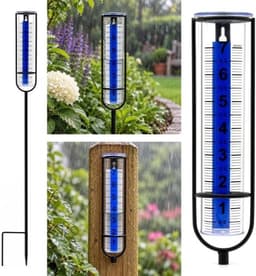
The mount has to survive the week. The KINGLAKE and the TFA Dostmann 47.1001 leave you to supply the rod, and a wobbling cane leans by the first gust. Push it in until the rim is level. A stone in a light cone can stop it blowing away if it stays clear of the scale. It does not fix a site under a tree. Weak magnets on the Geevon let the outdoor unit tilt. Pick the compromise you will still empty. A purchase through our links can earn a commission at no extra cost to you.

Common questions

How far from a fence should it be?
WOW guidance asks for at least twice the obstacle height. A 2 m fence means about 4 m of open ground. Four times the height, about 8 m in that example, is the stricter school figure. Many gardens can do neither. If you cannot, move the gauge as far into the open as you have, keep it off the fence, and do not treat the reading as a station total.
Can I mount it on the fence to see it from the kitchen?
You can. The CKB 75 cm gauge has a rear slot, and the Toiclebor offers a fence fitting. You will see it. You will also sit in the shelter and the drip of the fence. A view from the window is a real convenience. It is a poor match for a number you want to compare with the forecast.
How high should the rim be?
About 30 cm is the storage-gauge height, and mounting notes warn that a higher rim loses catch to the wind. Stakes in this set are often 75 cm, about 100 cm, or a claimed 19 to 29 inches. Use that height if you need to read without kneeling, and do not call it the official rim. Keep whatever you choose level.
What if my garden is too small for the twice-height rule?
Use the most open spot you can reach, keep the rim level and as low as you will still read, and treat the figure as your garden's, not the town's. A patio record can still show that this week was wetter than last week. It should not be logged as a well-exposed station. Do not put the gauge on the roof to escape the fence.
Will a sprinkler ruin the reading?
Yes, if you wanted rain. Water from a sprinkler or a can is real water in the tube and false rain in the notebook. The Tildenet is marketed for sprinkler fall as well, so keep irrigation off the mouth when the chart is a rainfall chart. If the gauge is full on a dry day, check the sprinkler before you adjust anything else.

Related pages

Sources

Public UK sources and the amazon.co.uk listings saved for this comparison. Pages were read on 19 October 2026.

  1. Met Office — How we measure rainfall (retrieved 19 October 2026)
  2. Met Office WOW — Site ratings (retrieved 19 October 2026)
  3. CEDA — Rainfall gauge catch comparison (retrieved 19 October 2026)
  4. RHS — Watering (retrieved 19 October 2026)
  5. GOV.UK — Check for flooding (retrieved 19 October 2026)
  6. UKHSA — Invasive mosquitoes and standing water (retrieved 19 October 2026)
  7. Consumer Rights Act 2015 (retrieved 19 October 2026)
  8. amazon.co.uk — Best sellers in rain gauges (retrieved 19 October 2026)