Independent comparisons. We may earn from shop links. More info

Manual or wireless rain gauge

Updated: October 2026

You already walk the garden most mornings, the forecast is in millimetres, and a wireless console near £35 keeps appearing next to cones under £10. The choice is not which one is more accurate in the abstract. It is whether you need a tube you can see, or a counter in the kitchen. In this comparison the wireless option is the Geevon, at £34.99. Everything else is a manual gauge you read and empty. The tall CKB at £33.95 is still manual. The price sits near the Geevon and the job does not. Models are on the [rain gauge comparison](/hub/climate-measuring/rain-gauge).

You already walk the garden most mornings, the forecast is in millimetres, and a wireless console near £35 keeps appearing next to cones under £10. The choice is not which one is more accurate in the abstract.

Our top picks

On this page

A tube you read, or a counter you do not

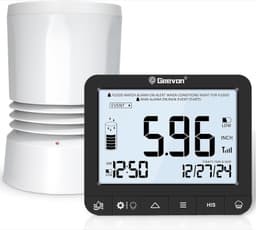
A manual gauge is a cone or a stake tube. You read a printed scale, write the depth, and pour the water out. The Geevon listing claims the other job: a backlit indoor screen, inches and millimetres, about 100 m of range, and a self-emptying collector. Neither type earns an accuracy crown here. A Met Office tipping-bucket gauge tips at about 0.2 mm with the rim near 450 mm. That instrument is not this Geevon. A shop guide that recommends its own console is not a test of this one either.

What you give up with a manual gauge

You give up the walk, the pour, and sometimes the unit. Cones run from about £6.59 to about £8.97, and you read them outside. Skip a day and the water mixes two showers. The routine, on how to read a rain gauge, is the bottom of the curve, the same time, then empty. The Tildenet states millimetres and inches, with 4.6 from 1,132 reviews. The TFA Dostmann 47.1001 has 4.6 from 8,364 reviews and a memory ring, and the listing does not state the unit or include a rod. What you keep is the water, with no batteries. The CKB LTD 100 cm gauge at about £33.95 is still manual. Six reviews and a lift-out emptying method do not buy an indoor total.

What the Geevon listing adds

The Geevon adds the indoor number. At £34.99, with 3.8 from 31 reviews, the bullets describe a collector, a display, about 100 m of range, and self-emptying. Inches and millimetres are both named. One reviewer mentions a 0.2 mm step, and the listing states ±1. Those are not the same claim, and neither is a Met Office calibration. If the screen says 4 mm and the patio looks dry, you have a fault to chase. The title says grey without sensor, so check the live variant. A UK review says to bring the collector in if frost is likely.

The alarm is not a flood warning

The Geevon listing mentions a flood alert. That is a message from the product, not an Environment Agency warning and not Floodline. The public check is the GOV.UK check-for-flooding service, and Floodline is 0345 988 1188. Use the console for a garden total. Use the government service if you need to know whether the street floods.

When the console is the job, and when it is not

Choose the Geevon if the sensor is in the variant and you want the indoor number. For millimetres you will read yourself, that is the Tildenet. A purchase through our links can earn a commission at no extra cost to you.

Common questions

Is a wireless gauge more accurate?
Not on the evidence here. The Geevon states ±1 on the listing, and one reviewer mentions a 0.2 mm step. A Met Office tipping bucket also uses about 0.2 mm, at a set rim height, and that instrument is not this product. Pick wireless for an indoor total. Pick manual for a scale you can see. Do not pick either because a shop guide called its own model more accurate.
What do I gain if I already walk the garden?
Very little, unless the walk is the part you want to stop. You can read a Tildenet or a TFA Dostmann while you are there and empty it in the same minute. The wireless set adds batteries, a sensor question in the title, and a number you cannot confirm by looking at the water. The gain is real only when you will not make that walk.
Does self-emptying mean I cannot re-check the water?
Yes. The Geevon is supposed to clear the collector and keep the count on the display. A manual tube keeps the water until you pour it, so you can look again, and you can also spoil the next day if you forget. This set does not offer a stored total and a second look at the same water.
Will it work in January?
Manual cones work in January only if you empty them so the water cannot freeze and crack the plastic. A UK review says the Geevon instructions tell you to bring it in if frost is likely. A collector in the shed is not measuring the shower. Plan for a gap in the wireless record, or keep a manual tube you can empty and leave out.
What does without sensor mean on the Geevon?
The title says grey without sensor. The bullets describe a collector, a display and accessories. Those cannot both be your parcel. Check the live amazon.co.uk variant. A display-only purchase will not count rain. Goods should match the description, which is a reason to resolve the clash before you rely on a return.
Is the flood alert the same as Floodline?
No. Floodline is 0345 988 1188, and the public check is on GOV.UK. The alert on the Geevon listing is a product feature. Review notes say the alarm can be quiet. It is not an Environment Agency warning. If you use it at all, treat it as a nudge about the gauge, then look outside.

Related pages

Sources

Public UK sources and the amazon.co.uk listings saved for this comparison. Pages were read on 19 October 2026.

  1. Met Office — How we measure rainfall (retrieved 19 October 2026)
  2. Met Office WOW — Site ratings (retrieved 19 October 2026)
  3. CEDA — Rainfall gauge catch comparison (retrieved 19 October 2026)
  4. RHS — Watering (retrieved 19 October 2026)
  5. GOV.UK — Check for flooding (retrieved 19 October 2026)
  6. UKHSA — Invasive mosquitoes and standing water (retrieved 19 October 2026)
  7. Consumer Rights Act 2015 (retrieved 19 October 2026)
  8. amazon.co.uk — Best sellers in rain gauges (retrieved 19 October 2026)