How to use an infrared thermometer
You have the thermometer in your hand, or it is in the basket, and the laser dot looks as if it were measuring a pinprick. It is not. How to use an infrared thermometer depends on which instrument you bought: a forehead unit held close to dry skin, or a surface gun whose patch grows as you step back. The Products Compared editorial team took the distances and the warnings from the amazon.co.uk listings filed on 15 October 2026, and the optics from public guidance. There was no laboratory test. If you buy through our Amazon links, a qualifying purchase can earn us a commission at no extra cost to you. Which model belongs to which job is the [infrared thermometer comparison](/hub/climate-measuring/infrared-thermometer). This page is the procedure only.
You have the thermometer in your hand, or it is in the basket, and the laser dot looks as if it were measuring a pinprick. It is not.
You have the thermometer in your hand, or it is in the basket, and the laser dot looks as if it were measuring a pinprick. It is not. How to use an infrared thermometer depends on which instrument you bought: a forehead unit held close to dry skin, or a surface gun whose patch grows as you step back. The Products Compared editorial team took the distances and the warnings from the amazon.co.uk listings filed on 15 October 2026, and the optics from public guidance. There was no laboratory test. If you buy through our Amazon links, a qualifying purchase can earn us a commission at no extra cost to you. Which model belongs to which job is the infrared thermometer comparison. This page is the procedure only.
Our top picks
| Badge | Product | Instrument | How to aim | Limit on the listing | Note | Price | Offer |
|---|---|---|---|---|---|---|---|
| Best overall |  ERICKHILL ERICKHILL ROOK600C, −50 °C to 600 °C | Surface gun | 12:1, patch grows as you step back | Class 2, do not aim at eyes | 8.6 | about £14.99 | View offer |
| Alternative |  ANMEATE ANMEATE FC-IR202 forehead thermometer | Forehead unit | Under 3 cm, dry skin | No distance-to-spot ratio | 7.7 | about £15.99 | View offer |
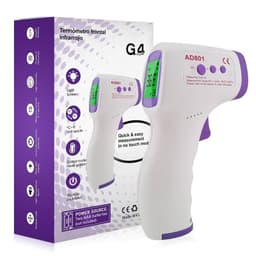
| Best value |  G4GADGET G4GADGET forehead and surface thermometer | Forehead unit, title says gun | Treat as a forehead hold | No laser class, no 12:1 | 6.8 | about £7.78 | View offer |


On this page
The laser shows where you aimed, not the whole patch
A forehead reading is a short hold on dry skin
A surface gun needs a clear patch and the right emissivity
Do not stare into the beam
Common questions
Is the laser dot the area you are measuring?
How close should a forehead thermometer be?
Why does a shiny pan read low?
What should you do if steam or dust is in the way?
Can you use the same steps on a baby and on a pizza stone?
Is it safe to look into the laser?
Related pages
Sources
Public UK sources used for this comparison. Listing prices, stars and review counts are from amazon.co.uk on 15 October 2026.
- MHRA — infrared thermometers: caution in use (retrieved 15 October 2026)
- MHRA — temperature-screening guidance (retrieved 15 October 2026)
- NHS — how to take a baby's temperature (retrieved 15 October 2026)
- NICE NG143 — recommendations for under-5s (retrieved 15 October 2026)
- Food Standards Agency — cooking your food (retrieved 15 October 2026)
- FSA — Safer Food, Better Business: Prove it (retrieved 15 October 2026)
- UKHSA — laser radiation safety advice (retrieved 15 October 2026)
- Which? — best digital thermometers 2026 (retrieved 15 October 2026)