Infrared thermometer for cooking
You want an infrared thermometer for cooking because the pizza stone looks ready, or the griddle is heating, or a delivery of cold food needs a quick check. The laser feels precise. It is reading the surface you can see. It does not show that the centre of a chicken, a joint or a reheated meal has reached 70 °C. The Products Compared editorial team set the eight surface guns from the amazon.co.uk listings filed on 15 October 2026 against Food Standards Agency guidance. There was no laboratory test. If you buy through our Amazon links, a qualifying purchase can earn us a commission at no extra cost to you. The full table, including the forehead units this page refuses, is the [infrared thermometer comparison](/hub/climate-measuring/infrared-thermometer).
You want an infrared thermometer for cooking because the pizza stone looks ready, or the griddle is heating, or a delivery of cold food needs a quick check. The laser feels precise. It is reading the surface you can see.
You want an infrared thermometer for cooking because the pizza stone looks ready, or the griddle is heating, or a delivery of cold food needs a quick check. The laser feels precise. It is reading the surface you can see. It does not show that the centre of a chicken, a joint or a reheated meal has reached 70 °C. The Products Compared editorial team set the eight surface guns from the amazon.co.uk listings filed on 15 October 2026 against Food Standards Agency guidance. There was no laboratory test. If you buy through our Amazon links, a qualifying purchase can earn us a commission at no extra cost to you. The full table, including the forehead units this page refuses, is the infrared thermometer comparison.
Our top picks
| Badge | Product | Stated top | Emissivity | Distance to spot | Note | Price | Offer |
|---|---|---|---|---|---|---|---|
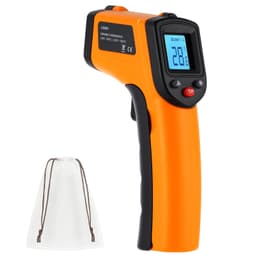
| Best overall |  ERICKHILL ERICKHILL ROOK600C, −50 °C to 600 °C | 600 °C | 0.1–1.0 | 12:1, Class 2 | 8.6 | about £14.99 | View offer |
| Alternative |  ABOHU ABOHU surface gun, −50 °C to 550 °C | 550 °C | Fixed 0.95 | 12:1, reviews shared with G1 | 7.3 | about £9.99 | View offer |
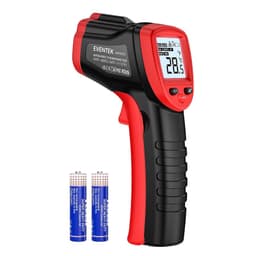
| Alternative |  Eventek Eventek ET312 gun, −50 °C to 600 °C | 600 °C | 0.1–1.0 | 12:1, class not stated | 8.2 | about £14.99 | View offer |

On this page
An infrared thermometer reads the surface, not the centre
A pizza stone needs a stated top that covers the heat
Emissivity and distance still apply on a stone or a griddle
Cold food is the other job infrared is allowed to do
Common questions
Can an infrared thermometer tell you the chicken is cooked?
Is a 400 °C gun enough for an oven stone?
Do you need adjustable emissivity for a stone or a griddle?
Can you use the gun on cold food in the fridge?
How far should you stand if the optic is 12:1?
Related pages
Sources
Public UK sources used for this comparison. Listing prices, stars and review counts are from amazon.co.uk on 15 October 2026.
- MHRA — infrared thermometers: caution in use (retrieved 15 October 2026)
- MHRA — temperature-screening guidance (retrieved 15 October 2026)
- NHS — how to take a baby's temperature (retrieved 15 October 2026)
- NICE NG143 — recommendations for under-5s (retrieved 15 October 2026)
- Food Standards Agency — cooking your food (retrieved 15 October 2026)
- FSA — Safer Food, Better Business: Prove it (retrieved 15 October 2026)
- UKHSA — laser radiation safety advice (retrieved 15 October 2026)
- Which? — best digital thermometers 2026 (retrieved 15 October 2026)