How to clean a MAF sensor without wrecking it
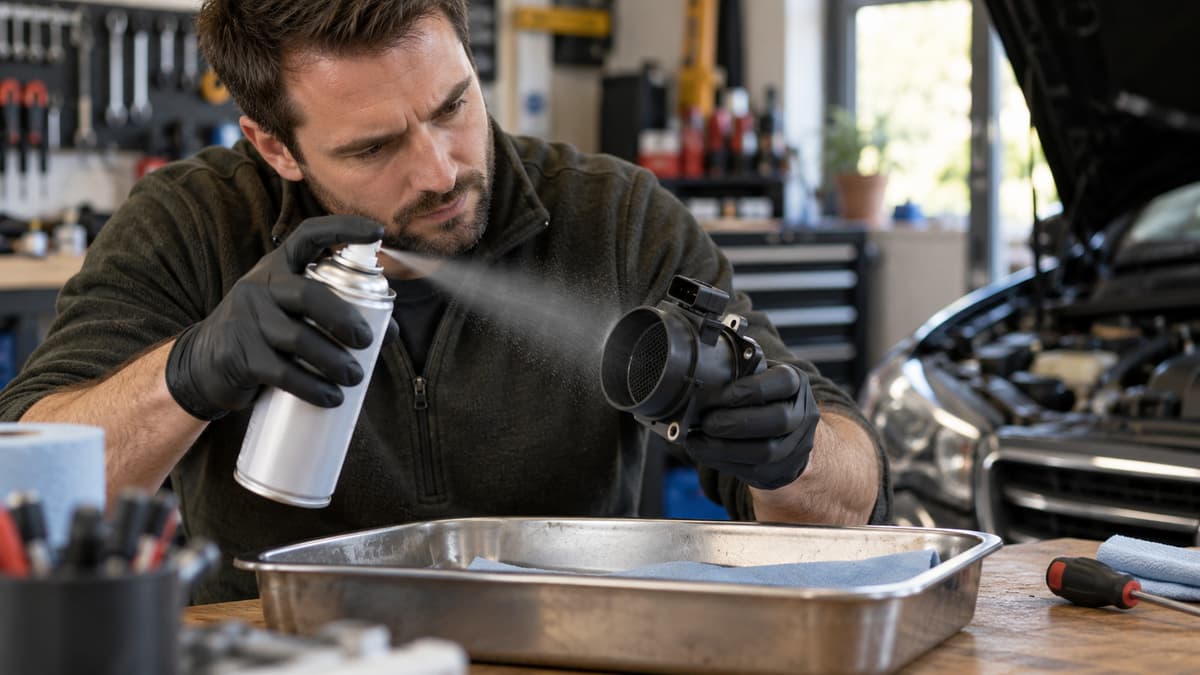
How to clean MAF sensor elements with a dedicated spray and at least 15 minutes of drying. Do not touch the film. Brake cleaner and compressed air stay off.
On this page

How to clean MAF sensor elements comes down to the can you pick up. Brake cleaner, already in many cupboards, is the wrong one. WAI UK's troubleshooting note tells you to use a MAF-specific spray, to keep brake cleaner and carb cleaner off the sensor, to skip compressed air, and to let the part dry for at least 15 minutes. CRC's MAF cleaner label sets the same chemical limits and warns you about Karman-vortex meters. There was no laboratory test of a spray on a meter. A qualifying purchase can earn a commission at no extra cost to you.
This is one clean, with the engine off and the plug disconnected, for a hot-film or hot-wire element you can remove. It is not a power upgrade, and it will not calibrate a film that has already failed.
In short
Use a MAF sensor cleaner only. Dry the sensor for at least 15 minutes before it goes back, and do not touch the element. If live data is still flat after that single clean, match the number on the old sensor and buy a replacement. Do not spray the same sensor again.
When a clean is worth trying
A clean is worth trying when contamination is a fair suspect and the sensing element is still intact. Oil mist from an oiled air filter is the usual coating. A hesitation, a hunting idle, or a sensor opening that looks filmed over are reasons to try one careful clean before you order another meter. The job is to lift that film without leaving a new one behind.
A clean is the wrong job when the only aerosols to hand are brake cleaner or carb cleaner, when you mean to wipe the element, or when the meter has already been sending compromised data. Bosch's UK guidance on air mass meters treats compromised data from a poor meter as a calibration issue, not as dirt alone. A spray does not put that calibration back. If the car got worse after a previous attempt with the wrong solvent, stop. Treat the sensor as suspect rather than as something to wash again.
You also need the right kind of meter. CRC warns about Karman-vortex meters. The routine on this page is for a hot-film or hot-wire element inside a mass air flow sensor you can take out. If you cannot tell a Karman-vortex unit from a hot-film sensor by the housing in the duct, stop. Do not settle the question by spraying.
What you may spray
WAI UK says a MAF-specific spray. That is the only product in this sequence. Brake cleaner is out. Carb cleaner is out. WAI UK and the CRC label agree on both bans. Those names show up in searches because the cans are already on a shelf. A workshop aerosol with the wrong solvent is how a short job leaves residue. The MoneySavingExpert thread on this job describes residue from the wrong spray.
Compressed air is out as well. WAI UK rules it out. Do not blow the element dry, and do not blast the housing with an airline to shift grit. The sensing surface is fine. Air from a compressor is not a shortcut around the 15-minute dry, and it is not a cleaner.
UK forums are looser than the label. On PistonHeads and MoneySavingExpert, owners argue for isopropyl alcohol and against oily contact cleaner. Oily contact cleaner works against the job, because oil on the element is the contamination you are trying to clear. Isopropyl is a forum argument, not the instruction from WAI UK. This article does not tell you to drip a cupboard solvent onto the film, and it does not treat isopropyl alcohol as the same product as a MAF sensor cleaner.
Do not touch the element. Cleaning a hot wire sensor still means you leave the wire alone: not a finger, not a cotton bud, not a cloth, and not a paper towel. The wire and the film are the measuring surface. Contact is how a clean becomes a damaged sensor. Spray into the opening and stop there.
The steps, including drying
Work with the engine off. Disconnect the plug before you unclip or unbolt the sensor, and leave it disconnected while you spray. Take the sensor out so you can see the airway, and hold it over a tray so the mist has somewhere to fall. You are cleaning the opening, not polishing a part you can grip.
- Spray a MAF sensor cleaner into the opening as a fine mist, and keep the nozzle clear of the element.
- Do not rub, poke, or wipe the wire or the film.
- Set the sensor somewhere clean and leave it to dry for at least 15 minutes.
- Refit it only once it is dry, then reconnect the plug and seal the duct.
If the element still looks wet when 15 minutes have passed, leave it longer. Fifteen minutes is the minimum WAI UK gives. It is not a cue to refit a damp sensor, and compressed air does not count as drying. This page does not add a soak, a scrub, or a second chemical on top of the MAF spray.
The clip or the screws, the seating in the duct, and the plug are on the how to fit page, so the hose seals and the connector sits fully home. Then start the engine. If you have a reader, watch live airflow. A useful trace moves when you raise the revs. A line that stays flat is not a reason to fetch the can again.
What a clean cannot fix
Cleaning does not calibrate a dead film. Lifting oil or dirt off a working element is a different task from repairing a meter whose output is already wrong. Bosch UK treats that compromised data as a calibration issue, not as dirt by itself. A MAF spray cannot write a new calibration into the unit in your hand. If the film is already dead, solvent will not rebuild it.
If live data is still flat after one careful clean, stop. A second pass is not the next step. Open the comparison and match the original-equipment number on the sensor you removed. In that set the top pick is the HouYeen 6C11 MAF, about £17.99, rated 4.2 from 98 reviews, listed for OE 6C11-12B579-AA. It is an aftermarket insert. It belongs on the car only when that number matches the label on the sensor you took out. A clean that changed nothing is the moment to buy the matching meter, not to empty the rest of the can.
A spray is not a power upgrade. If a can of MAF sensor cleaner promises extra horsepower, ignore that line. This article does not use it. Judge the job by whether the hesitation eases, and by whether the live reading moves, after the sensor has dried and gone back on the car.
Do not add a MAF clean to every service. The sequence here is for one attempt when contamination is a fair suspect. If the car runs properly, leave the element alone. A spray with no fault in front of you only adds the chance of the wrong chemical, or of a touch you meant to avoid.
Common questions
Can I use brake cleaner on a MAF sensor?
Is isopropyl alcohol safe on a MAF sensor?
Should I rub or wipe the MAF element?
How long should a MAF sensor dry before I refit it?
Will cleaning a MAF sensor add horsepower?
What if my car has a Karman-vortex meter?
Should I clean the MAF sensor at every service?
When should I replace the MAF sensor instead of cleaning it again?

Kevin B. is the editor for Cars & motoring at productscompared.co.uk. Comparisons in this category are checked against amazon.co.uk listings, review evidence and public UK sources.
Related articles

Oiled air filter MAF sensor: oil on the element
Oil from a cotton filter can coat the sensing element after a filter service.

P0101 code: what to check before a new sensor
A P0101 code is a reason to check the basics before you order a replacement sensor.

How long do MAF sensors last? There is no interval
There is no mileage interval that tells you when a MAF sensor is due for replacement.