Independent comparisons. We may earn from shop links. More info

Window restrictor child safety

Updated: 16 October 2026

An upstairs sash can be opened by a child who has climbed onto a bed, and the packet may say 100 mm as if that were the law for every UK window. It is not one number. Window restrictor child safety at home means a limiter or guarding where someone could fall, a gap measured along the whole sash, and a key an adult can find at night. Products are on the [window lock comparison](/hub/burglar-protection/window-lock). No listing here is child-safety certified. If you buy through our links, we may earn a commission at no extra cost to you. The Products Compared editorial team used public UK guidance and listings captured on 15 October 2026.

An upstairs sash can be opened by a child who has climbed onto a bed, and the packet may say 100 mm as if that were the law for every UK window. It is not one number.

Our top picks

On this page

Three different rules, not one number

Approved Document K (2013), paragraph 8.2, says that where a person may fall through a window above ground-floor level, you provide suitable opening limiters or guarding. Diagram 3.1 shows 800 mm guarding at opening windows. The paragraph does not set 100 mm. The 100 mm line most people quote is Health and Safety Executive guidance for care settings: 100 mm or less, released only with a special tool or key. That is not a cap for every private house. Use it in a care setting. At home, do not treat it as your building-regulations maximum. The Centre for Window and Cladding Technology's account of BS EN 13126-5 gives 100 mm under 350 N for a safety restrictor and 89 mm under 500 N for a child-safety restrictor. Those figures apply only if the identifier is printed. None of these nine prints BS EN 13126-5. Which device you need first is the window lock buying guide.

The gap along the whole window

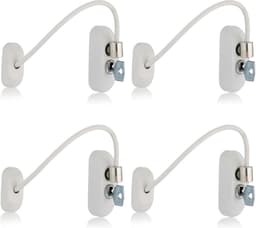
Measure the widest opening, not the photo beside the cable. A casement swings, so one restrictor by the handle can leave the far corner larger. If a child could get a shoulder through that corner, add a second screw-fixed restrictor. How to mark the plates is on how to fit a window restrictor. Screw into sound material. Adhesive is the wrong only fixing where a child could fall. Stored reviews say a pad was pulled off, including by a strong child, and that screws held. RoSPA's home advice is to restrict upstairs windows and keep furniture off the sill. None of these cables is Part Q, PAS 24 or insurance-approved.

Keys and the escape window

The key must be out of a small child's reach and in an adult's hand at night if that window is the way out. A kitchen drawer fails the second test. Stored Schlosser reviews describe one key per lock, so a lost key leaves the sash limited until you replace the unit. Approved Document B, volume 1, paragraph 2.10, allows locks, with or without removable keys, on dwelling escape windows. Some shops ban keys on escape windows. The paragraph does not.

A removable key is not always guarding

BCA Technical Guidance Note 1, for some glazing under 800 mm where the drop exceeds 600 mm, treats a restrictor you can remove as something other than guarding. Do not merge that into paragraph 8.2. If building control has already said a removable key is not enough, or has named PAS 24, you need their specification.

Common questions

Do I have to limit every window to 100 mm?
No. Paragraph 8.2 of Approved Document K does not set 100 mm for every dwelling. It asks for suitable limiters or guarding above the ground floor. The 100 mm figure is HSE guidance for care settings. Diagram 3.1's 800 mm is a guarding height, not the sash gap. Use 100 mm when that rule applies, or when the listing prints the standard.
What is the difference between 89 mm and 100 mm?
In the CWCT account, 100 mm under 350 N is the safety-restrictor figure and 89 mm under 500 N is the child-safety figure. They are different tests. HSE care guidance uses 100 mm or less with a special release. A listing meets those British Standard figures only if the number is printed. None in this comparison prints it.
Are adhesive restrictors enough to stop a child falling?
No. Stored reviews say pads were pulled off, including by a strong child, and that screws held. Screw into sound material where a fall would injure someone. A cable does not stop an adult forcing the screws. Keep furniture off the sill so the window is not the next step up.
Where should the key be kept?
Away from small children, and where an adult can find it at once at night if the window is an escape route. A kitchen drawer fails that. One insurance example allows the key to stay in an escape lock at bedtime. One key per lock, as stored Schlosser reviews describe, means a lost key leaves the window limited until you replace the unit.
Can I fit a keyed restrictor on a fire-escape window?
Approved Document B allows locks with removable keys on dwelling escape windows. After release, the opening still needs at least 0.33 square metres and 450 mm each way, with the bottom no more than 1100 mm above the floor, and the sash must stay open on its own. Keep the key to hand at night.
Does a title that mentions standards mean PAS 24?
No. PAS 24 and Approved Document Q test a whole new-dwelling window, not a screw-on cable. Schlosser says tested to British Standards and names nothing. None of these listings prints BS EN 13126-5. Do not call them child-safety certified or Secured by Design.
Is one cable enough on a wide sash?
Not always. The gap by the cable can be small while the far end is wide enough to climb through. Measure the widest point with the cable taut, and add a second screw-fixed restrictor if you need to. A star rating does not tell you that gap on your window.

Related pages

Sources

Public UK sources and the amazon.co.uk listings in this comparison. Listings captured 15 October 2026. Page updated 16 October 2026.

  1. Approved Document K (2013) (retrieved 15 October 2026)
  2. Approved Document Q (retrieved 15 October 2026)
  3. HSE: falls from windows (retrieved 15 October 2026)
  4. CWCT: are window restrictors designed to resist adequate loads (retrieved 15 October 2026)
  5. BSI: PAS 24:2022+A1:2024 (retrieved 15 October 2026)
  6. AXA Connect LC01 locks requirement (retrieved 15 October 2026)
  7. MLA minimum security requirements, January 2025 (retrieved 15 October 2026)
  8. RoSPA: falls (retrieved 15 October 2026)