Wi-Fi water leak detector: no hub vs base station
Both boxes say Wi-Fi, and only one of them joins your router. A Wi-Fi water leak detector no hub vs base station choice, in the seven amazon.co.uk listings from 15 October 2026, is a sensor on 2.4 GHz against a sensor that talks to a mains base which then holds the Wi-Fi. The [Wi-Fi water leak alarm comparison](/hub/burglar-protection/water-leak-alarm-wifi) lists the prices. This page says when each path fits, including a dead router. It does not rank every ASIN and it does not draw a floor plan. The Products Compared editorial team did not bench-test a dead router. A qualifying purchase can earn a commission at no extra cost to you.
Both boxes say Wi-Fi, and only one of them joins your router.
Both boxes say Wi-Fi, and only one of them joins your router. A Wi-Fi water leak detector no hub vs base station choice, in the seven amazon.co.uk listings from 15 October 2026, is a sensor on 2.4 GHz against a sensor that talks to a mains base which then holds the Wi-Fi. The Wi-Fi water leak alarm comparison lists the prices. This page says when each path fits, including a dead router. It does not rank every ASIN and it does not draw a floor plan. The Products Compared editorial team did not bench-test a dead router. A qualifying purchase can earn a commission at no extra cost to you.
Our top picks
| Badge | Product | Wi-Fi path | Local siren | Phone alerts | Note | Price | Offer |
|---|---|---|---|---|---|---|---|
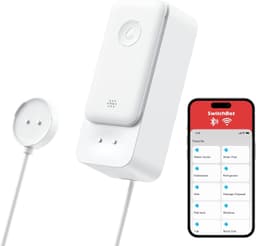
| Best overall |  SwitchBot SwitchBot detector with 1 m cable | Direct 2.4 GHz, no hub | Yes, 100 dB stated | App and email | 9.0 | about £19.99 | View offer |
| Alternative |  X-Sense X-Sense SWS54 kit, 3 sensors | Base SBS50 in the box | Sensor and base, up to 110 dB | Push via the base | 9.0 | about £55.99 | View offer |
| Preis-Tipp |  SwitchBot SwitchBot water leak detector | Direct 2.4 GHz, no hub | Yes, 100 dB stated | App and email | 9.0 | about £16.99 | View offer |


On this page
Two paths that both say Wi-Fi
When direct 2.4 GHz is enough
When the SBS50 is the path
What still works if the router is dead
Common questions
Do I need a hub for a Wi-Fi water leak detector?
What is the X-Sense base station doing?
Can I buy the £13.59 sensor on its own?
Will the alarm still sound if the router is off?
Will I get a phone alert with no internet?
Is the X-Sense sensor on Wi-Fi or on another radio?
Can I mix a SwitchBot with an X-Sense base?
Related pages
Sources
Public UK sources and the amazon.co.uk listings in this comparison. Last checked 15 October 2026.
- GOV.UK: Radio Equipment Regulations 2017 (retrieved 15 October 2026)
- GOV.UK: regulations for consumer connectable product security (retrieved 15 October 2026)
- Ofwat: supply pipes (retrieved 15 October 2026)
- Building Regulations 2010, regulation 36 (retrieved 15 October 2026)
- Met Office: frozen or burst pipes (retrieved 15 October 2026)
- Aviva: water damage and escape of water (retrieved 15 October 2026)
- SwitchBot UK: water leak detector (retrieved 15 October 2026)
- X-Sense: SWS54 smart water leak detector kit (retrieved 15 October 2026)