Independent comparisons. We may earn from shop links. More info

How to fit an outdoor PIR sensor

Updated: 20.10.2026

The sensor is in the box, the old one never saw the door, and the new one will do the same if it stares down the path. This is how to fit an outdoor PIR sensor so the lens crosses the route people actually walk, and so you stop before the mains terminals unless that work is yours to do. The steps follow Eterna, Luminite, and Electrical Safety First, not a lab test on the eight listings in our [motion sensor outdoor comparison](/hub/burglar-protection/motion-sensor-outdoor). Which box to buy is on the [outdoor PIR sensor buying guide](/hub/burglar-protection/motion-sensor-outdoor/sub/motion-sensor-outdoor-buying-guide). Peter F. checked the listings against that guidance.

The sensor is in the box, the old one never saw the door, and the new one will do the same if it stares down the path.

Our top picks

SEBSON SEBSON IR_OUT_IA

Best overall

SEBSON SEBSON IR_OUT_IA
9.2/10about £17.99
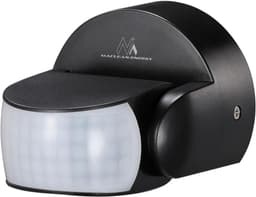
Maclean Maclean MCE468 B

Best value

Maclean Maclean MCE468 B
9.0/10about £10.96
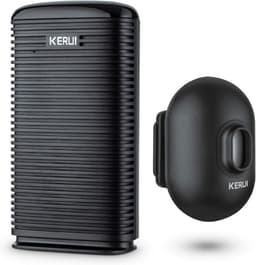
KERUI KERUI DW9

Alternative

KERUI KERUI DW9
8.0/10about £39.99
On this page

Height and direction

For a wall sensor that switches a lamp, plan on about 1.8 m to 2.5 m, the band in the Eterna PIR180 guide. Range still changes with height and temperature. People should cross the field of view, not walk straight down the lens. Turn the head so the fan lies across the gate and the front door. The SEBSON dual-head adds a short zone of about 3 m underneath. That does not repair a head pointed at the road. A driveway chime is the exception. The KERUI listing suggests about 3–4 ft, to cut small animals and passing traffic. Do not copy that height onto a mains sensor over a door. That split is why the wireless driveway alarm page exists.

What the lens must not see

Eterna's guide tells you not to aim at the sun, and to keep the field off trees, white walls, pools, and flues. Luminite makes the same point about foliage and vents. A white wall, a boiler flue, or a moving birch can cycle the lamp on a still night. A neighbour's floodlight can do the same from the other side of the boundary. Shade the lens from that lamp rather than buying a longer-range title. An IP44 housing still needs a sheltered face, and IPX3 does not become IP65 because the screws are better. KERUI window covers narrow a 90° lens. They do not invent pet immunity the listing never claimed.
SEBSON SEBSON IR_OUT_IA

Testsieger

SEBSON SEBSON IR_OUT_IA
9.2/10about £17.99

Lux, time and a walk test

Set the lux dial before you judge the lens. On these mains listings the scale runs from about 3 lux to 2,000 lux. Leave it at the daylight end for a walk test, or you will decide the unit is dead at noon. After the test, move it toward night-only if you do not want the lamp in the daytime. Ten seconds is long enough to see a trigger. The dual-head SEBSON stops at 7 minutes. The others in the mains group run to 15. Walk across the approach, not straight at the lens. If the lamp comes on for the footway, turn the head until that crossing drops out. Hue states a dusk-to-dawn sensor, and Eve's Amazon spec block has no lux figures. Which of them to buy is on the best outdoor motion sensor page.

Where you stop and call an electrician

Isolate the circuit and prove it dead before any mains cover comes off. The Maclean and the three SEBSON units are 3-wire light switches on 230 V. Hue, Eve, KERUI, and Betterlink are not. Battery chimes and a Hue or Eve sensor on a screw are householder jobs if you follow the manual. The mains covers are not. Electrical Safety First expects outdoor lighting to BS 7671 by a registered electrician. In England, a new circuit is notifiable, and an extra lighting point on an existing circuit, away from a bath or shower, is not. Do not copy that England note to Scotland or Northern Ireland. Call an electrician if you cannot identify the conductors, or if the outside circuit trips or looks damaged. There is no terminal diagram here.

Common questions

How high should I mount an outdoor PIR?
For a sensor that switches a wall light, use about 1.8 m to 2.5 m, which is the band in the Eterna PIR180 guide and the Luminite placement note. Range still changes with height and weather. The KERUI driveway listing's 3–4 ft is for that chime, not for a PIR over a front door.
Should people walk towards the sensor or across it?
Across it. Maker guides treat movement across the beams as the reliable trigger, and movement straight at the lens as the weak one. Aim the head so the gate and the door cross the fan. A sensor pointed down the path is why visitors reach the step in the dark.
What should the sensor not face?
Keep it off the sun, trees, white walls, pools, flues, and a neighbour's lamp or window. Those surfaces and plumes trip the sensor or hold the photocell in daylight mode. The public pavement is a detection you may not want, even when the hardware is working.
Why does it switch on in the daytime?
The lux dial is probably at the daylight end, which is correct for a walk test and wrong if you only wanted the lamp at night. A neighbouring flood can also confuse the photocell. Move the dial toward night after the test, and shade the lens from the other lamp if that is the cause.
How do I walk-test it?
Let it finish its warm-up, set lux so it can operate in daylight, and walk across the zone rather than straight at the lens. Include the place you hope it will ignore, such as the road. Then put the timer and the lux back to the night setting you actually want. Ten seconds is enough to see a trigger.
Can I connect the three wires myself?
Only if you are competent to work on that 230 V circuit and you can identify the conductors. Otherwise stop at the cover and use a registered electrician. Hue, Eve, and the driveway chimes in this set are not 3-wire light switches. This page does not include a connection diagram.
Does Part P mean every sensor is notifiable?
No. In England, a new circuit is notifiable and an extra light point on an existing circuit, away from a bath or shower, is not. BS 7671 still applies. That split is an England rule. Do not assume the same paperwork in Scotland or Northern Ireland, and do not treat a battery chime as notifiable lighting work.

Related pages

Sources

Public UK sources from the research digest, plus the amazon.co.uk listings for the eight ASINs. Shelf prices in the scoring note are 19 October 2026.

  1. Electrical Safety First — outdoor lighting (retrieved 20 October 2026)
  2. GOV.UK — Electrical safety: Approved Document P (retrieved 20 October 2026)
  3. GOV.UK — when building regulations approval is not needed (retrieved 20 October 2026)
  4. Philips Hue UK — outdoor sensor (retrieved 20 October 2026)
  5. Eve — Eve Motion (retrieved 20 October 2026)
  6. Eterna — PIR180 installation guide (retrieved 20 October 2026)
  7. KES Lighting — IP65 versus IP44 (retrieved 20 October 2026)
  8. Parabeam — outdoor beam FAQ (retrieved 20 October 2026)