Independent comparisons. We may earn from shop links. More info

Wireless driveway alarm

Updated: 20.10.2026

Someone can be halfway up the drive before the house notices. A wireless driveway alarm is a PIR and a chime. The long number on the box is how far that news can travel by radio in the open, not how far the lens sees. This page stays with the two kits in our [motion sensor outdoor comparison](/hub/burglar-protection/motion-sensor-outdoor): the KERUI DW9 at £39.99 and the Betterlink 1R2S at £79.99, amazon.co.uk prices on 19 October 2026. If you still want a lamp, the [outdoor PIR sensor buying guide](/hub/burglar-protection/motion-sensor-outdoor/sub/motion-sensor-outdoor-buying-guide) splits those jobs. Peter F. used the listings, not a lab test.

Someone can be halfway up the drive before the house notices. A wireless driveway alarm is a PIR and a chime. The long number on the box is how far that news can travel by radio in the open, not how far the lens sees.

Our top picks

Betterlink Betterlink 1R2S

Best overall

Betterlink Betterlink 1R2S
9.0/10about £79.99
KERUI KERUI DW9

Best value

KERUI KERUI DW9
8.0/10about £39.99
On this page

A chime is not a light

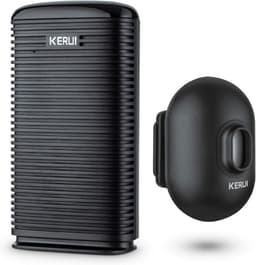
The KERUI DW9 is one outdoor PIR and an indoor receiver, 4.0 from 221 reviews. The box includes a UK adaptor and does not include batteries. The sensor takes 2 AA cells and the receiver takes 3 AA cells or the adaptor. Nothing in that kit connects to a lighting circuit. "IPV4" on the page is not an IP code. Do not file it as IP44. The Betterlink 1R2S is two solar PIRs and one receiver at £79.99, rated 4.5 from 280 reviews. The housings are listed IP65, with a USB-C backup. The listing does not measure a British winter. The extra £40 buys a second head and solar charging, not a lamp and not a longer pair of eyes. If the real aim was to light the path, use a mains PIR. The best outdoor motion sensor page names that pick separately.

Two ranges on one listing

KERUI's bullet says about 20 ft of detection. A specification line says 12 m. Neither figure is the 500 ft open-area radio range. Betterlink's bullets say detection up to 30 ft and radio up to half a mile, also written as 1,500 ft. Half a mile is the chime link in the open. It is not an 800 m lens. Walls cut radio. Place the receiver where you actually sit, then walk the drive. A 10 m drive can sit inside a 30 ft or 12 m detection claim and still miss a person who walks straight at the lens. Crossing the beams is the stronger test. The 500 ft or half-mile figure never enters that walk.
Betterlink Betterlink 1R2S

Testsieger

Betterlink Betterlink 1R2S
9.0/10about £79.99

Animals, height and batteries

Both kits see heat and movement. Betterlink's bullets name people, cars, and animals, and reviews mention birds. KERUI's window covers narrow a 90° lens. They do not add a pet-immune claim the page never made. KERUI's listing suggests a mount of about 3–4 ft. That is lower than the 1.8–2.5 m used for a wall PIR over a door. The how to fit an outdoor PIR sensor page keeps that wall-light height separate. Point the lens across the drive, and use the covers to blank the pavement if passers-by are the nuisance. Buy the AAs with the KERUI. A flat Betterlink battery after a dull fortnight is what the USB-C port is for.

When a PIR chime is the wrong tool

Buy the KERUI when one zone and a plug-in receiver are enough. Buy the Betterlink when you want two IP65 solar heads and you accept the £79.99. Skip both if you needed the outside lamp to come on. Skip a PIR chime as well if you only want cars, not people, cats, and birds. A break-beam, of the kind a UK maker such as Parabeam describes, trips when something solid crosses the beam. That is their claim about their own product, not a third row in this comparison. The chime rings in the house and stops there. It is not a monitored intruder alarm.

Common questions

Will a driveway alarm turn on my outside light?
No. The KERUI and the Betterlink are chimes. They do not connect to a lighting circuit. The outside lamp stays on its own switch or on a mains PIR. If the lamp is the point, use a mains sensor, not a longer radio claim.
How far can the sensor see, as opposed to how far it can radio?
KERUI's bullet says about 20 ft of detection and a spec line says 12 m. The 500 ft figure is open-area radio. Betterlink says up to 30 ft of detection and half a mile of radio. Use the short number for what the lens might see, and the long number only for the chime link in the open.
Does half a mile survive a house wall?
The listing states half a mile, or 1,500 ft, as a radio claim, not as a test through brick. Walls, a garage, and other electronics shorten it. Walk the route with the receiver where you sit before you treat that figure as the range inside your house.
Will cats, foxes or birds set it off?
They can. Betterlink's bullets include animals, and reviews mention birds. KERUI's covers narrow the lens and do not claim to ignore pets. Mounting the KERUI at about 3–4 ft reduces some of that. It does not make a PIR selective for people only.
Do I have to buy batteries for the KERUI?
Yes. The sensor needs 2 AA cells and the receiver needs 3 AA cells or the included UK adaptor. None of the cells are in the box. Receiver-battery complaints are part of why the listing sits at 4.0 from 221 reviews. The adaptor at least keeps the indoor unit off cells.
Is the solar kit worth the extra £40?
It is worth it if you want two IP65 heads and solar charging with a USB-C backup, at 4.5 from 280 reviews. It is not worth it if you only needed one zone, because detection is still about 30 ft, not half a mile, and birds remain in the reviews. The listing does not prove a UK winter on solar alone.
When is a break-beam the better idea?
When you want a trip only if something solid crosses a line, rather than every heat source in a fan. Parabeam, a UK beam maker, makes that distinction because an open PIR also sees foliage, animals, and weather. That is a different purchase from these two PIR kits, not a setting on them.

Related pages

Sources

Public UK sources from the research digest, plus the amazon.co.uk listings for the eight ASINs. Shelf prices in the scoring note are 19 October 2026.

  1. Electrical Safety First — outdoor lighting (retrieved 20 October 2026)
  2. GOV.UK — Electrical safety: Approved Document P (retrieved 20 October 2026)
  3. GOV.UK — when building regulations approval is not needed (retrieved 20 October 2026)
  4. Philips Hue UK — outdoor sensor (retrieved 20 October 2026)
  5. Eve — Eve Motion (retrieved 20 October 2026)
  6. Eterna — PIR180 installation guide (retrieved 20 October 2026)
  7. KES Lighting — IP65 versus IP44 (retrieved 20 October 2026)
  8. Parabeam — outdoor beam FAQ (retrieved 20 October 2026)