Independent comparisons. We may earn from shop links. More info

How to install a battery motion sensor light

Updated: 20.10.2026

The lamp is in the box, the drill is in your hand, and the last one you owned lit the street every time a car passed. This is how to install a battery motion sensor light so the lens crosses your own path, the fixing stays on the wall, and the beam stops before a neighbour’s window. The steps follow the eight listings in the [motion sensor outdoor battery comparison](/hub/burglar-protection/motion-sensor-outdoor-battery), plus public UK guidance from KES Lighting, DCC Electrics, the Planning Portal, and GOV.UK. They are not a lab test. A purchase through our links can earn a commission at no extra cost to you.

The lamp is in the box, the drill is in your hand, and the last one you owned lit the street every time a car passed.

Our top picks

On this page

Put it where people cross the view

A PIR notices heat moving across the lens more reliably than a person walking straight at it. KES Lighting and a YESSS sheet both say to aim across the route, not down it. Keep the view off the pavement, the road, and next door’s glass. The Planning Portal says minor fittings are not planning-controlled, and it still says not to trip the sensor on traffic. Proxinova’s listing says about 6 to 8 feet, and to fit in the dry. A 2.5 metre line on a mains sheet is a different product. Do not copy it if you cannot change the cells in January. Aim fails if the lamp falls off the pad the first wet week.

Screw it, then deal with the cells or the USB lead

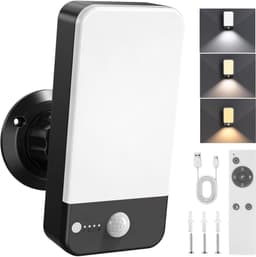
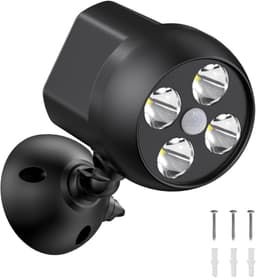
Auraglow and Proxinova include a sticky pad. Reviews say it lets go, and screws are the fixing that stays. Use plugs into brick or a timber batten. Auraglow takes three AA cells, not included. NICREW takes four D-cells per head and says to keep the head under shelter, because no IP rating is printed. Try the battery cover before the last screw. LaiTeny and ONEWAY twist off for a USB-C charge. AIXPI’s lead has no mains plug in one review, so you need a USB source indoors. Close the cover afterwards. ONEWAY’s remote does nothing until the lamp is switched on.

Test it on your path only

Wait until dusk. Most of these lamps stay dark in daylight because a sensor is doing that job, not because the unit is faulty. Walk across the lens and see where the beam stops. Auraglow and NICREW claim about 20 seconds. AIXPI’s night modes claim 30 or 60 seconds. You cannot dial those times. If 20 seconds is too short to find a key, you need a second crossing or a different listing. AIXPI’s mode 3 is constant light day and night, and it drains the pack. Leave it off unless a neighbour has agreed. GOV.UK does not publish a lux number for a nuisance, and councils must still look at complaints.

When it trips for nothing

A lamp that fires at an empty path is usually aim, heat, or movement, not a dead sensor on day one. DCC Electrics lists vegetation, traffic, pets, and reflections. A shrub in wind, a fox, or another lamp in the lens will do it. A PIR does not see through glass. Re-aim before you reorder. Turn the head so the lens no longer clears the pavement. None of these listings prints a pet-immunity switch. A 9 metre claim on a front elevation will see cars, and a new identical head will repeat that fault.

Stop and get help

Stop if the building is listed and you are about to fix into the fabric. Listed building consent is separate from ordinary planning permission. Stop if the job has become a new outdoor socket or a cable to a shed. NICEIC treats that as fixed wiring for a registered electrician in England and Wales. In Scotland, check building standards. Stop if a lithium pack is swollen, hot, or leaking. Do not puncture it. An unrated head in driving rain should come down. The shade fork is on battery or solar outdoor security light.

Common questions

How high should it go?
Use the leaflet for that model, and stay where you can change or charge the battery. Proxinova prints about 6 to 8 feet and says dry areas. A 2.5 metre line on a mains PIR manual is not a rule for these battery lamps. Higher is not more secure if the lens then watches the road, or if you will not climb to it in January. Aim across your path at the height you can still service.
Screws or the sticky pad?
Screws. Auraglow and Proxinova include tape or a 3M pad, and reviews on both say the pad lets go. The screws are the fixing that stays, into brick or a timber batten. A pad can hold the lamp while you mark the holes. It is a poor permanent mount on a UK wall that gets wet, cold, and a bit of wind.
Why does it light the street?
The lens can see past your boundary. A long detection claim, a high mount, or a head aimed down the road will trip on the pavement and on cars. Turn it so people cross the beam on your path only. There is no official lux threshold for a nuisance, and a council can still investigate under the Environmental Protection Act 1990. Pointing it at the road for security is the complaint, not the fix.
Why will it not come on in the day?
The daylight sensor is holding it off. Auraglow, NICREW, and AIXPI’s night modes are meant to run after dark. Test at dusk by walking across the lens. AIXPI’s mode 3 is the exception: constant light day and night, which also cancels that sensor and flattens the pack. Daytime silence on the other modes is normal, not a failed PIR.
How do you charge a USB light without removing the bracket?
LaiTeny and ONEWAY are described as twist-off bodies, so you take the lamp indoors and leave the bracket. AIXPI includes a USB cable, and one review says there is no mains plug, so you still need a charger. Fit the bracket where you can lift the body down. Close the port cover before it goes back outside. A charge lead left open on an IP65 head undoes the weather rating.

Related pages

Sources

Public UK sources and the amazon.co.uk listings named in the digest, last checked on 19 October 2026.

  1. Planning Portal: lighting (retrieved 19.10.2026)
  2. GOV.UK: artificial light nuisances (retrieved 19.10.2026)
  3. GOV.UK: light pollution (retrieved 19.10.2026)
  4. NICEIC: garden electrics (retrieved 19.10.2026)
  5. Harbro Electrical: how to choose a PIR security light (retrieved 19.10.2026)
  6. KES Lighting: IP65 vs IP44 (retrieved 19.10.2026)
  7. DCC Electrics: PIR sensor security lighting (retrieved 19.10.2026)
  8. YESSS Electrical: PIR instruction manual (retrieved 19.10.2026)